
That estimate isn’t a guess. It comes straight from Department of Energy research and field-tested data showing a 25,000-gallon pool dropping from 12.6 kWh a day to just 2.2 kWh. Rebates in many areas shave months, sometimes years, off that payback window.
TL;DR:
- The actual energy savings depend heavily on proper sizing, correct installation, accurate GPM measurements, and optimal programming of low and high-speed cycles.
- Rebates offered by utilities can offset the higher initial purchase cost, which generally ranges from $800 to $2,000 before incentives.
- Actual field data shows the difference in energy use is primarily due to the pump’s average wattage at filtration speed, not its peak horsepower.
- Proper setup, including long low-speed filtration cycles and avoiding throttling valves, is essential to maximize savings and ensure the pump performs as designed.
Table of Contents
- Why Variable Speed Pumps Cut Your Energy Bill So Much
- What Do Real Savings Look Like in Dollars and Kilowatt-Hours?
- How Do You Estimate Your Own Pump Energy Savings?
- What Does a Variable Speed Pump Cost, and How Fast Does It Pay Back?
- How Do You Install and Program a Variable Speed Pump for Maximum Savings?
- Longhorn Pools’ Take on Realistic Pump Savings
- Get a Professional Pump Assessment From Longhorn Pools
- Where These Numbers Come From
- Sources
- FAQ
Why Variable Speed Pumps Cut Your Energy Bill So Much
The math behind these savings comes down to something engineers call the pump affinity law. In plain terms: power consumption falls roughly with the cube of the speed reduction. Slow a pump down to half speed, and it doesn’t use half the power. It uses somewhere around one-eighth. That’s the whole secret behind variable speed pump savings, and it’s why the difference between a single-speed pump and a variable speed one feels so dramatic on your utility bill.
A few other pieces of pump technology stack on top of that physics:
- Permanent-magnet motors paired with variable frequency drives run far more efficiently at partial load than the old induction motors found in single-speed and even most two-speed pumps.
- Longer, slower filtration cycles often move the same or more water through your filter over 24 hours while using less total energy than a short, high-power blast.
- Lower speeds mean less strain on plumbing, which can reduce turbulence and pressure loss in the process.
The cube law is a guideline, not a guarantee. Your actual savings depend on your plumbing’s total dynamic head, fitting size, and how many hours you actually run the pump. A pump fighting through undersized pipes or a clogged filter will never hit its theoretical ceiling.
Pro Tip: Don’t just look at your pump’s horsepower rating when estimating savings. What matters is the average wattage it draws while running at filtration speed, which is often a fraction of its peak draw.
What Do Real Savings Look Like in Dollars and Kilowatt-Hours?
Numbers make this concrete. The most cited field example comes from a Building America measure guide and a companion PNNL resource guide, both tracking a 25,000-gallon pool. The single-speed pump drew 2,000 watts and ran 6.3 hours a day, burning 12.6 kWh. Swap in a variable speed pump set to a gentle 22 gallons per minute, and it draws just 116 watts, running longer (about 19 hours) to hit the same turnover, but landing at only 2.2 kWh a day.
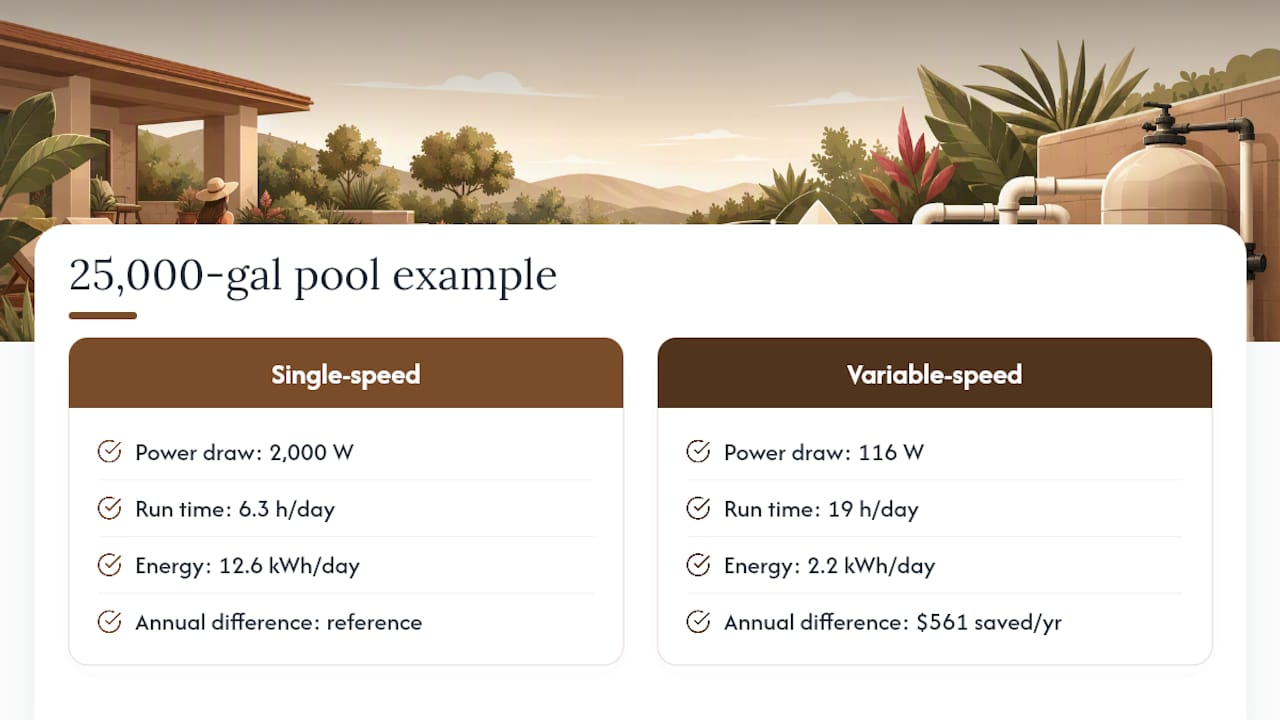
That $561 figure holds up whether you’re comparing it against your own bill or a contractor’s quote. Larger pools with bigger single-speed pumps, or ones running longer cycles for heaters and cleaners, can see even bigger absolute dollar swings.
That number reflects a best-case lab comparison, not a normal household. Real homes have friction losses, oversized single-speed pumps to begin with, and imperfect run schedules. The honest range, backed by DOE efficiency data, sits at 50% to 75%.
How Do You Estimate Your Own Pump Energy Savings?
You don’t need an engineering degree to run this math. You need your utility bill, your pump’s nameplate, and about ten minutes.
- Find your current pump’s wattage. Check the nameplate for horsepower and amps, or look up the model number online. Multiply volts by amps to estimate watts, then divide by 1,000 for kilowatts.
- Log your daily run hours. Most single-speed setups run 6 to 8 hours a day to hit adequate turnover.
- Calculate daily kWh. Multiply your pump’s kilowatts by daily run hours.
- Multiply by 365 for annual kWh, then by your electricity rate (check your bill, it’s usually listed per kWh) for annual cost.
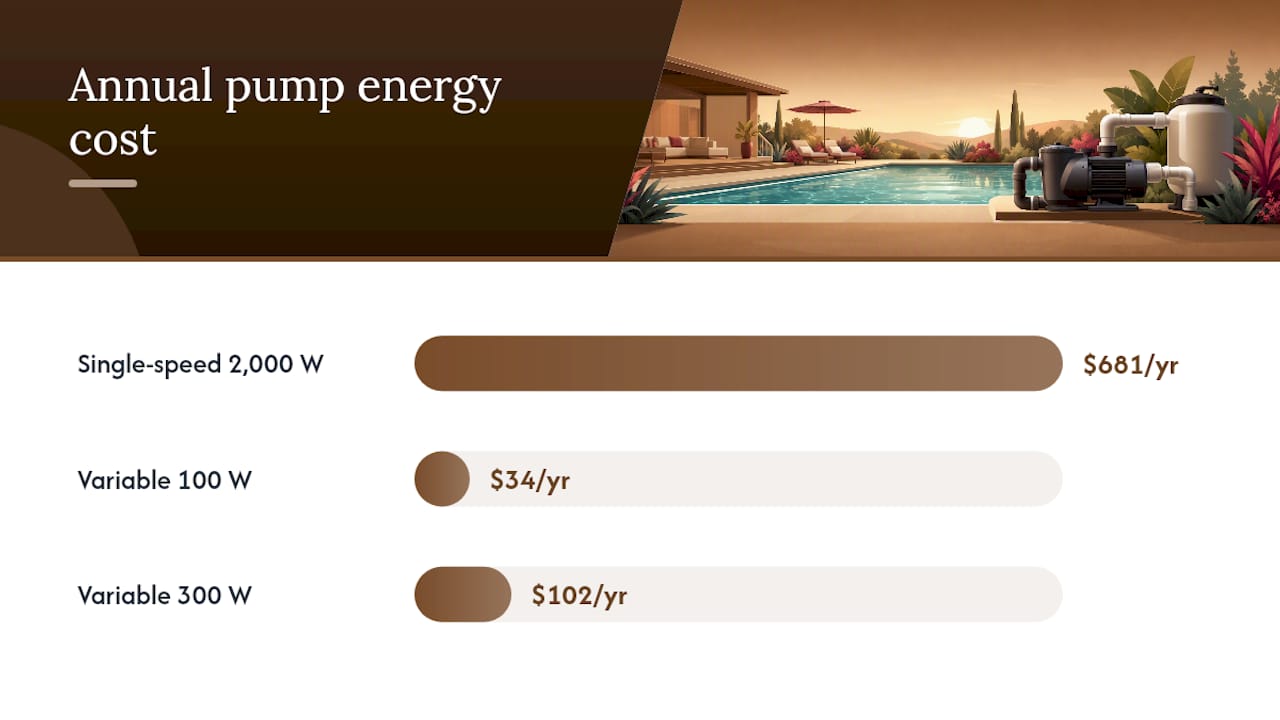
- Repeat the math using a variable speed pump’s average filtration-speed draw, which is often 100 to 300 watts rather than 1,000 to 2,000.
- Subtract the two annual costs, then subtract the pump’s net cost (after rebates) from that annual savings to get your payback in years.
One detail trips people up: use average draw at filtration speed, not the pump’s peak rating, since that’s what actually determines your real-world energy use. For pools with unusual plumbing runs or elevation changes, a professional GPM measurement beats guesswork every time.
Quick stat check: A pool running a 2,000 watt single-speed pump for 6.3 hours a day at $0.148/kWh spends about $681 a year on pump energy alone, before factoring in a heater or spa jets.
What Does a Variable Speed Pump Cost, and How Fast Does It Pay Back?
Expect to pay a premium of roughly $800 to $2,000 installed over a comparable single-speed replacement, according to industry savings calculator guidance. Where you land in that range depends on a few things:
- Whether your existing wiring and plumbing need modification to accept the new pump.
- Whether the job is a straight swap or part of a larger equipment upgrade.
- Local labor rates and permit requirements.
Rebates change the equation fast. Many utilities offer $100 to $900 back for qualifying variable speed installs, and checking DSIRE or your utility’s website before you buy is worth the five minutes it takes.
Beyond the dollars, variable speed pumps run quieter, filter more gently and consistently, and put less wear on your filter media over time. Those aren’t the headline number, but they add up.
How Do You Install and Program a Variable Speed Pump for Maximum Savings?
Buying the right pump only gets you halfway. Programming and installation decide whether you actually see those savings show up on your bill.
- Measure your pool’s gallons and required turnover rate rather than assuming your old pump’s schedule was correct. A lot of single-speed systems were oversized from day one.
- Set long, low-speed filtration cycles for daily turnover, and reserve short high-speed bursts for cleaners, spa jets, or heaters that need higher flow.
- Check for throttling valves left in the plumbing. These force the pump to work against unnecessary resistance, quietly eating into your savings.
- Confirm your electrical setup supports the variable frequency drive properly. A misinstalled VFD is a common source of underperformance.
- Ask any installer for a commissioning report that states expected average watts at filtration speed, projected annual savings, and warranty terms in writing.
Pro Tip: If your installer can’t tell you the pump’s expected average wattage at your filtration speed, ask again. That number is the entire basis of your savings estimate.
Programming mistakes are the single biggest reason people miss out on projected savings, according to the Building America measure guide. A pump left at factory defaults or run at high speed out of old habit won’t deliver much.
Longhorn Pools’ Take on Realistic Pump Savings
Homeowners searching for variable speed pump savings usually want a number they can trust, not a marketing ceiling.
We’ve built our energy-efficient upgrade checklist around a similar range, 40% to 80% energy reduction, because pool size, plumbing age, and accessory load swing the outcome more than any single spec sheet admits. The pumps themselves are mature technology at this point. The variable in “variable speed pump savings” isn’t the pump anymore. It’s whether someone measured your actual GPM needs before setting the schedule, and whether the installer bothered to hand you real numbers instead of a sales pitch.
— Mark
Get a Professional Pump Assessment From Longhorn Pools
Running the math yourself gets you close, but a properly sized install is what actually delivers those savings year after year. Longhorn Pools handles equipment upgrades as part of our broader pool renovation services, which means we measure your actual GPM and total dynamic head before recommending a pump, rather than guessing at what your old single-speed system was doing.

Installations typically include an assessment of existing wiring, plumbing, and filtration setup, as these details influence potential savings. If you’re weighing a pump swap on its own or as part of a larger equipment update, start with a design consultation and we’ll walk through what your specific pool, plumbing, and usage pattern would realistically save.
Where These Numbers Come From
The savings figures throughout this article trace back to the Building America measure guide for the physics and worked kWh example, the PNNL/BASC resource guide for the field-tested dollar figures, DOE regulatory guidance for the 2021 efficiency rules, and the PoolDial calculator for installed cost and rebate ranges. Check DSIRE for rebates specific to your utility before budgeting a payback timeline.
Sources
- Variable-speed pool pumps (BASC/PNNL resource guide)
- Measure Guideline: Replacing Single-Speed Pool Pumps with Variable Speed Pumps for Energy Savings (Building America / EERE)
- PoolDial variable speed pump savings calculator
FAQ
Does a Variable Speed Pool Pump Really Save Money?
Yes. Field data shows a properly sized variable speed pump cutting energy use by 50% to 75% compared to a single-speed model, with one documented example saving about $561 a year on a 25,000-gallon pool. Most homeowners recover the upfront premium within one to four years, faster with a rebate.
Should I Leave My Variable Speed Pool Pump on All the Time?
Running it continuously at a low filtration speed is usually more efficient than cycling a single-speed pump on and off at full power. The key is programming long low-speed hours for daily turnover and reserving short high-speed bursts only for cleaners, heaters, or spa jets that need extra flow.
What Is the Most Efficient Variable Speed Pool Pump?
Efficiency comes down to matching pump size to your pool’s actual gallons and turnover needs, not chasing the highest horsepower rating on the shelf. A pump sized through a proper GPM measurement will outperform an oversized model running at default settings every time.
What Are the Disadvantages of a Variable Speed Pool Pump?
The main drawback is upfront cost, typically an $800 to $2,000 premium over a single-speed replacement before rebates. They also require correct programming to deliver their advertised savings.