
Adding a spa to an existing pool typically runs from several thousand dollars for a prefab install up to tens of thousands for an attached gunite or spillover spa, and costs more for a custom raised spillover with premium finishes. Where your project lands depends on site access, structural changes to your existing shell, and equipment upgrades. The smartest first move isn’t picking a number off this page. It’s getting a site-specific estimate from a builder who can see your actual pool, your actual yard, and your actual soil.
TL;DR:
- A prefab spa costs between $8,000 and $15,000, but offers limited customization and usually excludes matching finishes and fast-recovery heaters.
- Attached gunite spas typically range from $15,000 to $35,000, providing structural tie-ins, spillover features, and matching finishes, with costs increasing for site-specific upgrades.
- Custom raised spillover spas can exceed $75,000 due to engineering, premium finishes, structural requirements, and automation, especially on raised structures with footings.
- Trenching distances, soil conditions, deck demolition, and permit fees significantly influence overall costs, with engineered reviews and engineering review often hidden in bundled quotes.
- Operating costs include a $1,500 to $4,000 heater upgrade, $800 to $1,500 for a dedicated pump, and a monthly energy increase of $20 to $50, impacting long-term expenses.
Table of Contents
- How Much Does a Spa Addition Cost by Type?
- What Factors Actually Move Your Price Up or Down?
- What Will Equipment and Monthly Operating Costs Add Up To?
- How Long Does a Spa Addition Take, and What Permits Apply?
- Which Finishes and Features Are Worth the Money?
- What Do Real Spa Addition Budgets Look Like?
- What Do Builders Wish Homeowners Knew Before Bidding?
- How Do You Get a Contractor-Ready Spa Quote?
- What Should You Do Next?
- A Builder’s Take on Spa Budgets
- Get a Site-Specific Spa Addition Estimate
- Sources
How Much Does a Spa Addition Cost by Type?
The type of spa you choose sets the ceiling and floor on your budget more than almost anything else. Here’s how the three main categories break down, along with what’s usually baked into each price and what tends to get left out.
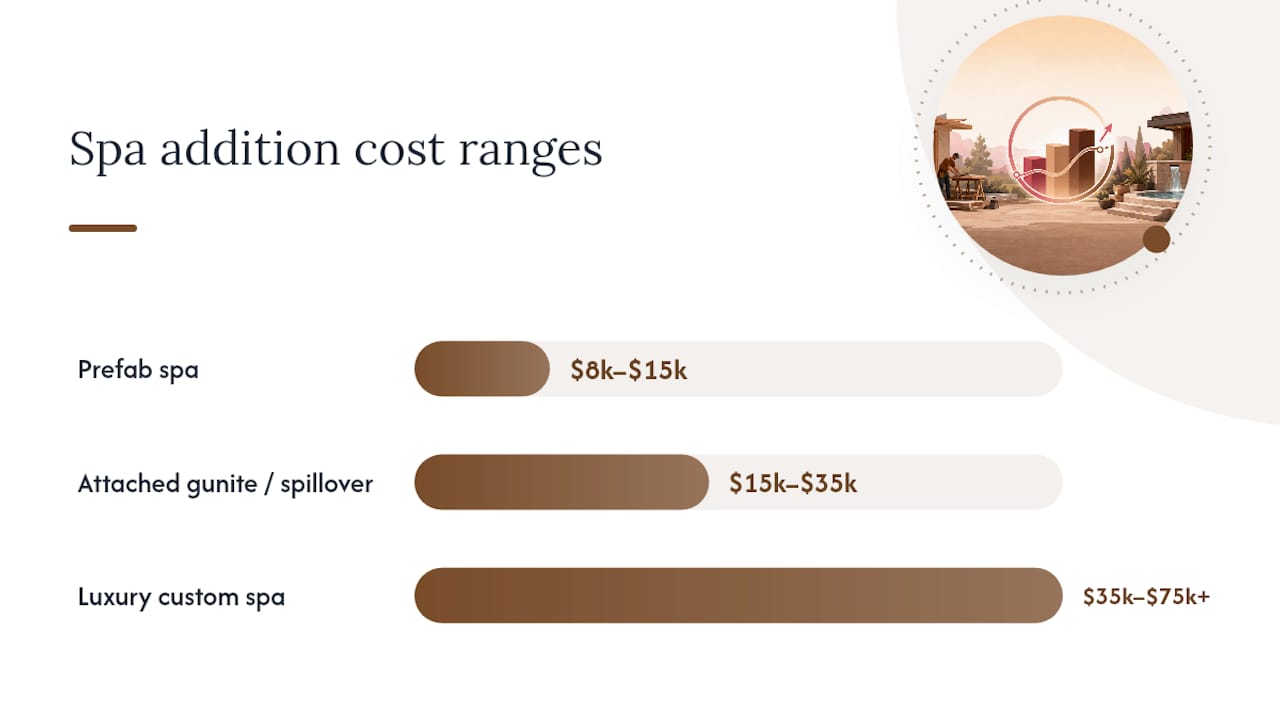
Prefab or portable spa, plumbed to your pool ($8,000–$15,000). This is the entry point, and it’s often what builders recommend when a full structural tie-in isn’t practical or the budget won’t stretch further. You’re paying for the acrylic shell, basic plumbing connection to existing equipment, a small footing or pad, and standard jets. What it usually skips: matching tile or coping, custom shape, and a dedicated heater rated for fast recovery.
Attached gunite or spillover spa ($15,000–35,000). This is where most homeowners actually land, according to regional builder pricing data. You get a poured shell tied structurally into your existing pool, a spillover edge or weir, matching coping and interior finish, and usually a dedicated spa pump. The number climbs when your soil requires extra reinforcement or your existing equipment pad needs expansion.
Luxury custom raised spillover ($35,000–$75,000+). This band covers raised walls, elevated spillways, premium tile or stone veneer, automation controls, and often a second heater sized for quick temperature recovery. The jump in price reflects engineering, not just aesthetics. Raised structures need footings, rebar, and often a structural engineer’s sign-off before a permit gets issued.
- Prefab: fastest, cheapest, least customizable
- Attached gunite: best balance of integration and cost
- Raised spillover: highest visual impact, highest structural demand
Industry cost guides consistently show this same three-tier pattern, and prefab-versus-custom breakdowns confirm the trade-off: less money now, or more integration and durability later.
What Factors Actually Move Your Price Up or Down?
Your pool’s shell material sets the baseline. Gunite pools accept a structural tie-in more easily than fiberglass or vinyl, which often need a standalone spa plumbed alongside rather than physically merged. That single decision can swing your quote by thousands.
Demolition and deck repair matter more than most homeowners expect. Cutting into an existing deck to run new plumbing or electrical almost always means patching or replacing decking around the work zone, and if there’s a retaining wall in the way, add another few thousand dollars for engineering and labor.
Distance between your equipment pad and the new spa location drives trenching costs directly. Every extra foot of pipe run and every electrical conduit upgrade adds labor hours. Gas line extensions for a dedicated heater are common and rarely quoted upfront by inexperienced bidders.
- Shell material and structural tie-in complexity
- Deck demolition, patching, and retaining wall work
- Trenching distance for plumbing, electrical, and gas
- Permit fees and required engineering review
Pro Tip: Ask every bidder whether their number includes permit fees and engineering review separately, or bundled. Bundled quotes hide the real cost of the paperwork, and that’s usually where budgets go sideways.
What Will Equipment and Monthly Operating Costs Add Up To?
A dedicated spa heater and pump are the most commonly underestimated line items. Expect $1,500 to $4,000 for a heater upgrade and $800 to $1,500 for a separate spa pump, according to builder cost breakdowns. Electrical panel upgrades or gas-line extensions can add more if your current setup wasn’t sized for a second heat source.
On the operating side, expect your energy bill to rise by roughly $20 to $50 a month depending on how often you heat the spa and which heating method you use, per spillover spa cost analysis. Chemical costs tick up too, since hot water burns through sanitizer faster than your pool does.
- Heater upgrade: $1,500–$4,000 installed
- Dedicated spa pump: $800–$1,500 installed
- Monthly energy increase: roughly $20–$50
Fast heat recovery matters more than it sounds. A spa that takes an hour to reach 104°F gets used a lot less than one that heats in fifteen minutes, which is why a properly sized heater is worth the upfront spend.
How Long Does a Spa Addition Take, and What Permits Apply?
Most spa additions move through five phases, though weather and inspection scheduling can stretch any of them.
- Design and permitting (1–4 weeks): Plans get drawn, and if you’re adding a raised structure, engineering review adds time here.
- Demolition and excavation (1–3 days): Deck cutting, shell prep, and trenching for plumbing and electrical.
- Structural and plumbing work (1–2 weeks): Rebar, gunite shell, plumbing tie-in, and electrical rough-in.
- Finishing (1–2 weeks): Interior finish, tile, coping, and equipment installation.
- Inspection and startup (3–7 days): Final inspection, water fill, chemical balance, and equipment commissioning.
Permit lead times vary widely by municipality, and raised or heavily modified structures almost always require engineering sign-off before work starts. Weather delays and inspection scheduling are the two most common causes of slipped timelines. Our guide to Austin permitting rules walks through what local review typically checks for.
Which Finishes and Features Are Worth the Money?
Interior finish choice moves your per-square-foot cost more than almost any other decision. Standard plaster sits at the low end. Pebble and quartz aggregate finishes cost more but last longer and resist staining better in hot water, where chemical demand runs higher.
Tile and mosaic work adds visible value fast, but glass tile and natural stone veneer can add several dollars per square foot over standard ceramic. Spillway features look dramatic and cost accordingly. A simple weir edge is far cheaper than a raised, sheeted waterfall spillway with LED lighting built in, which our water features guide breaks down in more detail.
- Standard plaster: lowest cost, shortest lifespan
- Pebble/quartz aggregate: mid cost, better durability
- Glass tile or stone veneer: highest cost, strongest resale appeal
- Simple weir spillway vs. raised sheeted waterfall: significant cost gap
If resale matters to you, durable interior finish and quality tile outperform flashy water features on long-term value.
What Do Real Spa Addition Budgets Look Like?
Seeing sample line items helps more than any range alone, because it shows where the money actually goes.
Value build ($10,000–$14,000): Prefab spa shell, basic plumbing tie-in to existing equipment, standard jets, minimal deck patching, no dedicated heater upgrade.
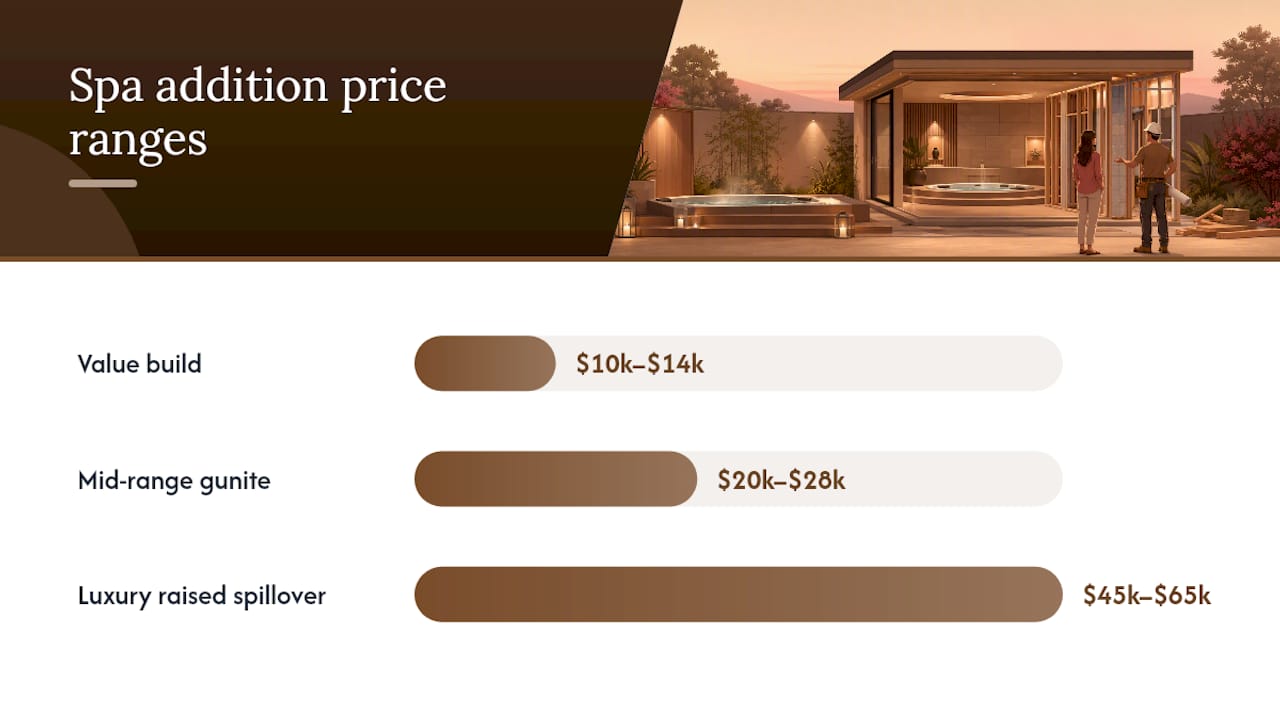
Mid-range build ($20,000–$28,000): Attached gunite spa with spillover edge, matching plaster and coping, dedicated spa pump, modest tile accent, standard permit and inspection fees.
Luxury build ($45,000–$65,000): Raised spillover with stone veneer, glass tile accents, dedicated high-BTU heater, automation controls, engineered footing, and hardscape integration around the new structure.
- Prefab: $10k–$14k
- Mid-range gunite spillover: $20k–$28k
- Luxury raised spillover: $45k–$65k
Retrofit projects run into surprises that new construction rarely does, since builders are working around an existing structure instead of starting from open ground.
What Do Builders Wish Homeowners Knew Before Bidding?
A spa retrofit is rarely just a spa job. It’s a structural renovation wearing a spa’s clothes. Cutting into an existing shell to tie in a spillover means rebar, engineering review, and sometimes a retaining wall you didn’t plan for. In Hill Country soil, that’s not the exception. It’s closer to the rule. The homeowners who budget well are the ones who treat this like a renovation from day one, not an add-on weekend project.
Access for future service matters just as much as the install itself. A spa equipment pad tucked behind a retaining wall with no clear path saves nothing now and costs plenty later.
How Do You Get a Contractor-Ready Spa Quote?
Before your first site visit, gather photos of your existing equipment pad, a rough sketch of your pool shape, and your current heater and pump model numbers. That alone speeds up bidding and sharpens accuracy.
- Is the spa structurally tied to the pool shell, or standalone with shared plumbing?
- Does the quote include a dedicated heater, and what BTU rating?
- Is engineering review included if a raised structure is planned?
- What’s the trenching distance from the equipment pad?
- Are permit fees itemized or bundled?
- What’s included in deck demolition and patching?
- Is electrical panel capacity confirmed for new equipment?
- What warranty covers the shell versus the equipment?
- What’s the estimated timeline from permit to completion?
- What happens if soil conditions require added reinforcement?
Pro Tip: Line up quotes side by side and check whether each one names the same scope. A quote that’s $6,000 cheaper but skips engineering review isn’t a better deal. It’s an incomplete one.
What Should You Do Next?
Prefab runs $8,000 to $15,000. Attached gunite or spillover lands between $15,000 and $35,000. Luxury custom builds start around $35,000 and climb from there. Structural changes, trenching distance, and finish choices are the biggest levers you control.
Gather your equipment specs, schedule two or three site visits, and set aside a contingency before you commit to a number. A site-specific estimate from an experienced builder beats any range on this page, because it accounts for your soil, your shell, and your yard.
A Builder’s Take on Spa Budgets
The homeowners who end up happiest with their spa addition aren’t the ones who found the lowest bid. They’re the ones who thought about how often they’d actually use it on a Tuesday night in February, not just how it photographs. Detailed case examples and project specifics will follow as we add them here, but the principle holds regardless: budget for how you’ll live with it, not just how it looks on paper.
— Mark
Get a Site-Specific Spa Addition Estimate
Every range in this guide gets more accurate once a builder sees your actual pool and yard. We work with clients on spa additions, gunite spillovers, and full pool renovations, handling structural review, permitting, and equipment sizing typical for retrofit projects.

Our process starts with a real site visit, not a phone estimate, because soil conditions and existing equipment layout change the math every time. If you’re weighing a spa addition against a broader renovation, our pool renovation process guide walks through what to expect start to finish. Ready to see what your specific project would cost? Request a consultation and get a number built around your backyard, not a national average.
Sources
- Can A Spa Be Added To An Existing Pool? Brilliant Easy Answers | Cristallo Pools
- Adding a Spillover Spa to Your Pool Without Drowning in Debt
- Pool + Spa Combos: Design Options, Costs & What LA Homeowners Are Building in 2026