
Slope the deck away from the pool, install perimeter drains or slot drains at the low points, and route roof runoff at least 10 to 15 feet from the water’s edge. Those three moves solve most rainwater problems before they start. If your pool is already overflowing, get a submersible pump running and siphon the excess before you worry about anything else, and call a designer or contractor for anything that looks like a grading failure rather than a one-time storm fluke.
TL;DR:
- Proper grading and routing of roof runoff away from the pool area significantly reduce stormwater accumulation and overflow risks.
- Drains should be placed at low points, along coping edges, and near equipment pads, with slot and point drains chosen based on runoff volume and spot size.
- Managing upstream water sources like downspouts and creating features like swales or rain gardens can lower the load on drainage hardware.
- After heavy rain, promptly lowering water levels, adjusting chemistry, and inspecting for damage are critical to maintaining pool health and safety.
- Ongoing maintenance, site assessment, and professional regrading are essential for long-term drainage effectiveness and preventing recurring pooling issues.
Table of Contents
- How to Map Runoff and Set the Right Grade Around a Pool
- Which Drains to Use Where: Deck, Slot, and Point Drains
- Managing Upstream Runoff Before It Reaches the Pool
- Can You Use Rainwater to Fill or Top Off a Pool?
- What to Do After Heavy Rain: Pump, Test, Inspect
- Maintenance Schedule and Homeowner Checklist for Rainwater Systems
- How Longhorn Pools Designs Around Rainwater From Day One
- Get a Drainage-Ready Pool Design or Retrofit
- Sources
- FAQ
How to Map Runoff and Set the Right Grade Around a Pool
Every drainage problem starts the same way: water is following a path you never planned for it. Before you buy a single drain grate, walk your yard during or right after a hard rain and watch where the water actually goes.
Grab a notebook or your phone and track it. You’re looking for roof leaders dumping onto pavement, uphill lawns feeding water toward the pool deck, and any low spots where puddles sit for more than an hour.
- Note every downspout location and which direction it drains
- Mark spots where water pools against the coping or equipment pad
- Check whether the deck itself pitches toward or away from the pool
- Look for erosion channels in mulch beds or turf, which reveal hidden flow paths
Once you’ve got that map, check the deck pitch. A connected source, route, and destination plan can be the difference between a deck that sheds water cleanly and one that ponds every spring. Most residential decks need a slight, consistent slope moving away from the coping toward a drain or planted area, not toward the pool.
If the water’s coming from your own yard sloping toward the pool, regrading fixes the root cause. If it’s really about hardscape runoff pooling at a low point, drains solve it faster and cheaper. Regrading near foundations, retaining walls, or septic fields is where you bring in an engineer, and many municipalities require a permit before you move significant soil near a pool shell.
Pro Tip: Take photos of standing water an hour after a storm, not during it. That’s when you see which spots genuinely fail to drain versus which ones just look wet.
Which Drains to Use Where: Deck, Slot, and Point Drains
Not every drain does the same job, and picking the wrong one is how homeowners end up with a drain that clogs every season or a deck that still ponds two feet from a working inlet.
Deck drains (round or square point drains set into the concrete) work well for isolated low spots, like a corner near the equipment pad. Slot drains run in a continuous line and handle a higher volume, which makes them the better call along a long coping edge or a pool deck that catches runoff from an adjacent patio. Slot drains also tend to look cleaner since the opening is a narrow linear slit rather than a visible grate.
- Point drains: best for small, isolated low spots
- Slot drains: best for long runs and higher flow volume
- Channel drains: a middle ground, often with removable grates for easier cleaning
Placement matters more than the drain type itself. Put drains at the coping edge, around equipment pads, and at any low point your runoff map identified, and never tie a deck drain into your pool’s own plumbing.
One consistent finding across drainage guides: heel-safe, corrosion-resistant grates on polymer concrete channel drains show up as the standard recommendation for residential decks, largely because they hold up to both foot traffic and chlorinated splash-out without corroding.
Managing Upstream Runoff Before It Reaches the Pool
Here’s what most homeowners miss: the deck drains only have to work as hard as whatever’s flowing onto the deck in the first place. Control the upstream sources and you cut the load on every drain you install.
Roof leaders are usually the biggest culprit. Routing downspouts at least 10 to 15 feet away from the pool, or into a managed feature instead of straight onto the patio, takes a huge amount of volume off your perimeter drains before it ever becomes their problem.
From there, you’ve got a few solid options depending on your lot:
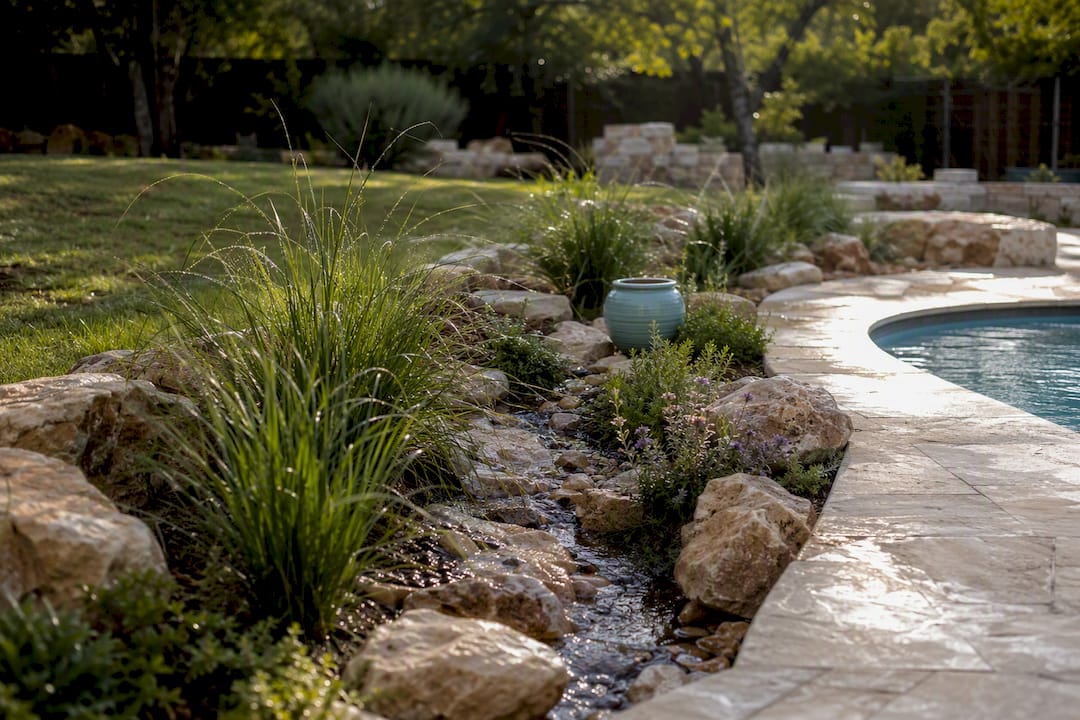
- A swale, a shallow graded channel that redirects surface water toward a safe discharge point
- A dry well, a buried gravel-filled basin that lets water infiltrate slowly
- A rain garden, planted with water-tolerant species that soak up runoff while filtering it
- Engineered retention, for lots with limited grading options
Rain gardens and permeable surfaces do double duty: they cut runoff volume and filter out debris and pollutants before water ever reaches a mechanical drain. Whichever option you choose, never direct water onto a neighbor’s property, and keep any infiltration feature separate from pool plumbing to avoid backflow risk.
Pro Tip: If you’re landscaping the pool area anyway, work with a designer who can integrate a swale or rain garden into the plan rather than bolting one on after the fact. Our backyard landscaping guide for Austin pool owners covers plant choices that handle both drought and runoff duty.
Can You Use Rainwater to Fill or Top Off a Pool?
Yes, with the right filtration in place first. Rainwater harvesting for pool use starts with catchment: your roof area determines how much you can realistically collect, and a first-flush filter diverts the initial, dirtiest runoff away from your storage tank before clean water gets captured.
Storage sizing depends on how much topping-off you actually need. A small tank is fine for evaporation makeup; a larger cistern makes sense if you’re trying to offset a full seasonal refill.
Water quality is where people get tripped up. Roof runoff carries debris, pollen, bird droppings, and often runs slightly acidic, none of which you want going straight into a chlorinated pool.
- Pre-filter for sediment and organic debris before storage
- Test pH and adjust before adding harvested water to the pool
- Never add rainwater during a heavy runoff event without treatment, since contaminant loads spike early in a storm
Retrofitting a harvesting system after a pool is already built is possible, but it usually means compromising on tank placement or capacity. Systems designed in from the start work better and look better, which is worth factoring in if you’re planning a renovation anyway. Check local permit rules before installing storage tanks of meaningful size.
What to Do After Heavy Rain: Pump, Test, Inspect
A pool that’s taken on several inches of rain overnight needs a quick, methodical response, not guesswork.
- Lower the water level safely. Use a submersible pump or siphon to bring the pool back to normal operating level, discharging onto a lawn area or approved drain, never onto a neighbor’s property or into a storm drain carrying pool chemicals.
- Test and rebalance chemistry. Rain dilutes your sanitizer and often introduces mildly acidic runoff, so check pH and chlorine levels and adjust before swimming.
- Run the filter through a full cycle to clear cloudiness from stirred-up debris.
- Walk the perimeter. Check grates, inlets, and the equipment pad for standing water, visible leaks, or any sign the ground has settled.
Maintenance Schedule and Homeowner Checklist for Rainwater Systems
Drainage hardware fails less from bad design and more from neglect. A simple recurring routine keeps everything working the way it was installed to work.
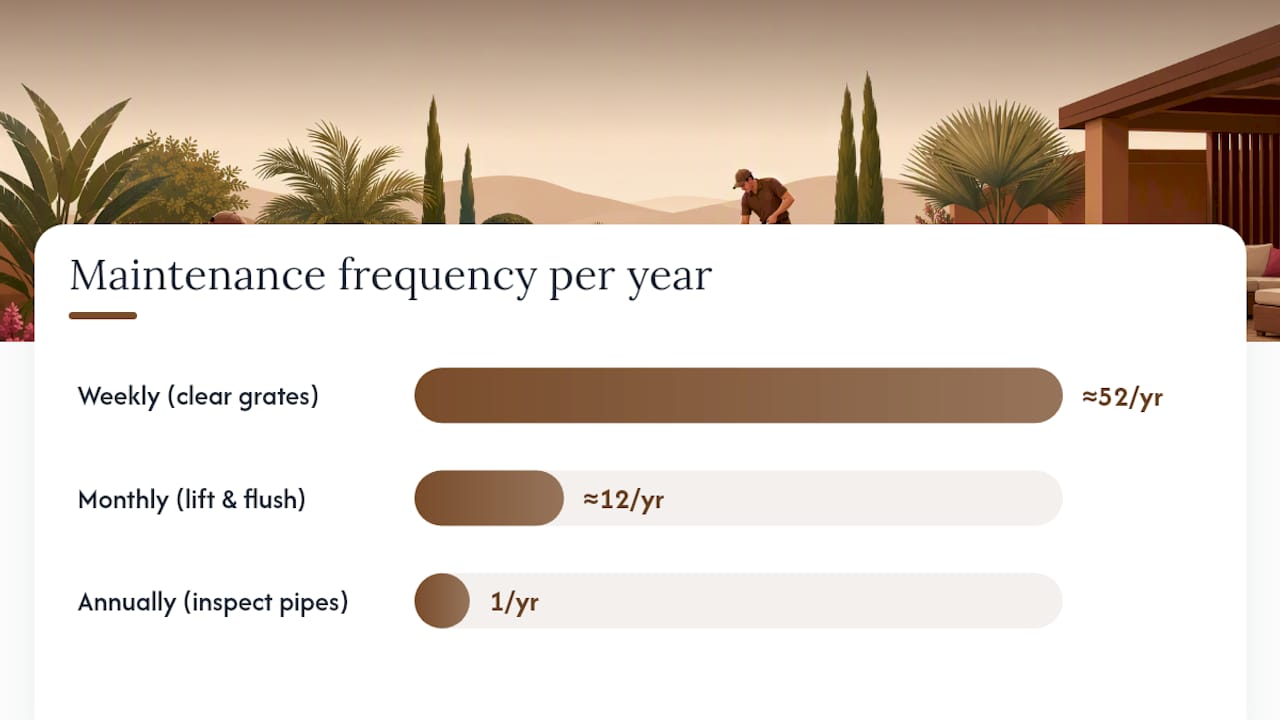
- Weekly: clear leaves and debris off every grate and visible inlet
- Monthly: lift channel drain grates and flush the channel with a hose to clear sediment buildup
- Annually: inspect buried pipes and cleanouts, ideally before the start of your region’s rainy season
Beyond the calendar, build yourself an as-built map showing where every grate, cleanout, and final grade elevation sits. A documented source-to-outlet map with photos is a small upfront effort that saves you from guessing during a future renovation or, worse, an expensive exploratory dig.
Pro Tip: Keep that maintenance map in the same folder as your pool’s equipment manuals. It’s the first thing a contractor will ask for if you ever need drainage repairs.
Call a contractor when you see sustained ponding that doesn’t drain within a day, a buried pipe that stays clogged after flushing, or grading that seems to be sinking or shifting near the pool shell. Those aren’t maintenance issues anymore. They’re design problems.
How Longhorn Pools Designs Around Rainwater From Day One
We treat drainage as part of the design, not an afterthought bolted on after the shell is poured. Every project starts with grading and drain placement worked out before equipment pads or decking go in, because moving a drain line after the concrete is down costs far more than planning it correctly the first time.
We also build with Central Texas conditions in mind: drought-friendly landscaping, evaporation control, and water-efficient equipment all factor into the same site plan as the drainage layout. A pool designed for our soil and our storms holds up better through both extremes.
— Mark
Get a Drainage-Ready Pool Design or Retrofit
Some rainwater problems are genuinely DIY, clearing a grate, resloping a small mulch bed, adjusting a downspout extension. But once you’re talking about regrading near the pool shell, adding buried drain lines, or fixing a deck that’s ponding every storm, that’s a job for a contractor who understands how grading interacts with the pool structure itself, not just the surface fix.

Every renovation should begin with site assessment, followed by an engineered grading plan, and installation of appropriate hardware. This approach differs from general landscaping methods that rely on less precise slope estimation. If your current setup keeps flooding the same corner every season, our pool renovation services cover drain retrofits, deck regrading, and surface work in one project instead of three separate contractors. Homeowners building new can fold drainage planning directly into a custom pool design from the first site visit. Reach out for a design consultation and we’ll walk your property with you before anything gets dug.
Sources
These sources back the technical guidance above and are worth bookmarking if you want to go deeper on any single fix:
- Gutters and downspouts | BASC (PNNL)
- Pool deck drainage (StructureSmart)
- Pool deck drainage planning | Creative Edge Pools
- Rain gardens and stormwater (Stroud Water Research Center)
FAQ
What Should I Do When a Pool Fills With Rainwater?
Use a submersible pump or siphon to bring the water back to normal level, discharging onto a lawn area or approved drain, then test and rebalance chemistry once the level is corrected.
Do I Need Drainage Around My Pool?
Most decks do, since even a well-graded slab needs somewhere for splash-out and storm runoff to go; channel or slot drains at low points are the standard fix for residential decks.
Does Rainwater Affect Pool Water Chemistry?
Yes. Rain dilutes chlorine and often introduces mildly acidic runoff, so pH and sanitizer levels typically need adjustment after a heavy storm.
How Do I Keep Rainwater From Collecting on a Pool Cover?
Use a cover with a built-in pump or a mesh design that lets water pass through rather than pool on top, and check it after every storm since standing water adds weight the cover isn’t built to hold long term.
Can Longhorn Pools Help Fix a Drainage Problem on an Existing Pool?
Yes. Longhorn Pools’ renovation services include grading corrections, drain retrofits, and deck rebuilds for pools with recurring rainwater problems.