
Yes, if your water looks cloudy or your chemicals never seem to balance, low pool turnover rate problems are the most likely suspect. Before you touch a chemical bottle or call a pump salesman, measure your actual flow in gallons per minute (GPM). The Model Aquatic Health Code and the standard turnover formula give you the benchmark. Some pool builders see the same root causes over and over in Hill Country pools.
TL;DR:
- Most residential pools should aim for a turnover of 6 to 8 hours, but many systems fall short due to inadequate flow measurements or plumbing issues.
- One turnover filters around 63% of the water, so multiple cycles are necessary to reach acceptable cleanliness levels, especially for areas with high bather loads.
- Low flow often results from simple, inexpensive causes like clogged baskets, dirty filters, or air leaks, which can be fixed without replacing equipment.
- Accurate flow measurement using a flow meter or bucket test is crucial, as pump horsepower alone does not reflect actual system performance.
- Renovations that address undersized plumbing or relocate equipment can significantly improve circulation and prevent chronic turnover problems.
Table of Contents
- What Is the Pool Turnover Rate Formula? (With Worked Examples)
- What Turnover Rate Should Your Pool Actually Hit?
- Why One Turnover Doesn’t Mean Clean Water
- What Causes Low Turnover and Weak Circulation?
- How Do You Measure Your Actual Flow Rate?
- Step-By-Step Fixes for Turnover and Circulation Problems
- When Should You Call a Professional?
- How Renovation Prevents Chronic Turnover Problems
- A Homeowner’s Quick Diagnostic Checklist
- Fixing Circulation for Good: Longhorn Pools’ Equipment and Renovation Services
- Where to Verify Turnover Standards and Run the Numbers Yourself
- Sources
- FAQ
What Is the Pool Turnover Rate Formula? (With Worked Examples)
Turnover time tells you how long it takes your equipment to filter a volume of water equal to your entire pool. The formula is simple: Turnover time (hours) = Pool volume (gallons) ÷ (GPM × 60).
Here’s how that plays out on real pools:
- 10,000-gallon pool at 40 GPM: 10,000 ÷ (40 × 60) = 4.2 hours per turnover.
- 10,000-gallon pool at 30 GPM: 10,000 ÷ (30 × 60) = 5.6 hours.
- 15,000-gallon pool at 50 GPM: 15,000 ÷ (50 × 60) = 5 hours.
- 15,000-gallon pool at 35 GPM: 15,000 ÷ (35 × 60) = 7.1 hours, already past the typical residential window.
Multiply GPM by 60 to convert to gallons per hour, since flow meters and pump curves report in GPM, but turnover math runs in hours. If your pool volume estimate is off by even a thousand gallons, your turnover math will be too. Most builders can pull the original volume calculation from your permit file, but a rough pour-and-measure estimate works fine for troubleshooting.
What Turnover Rate Should Your Pool Actually Hit?
Public and semi-public pools don’t get to guess at turnover. Health departments enforce specific benchmarks under MAHC, and inspectors will check them with a flow meter, not a stopwatch and a hunch.
- Commercial pools: typically a 6-hour turnover target under MAHC-based codes.
- Spas and therapy pools: often 30 minutes, since bather load and water temperature accelerate contamination.
- Wading pools: frequently required to turn over in an hour or less, given how often young children are in the water.
- Residential pools: usually a recommended range of 6 to 8 hours, not a hard legal requirement.
That gap between “recommended” and “required” trips people up. Your backyard pool won’t get shut down for a slow turnover, but an HOA amenity pool or a commercial property absolutely can. If you manage a public or semi-public pool, check with your local authority having jurisdiction (AHJ) before assuming these numbers apply exactly as written. Codes vary by state and county, and some jurisdictions layer on stricter local rules.
Why One Turnover Doesn’t Mean Clean Water
Here’s the part almost nobody explains clearly: one turnover does not mean 100% of your water has passed through the filter. It means roughly 63% has, thanks to how dilution actually works.
The Gage–Bidwell dilution model shows this as an exponential curve, not a straight line. One turnover gets you to about 63% filtered. Two turnovers gets you to roughly 86%. Three lands around 95%, and you need about four turnovers to hit close to 98%.
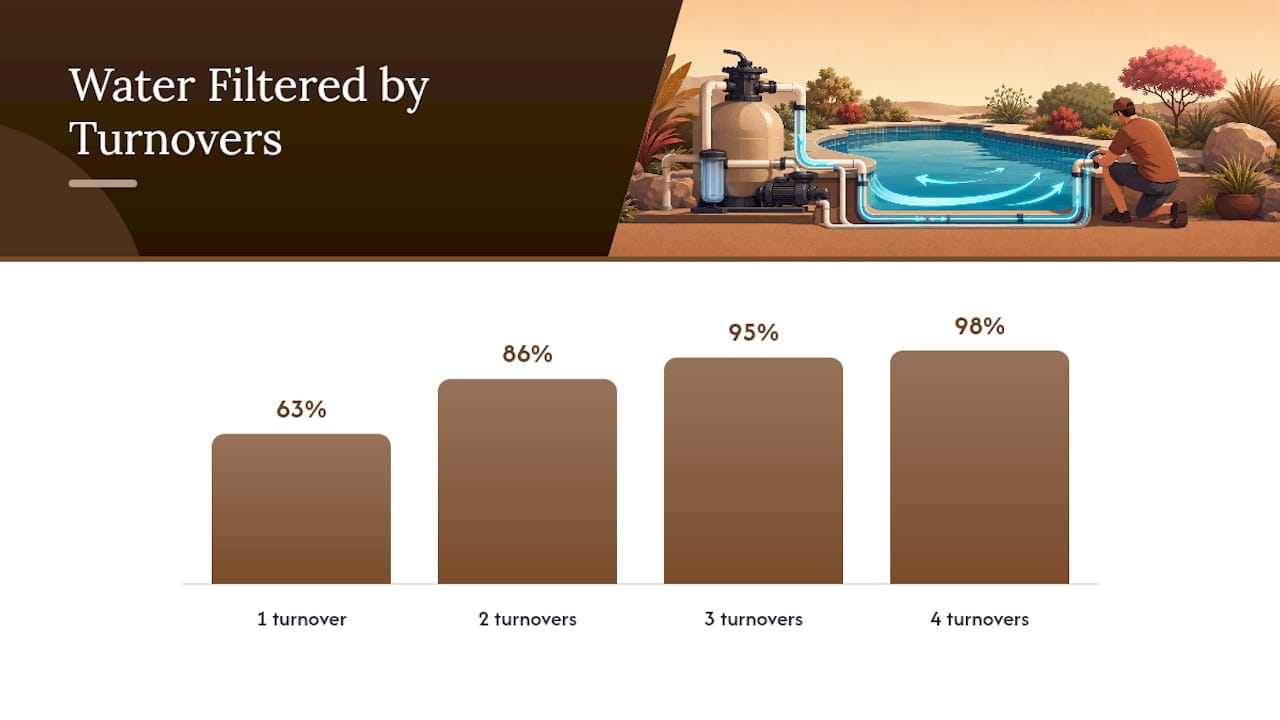
This is why sanitizer levels can swing even when your pump “runs enough hours.” A single daily turnover leaves more than a third of your water untouched by the filter at any given moment. It’s also why circulation pattern matters as much as raw volume math. Water that short-circuits straight from a return to the skimmer without sweeping the whole pool never gets its fair turn in that dilution curve, no matter what your GPM number says.
What Causes Low Turnover and Weak Circulation?
Most turnover complaints trace back to a short list of mechanical culprits, and the fix is almost always cheaper than a new pump. Field data on low-flow complaints backs this up: a well-ordered troubleshooting checklist resolves the vast majority of cases before equipment replacement is ever necessary.
- Skimmer and pump baskets. A basket packed with leaves is the number one flow killer, and it takes thirty seconds to check.
- Dirty filter cartridges or grids. A filter clogged with debris chokes flow just as effectively as a closed valve, even though the pump sounds fine.
- Low water level. If the water drops below the skimmer opening, your system is sucking air instead of water, and no amount of pump power fixes that.
- Suction-side air leaks. Look for a stream of tiny bubbles inside the pump strainer pot. That’s air entering through a cracked lid O-ring, a loose union, or a hairline crack in suction plumbing before the pump.
- Valve mis-settings. A multiport valve stuck between positions, or a partially closed return valve, throttles flow without any obvious warning sign.
- Worn or jammed impeller. A chipped or debris-jammed impeller causes cavitation, that grinding or whining noise, and a flow rate that never matches the pump’s rated output.
- Plumbing friction losses. Undersized pipe, too many 90 degree elbows, or long suction runs from an equipment pad set far from the pool all eat into available flow before the water even reaches the pump.
- Dead zones from poor jet placement. Even a technically adequate turnover number won’t fix cloudy corners if the return jets never sweep that part of the pool. This is where a pool brush becomes a diagnostic tool, not just cleaning equipment.
Pro Tip: Walk this list in order, top to bottom, before you spend a dollar on new equipment. Nine times out of ten, the fix is a basket, a valve position, or a $12 O-ring, not a new pump.
How Do You Measure Your Actual Flow Rate?
Guessing at GPM is how homeowners end up buying pumps they don’t need. Measuring it takes fifteen minutes.
- Flow meter: the gold standard, and what inspectors use on commercial pools. A permanently installed or clamp-on meter gives you a direct GPM reading at operational head, which is the only number that actually matters.
- Bucket and stopwatch: works for accessible discharge points like a waterfall spillway or return line you can temporarily redirect. Time how long it takes to fill a 5-gallon bucket, then do the math to convert to GPM. It’s rougher than a flow meter but far better than guessing.
- Filter pressure differential: compare your current filter pressure against the clean, freshly backwashed baseline (usually printed on a sticker near the gauge). A rise of 8 to 10 PSI above baseline typically signals it’s time to clean or backwash.
- Variable-speed schedules: if your pump runs multiple speeds throughout the day, calculate a weighted average flow across the full cycle, not just the peak speed, since low overnight settings can quietly drag your daily average below target.
Nameplate horsepower on the pump label tells you almost nothing about real-world flow. A 2 HP pump fighting a clogged filter and 40 feet of undersized 1.5-inch pipe can deliver less usable flow than a properly sized 1 HP pump on clean plumbing. That’s why measuring at operational head, meaning with the system running under its actual resistance, is the step that separates a marginal shortfall you can fix yourself from a system-capacity failure that needs equipment or plumbing work.
Step-By-Step Fixes for Turnover and Circulation Problems
Work through these in order. Most homeowners never get past step 3.
- Clear every basket and clean the filter. Empty skimmer and pump baskets, then backwash a sand or DE filter or hose off cartridges. This alone resolves a surprising share of “my pump seems weak” calls.
- Reseal the pump lid. If you spotted bubbles in the strainer pot, replace the lid O-ring and check the gasket seat. A five-dollar part often ends an air-leak mystery that’s been running for months.
- Verify valve positions. Confirm your multiport or push-pull valves are fully seated in the intended position, not partway between settings.
- Aim your return jets. Angle them to sweep the full perimeter of the pool rather than firing straight across a narrow channel, and brush dead corners weekly so debris doesn’t settle where flow is weakest.
- Reprogram variable-speed pumps. Set your main filtration speed to hit your target GPM during a defined daily window, rather than running low speeds around the clock and hoping the average works out.
- Replace a worn impeller or service motor bearings. If flow tests low even after basket, filter, and valve checks come back clean, the pump itself may be the problem.
- Upsize suction plumbing. If the equipment pad sits far from the pool with long, narrow suction runs, undersized pipe may be capping your flow no matter what pump you install.
Pro Tip: Resist the urge to fix low flow by simply cranking pump speed or runtime. That burns more electricity without addressing the real bottleneck, and it’s the fastest way to inflate your power bill without improving water clarity. A correctly sized system hits its turnover target at a lower, steadier speed than an undersized one running flat out.
When Should You Call a Professional?
Some fixes are weekend projects. Others aren’t. Call a licensed technician for major plumbing repairs (cutting into suction or return lines), any electrical work on pump wiring or bonding, or persistent flow shortfalls that survive every item on the diagnostic checklist above.
Compliance risk is where this gets serious for public and semi-public pools. Inspectors verify turnover with flow meters, not estimates, and a pool that fails to hit its required rate can be cited or closed until remediated. HOA and commercial properties should treat a flow shortfall as a compliance issue first, a comfort issue second. Never attempt electrical or major plumbing repairs yourself if you’re not qualified. That’s a safety issue, not just a code issue.
How Renovation Prevents Chronic Turnover Problems
We’ve seen the same story play out on renovation jobs across Austin and the Hill Country: a homeowner adds a spa or a water feature to an existing pool, and suddenly turnover suffers because the original plumbing was never sized for the extra draw. Splitting flow across a pool, spa, and waterfall without upsizing suction lines is one of the most common ways a previously fine system starts running slow.
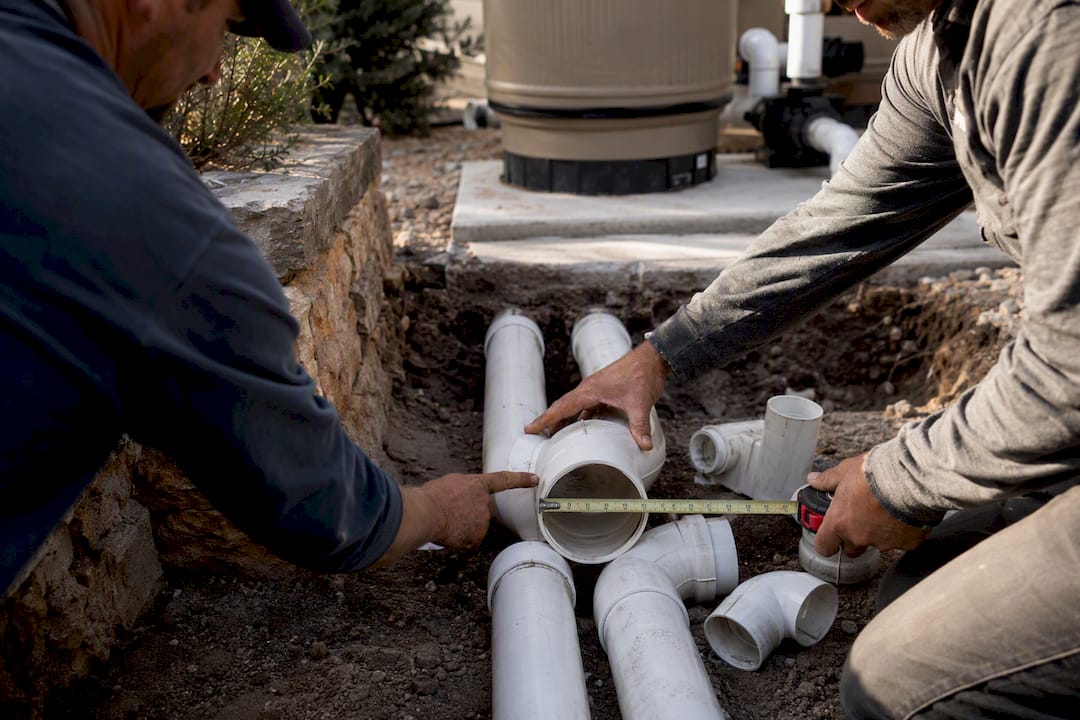
The retrofit fixes we recommend most often aren’t glamorous, but they work. Relocating the equipment pad closer to the pool shortens suction runs and cuts friction loss immediately. Increasing suction pipe diameter during a renovation, even by a half inch, can restore flow that undersized original plumbing never delivered. Consolidating unnecessary fittings and unions, each one is a friction point, cleans up flow paths that decades of add-on plumbing tend to clutter. Long plumbing runs and undersized suction lines are consistently the two culprits behind chronic circulation complaints we’re called in to fix.
Whatever the fix, document your baseline GPM and filter pressure right after the work is done. That number becomes your reference point for every future service call.
A Homeowner’s Quick Diagnostic Checklist
Before you spend money on anything, run three checks yourself: pull and inspect the skimmer and pump baskets, watch for air bubbles in the pump strainer pot, and read your filter pressure against its clean baseline. These three take fifteen minutes combined and catch the majority of real-world flow problems.
The mindset that matters here is measure first, replace second. A new pump feels like progress, but if the real problem is a cracked lid O-ring or a stuck valve, you’ve spent hundreds of dollars and changed nothing. Once you fix something, write down the new GPM and pressure reading. That baseline is what tells you, six months from now, whether a new symptom is actually new or something you missed the first time.
— Mark
Fixing Circulation for Good: Longhorn Pools’ Equipment and Renovation Services
Some pool service companies offer an alternative to guessing your way through pump upgrades. Where a big-box retailer sells you a pump based on pool size alone, we start with an actual equipment audit, measuring real flow, checking plumbing runs, and pinpointing exactly where your system is losing GPM before recommending anything.

They handle both diagnostics and the permanent fix. If your turnover shortfall traces back to undersized suction plumbing, an equipment pad set too far from the pool, or a system that was never designed for the spa and water feature you added later, that’s renovation territory, and some companies specialize in this work. Our renovation services cover plumbing upgrades, equipment replacement, and full retrofit work for homeowners, HOAs, and commercial properties across Austin and the Hill Country. For new builds, our residential pool construction process sizes plumbing and equipment correctly from day one, so you never end up chasing turnover problems five years in.
If your water’s been cloudy longer than it should, or your filter pressure keeps climbing no matter how often you backwash, reach out to Longhorn Pools for an equipment audit and consultation.
Where to Verify Turnover Standards and Run the Numbers Yourself
For the official code language behind commercial turnover requirements, the CDC’s Model Aquatic Health Code is the primary reference most jurisdictions build from. For flow-rate math on a variable-speed schedule, the turnover compliance calculator is a useful cross-check. Always confirm final numbers with your local AHJ.
Sources
- Turnover rate explanation and formula
- Pool Service Turnover Rate Compliance
- Revisiting the Gage–Bidwell Law of Dilution (academic)
- How to determine the cause of low water flow
FAQ
What Is a Good Turnover Rate for a Pool?
Residential pools typically aim for a 6 to 8 hour turnover, while commercial pools usually follow a MAHC-based 6-hour target and spas often require 30 minutes or less.
How Many Times Should Pool Water Turn Over in a Day?
Most residential pools aim for about 3 turnovers per day at an 8-hour turnover rate, while commercial pools targeting 6 hours aim for closer to 4 turnovers daily.
What Is the Recommended Turnover Rate for a Swimming Pool?
The standard formula is turnover time (hours) = pool volume (gallons) ÷ (GPM × 60), with residential guidance landing in the 6 to 8 hour range and public pools generally required to hit 6 hours or less under MAHC-based codes.
How Many GPM Does a 10,000-Gallon Pool Need?
To hit a 6-hour turnover, a 10,000-gallon pool needs a flow rate around 30 GPM; to hit 8 hours, it needs around 25 GPM. Measuring actual flow with a flow meter or bucket test, rather than assuming pump nameplate output, is the only reliable way to know where your system actually lands.