
Most homeowners pay somewhere between $1,000 and $8,000 for a pool slide fully installed, with straightforward freestanding models landing at the low end and custom rock or grotto builds pushing past $25,000. The single biggest swing factor is whether your deck can accept the slide as is or needs a new reinforced footing. If you’re eyeing a small bolt-down slide on a solid deck, DIY is realistic. Anything touching plumbing, structural footings, or permits is a job for a pro.
TL;DR:
- Most pool slide installations cost between $1,000 and $8,000, with custom grotto builds exceeding $10,000 due to elaborate construction.
- Costs primarily depend on deck reinforcement needs, with reinforced footings often accounting for the largest additional expense.
- Labor, plumbing, and site conditions, such as grading and permit requirements, significantly influence the final price beyond material choices.
- Proper safety measures, including adequate runout depth, anchoring, and non-slip features, are essential to prevent injuries and avoid warranty voidance.
- DIY installation is feasible for simple, bolt-down slides on solid decks, but complex projects involving new footings or plumbing should always involve professionals.
Table of Contents
- How Much Does a Pool Slide Installation Cost?
- What Actually Drives the Price of a Slide Installation?
- How Is a Pool Slide Actually Installed?
- Is Your Pool Deep Enough and Safe Enough for a Slide?
- Should You DIY the Slide or Hire a Professional?
- A Pool Builder’s Checklist for Getting Reliable Quotes
- Get a Site Visit for Your Pool Slide Project
- Where to Read the Safety and Code Guidance Yourself
- Sources
- FAQ
How Much Does a Pool Slide Installation Cost?
The number you land on depends almost entirely on which category your project falls into, and the three tiers below don’t overlap much. Once you know which one describes your pool, the guesswork mostly disappears.
Entry-level installs run roughly $1,000 to $3,000 installed, according to contractor cost guides that track typical freestanding slide projects. This tier covers straight fiberglass or rotationally molded polyethylene slides bolted directly to an existing deck that’s already thick and level enough to handle the load. Picture a family with a standard gunite pool and a poured deck in good shape. A local dealer measures, drills anchor points, sets the slide, and you’re sliding by the weekend.
Mid-range projects land between $3,000 and $8,000, and this is where most homeowners with an average backyard end up. Curved or corkscrew-style slides usually cost more per unit than a straight model, and they often require a new or reinforced footing because the load isn’t distributed the same way. Add a booster pump for water delivery, a short plumbing run, and a day or two of labor, and you’ve explained the jump from entry-level pricing. Industry buyer guides peg freestanding fiberglass slides at $1,500 to $8,000 depending on curve complexity and mounting needs, which lines up closely with this range.
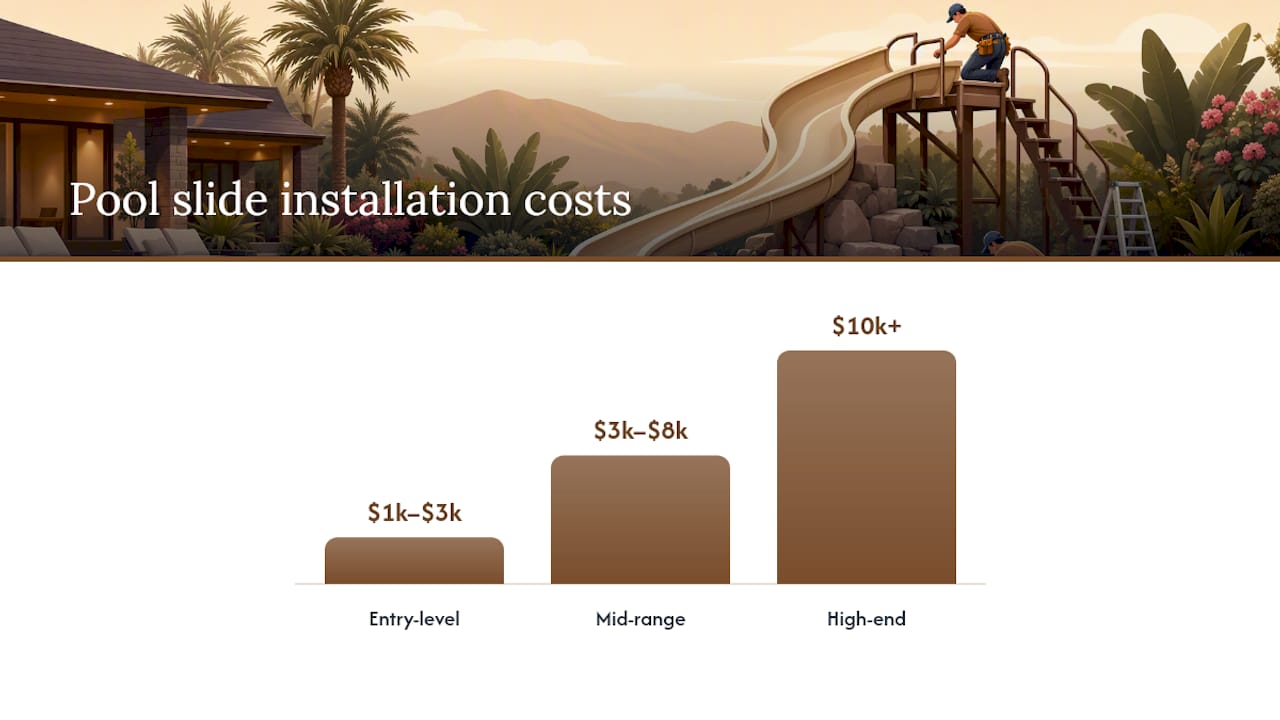
High-end and custom installs begin at a higher price point and may reach much larger amounts for elaborate rock or grotto builds with integrated waterfalls and landscaping. These aren’t off-the-shelf products. A grotto slide is essentially a small construction project: engineered footings, hand-formed rockwork, dedicated plumbing, and often a crane for placement. If you’re picturing a resort-style backyard with a slide built into a boulder formation, this is the tier you’re budgeting for.
A quick way to sort your own project:
- You have a solid deck and want something simple: budget entry-level, $1,000 to $3,000.
- You want a curved slide or your deck needs reinforcement: budget mid-range, $3,000 to $8,000.
- You’re building a custom feature with rockwork or a waterfall: budget high-end, $10,000 and up.
What Actually Drives the Price of a Slide Installation?
Materials set your baseline, but labor and site conditions decide how far above that baseline you land. Polyethylene and rotationally molded slides hold up well against UV exposure and Texas heat without the fading and cracking that cheaper plastics show after a few summers, which is why they price reasonably compared with more exotic materials. Fiberglass slides cost more but offer a smoother slide surface and longer lifespan. Stainless steel and custom-finished rock slides sit at the top of the material scale, both in unit price and in what they demand from installers.
Mounting method is where quotes diverge the most. A slide that bolts to an existing deck with standard anchors is a half-day job. A slide that needs a new poured footing to distribute dynamic load, which happens often when the existing deck is too thin or wasn’t built to handle a moving load in the first place, can add thousands to the bid before the slide itself ever gets installed.
Plumbing matters more than most homeowners expect going in. Some slides run fine on a garden hose. Others need a dedicated water line and a booster pump to keep flow consistent, and confirming pump capacity before assuming a simple hose will work saves you from a mid-project surprise.
Other line items worth watching on a quote:
- Site access and grading, especially on sloped Hill Country lots
- Delivery and trucking fees for larger or custom units
- Local labor rates, which vary noticeably across Central Texas markets
- Permit fees and inspection costs tied to structural or electrical work
Quick stat: Contractor cost data shows labor, footing, and plumbing are consistently the top three cost adders across every tier, not the slide itself.
How Is a Pool Slide Actually Installed?
The process is more predictable than most homeowners assume, but the sequence matters because skipping a step is how projects end up over budget.
- Pre-install assessment. A contractor checks deck thickness, verifies your pool’s runout depth against the manufacturer’s spec sheet, and confirms clearance from ladders, diving boards, or other fixtures.
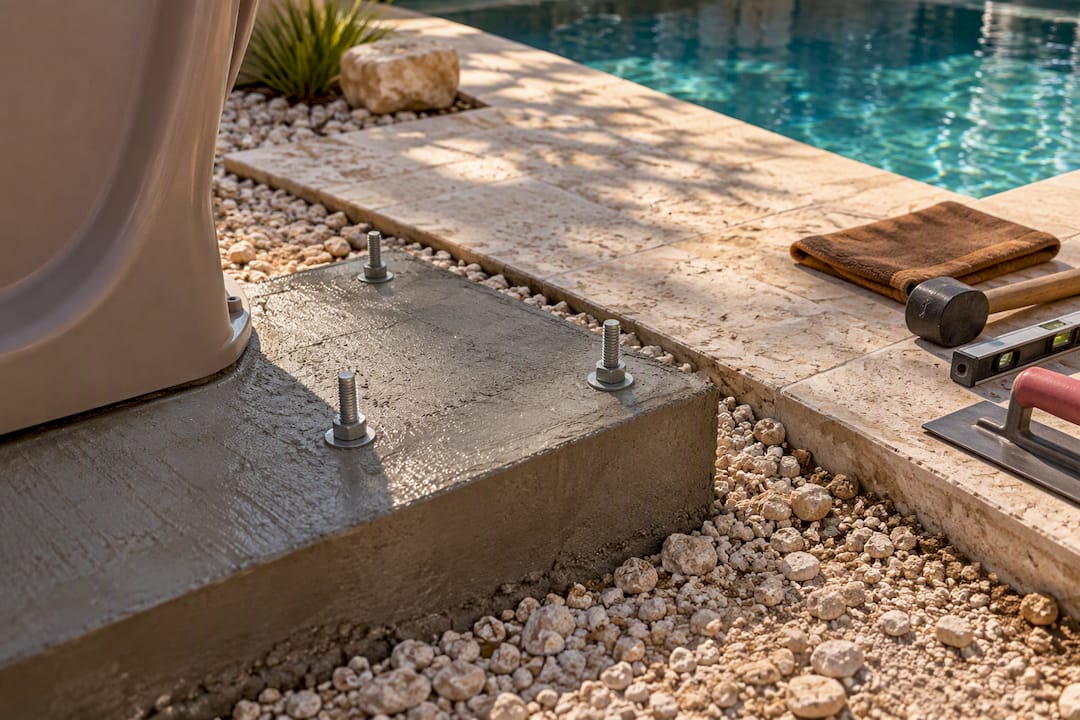
- Site prep. Crews mark anchor locations, cut into the deck if needed, and remove old decking or hardware. If the deck can’t handle the load, this is where a reinforced concrete pad gets poured, similar to the prep work involved in broader excavation and deck planning.
- Mounting and plumbing. Anchors go in, the slide gets set and leveled, and any water line or booster pump gets connected and tested for flow.
- Inspection and finishing. Anchors are sealed, decking is patched and finished to match, and the contractor tests the slide’s flow rate and checks for pinch points or sharp transitions.
A freestanding slide on a ready deck typically wraps in one to three days. A custom rock or grotto build can stretch into several weeks once you factor in curing time for footings and rockwork.
Pro Tip: Ask your contractor for the footing cure time up front. Rushing a slide onto fresh concrete is one of the more common reasons anchors loosen within the first year.
Is Your Pool Deep Enough and Safe Enough for a Slide?
Depth and clearance aren’t suggestions. The Consumer Product Safety Commission publishes guidance on pool slide safety specifically because insufficient runout depth is one of the more common causes of slide-related injuries, and manufacturers build their installation manuals around meeting that standard. Federal design and testing requirements for recreational water equipment are laid out in the Code of Federal Regulations, and public health researchers have found that improper installation and shallow water depth are recurring factors in pool slide injuries.
A few checks that affect both safety and your final bill:
- Confirm your pool’s runout depth meets the specific slide manufacturer’s minimum, not just a general rule of thumb.
- Have your deck’s structural capacity checked before anchoring. An inadequate deck often forces a reinforced footing, which is frequently the single largest add-on cost in an otherwise simple project.
- Check local permit requirements before work starts. Many jurisdictions require a permit for structural or electrical changes tied to the install, and skipping that step can complicate future inspections.
- Ask your insurance carrier whether adding a slide affects your policy, and keep installation and inspection documentation on file in case they ask.
Quick stat: Improper anchoring doesn’t just create a safety risk. Manufacturer installation notes routinely warn that anchoring outside spec can void the warranty entirely.
Non-slip steps, handrails, and dedicated deck lighting add modest cost but meaningfully reduce injury risk, especially for slides used after dark.
Should You DIY the Slide or Hire a Professional?
Competent DIY works for small molded slides going onto a deck that’s already structurally sound, with a bolt-down mount and simple hose-fed water delivery. That’s a real, doable weekend project for a handy homeowner.
Where DIY runs out of road: anything involving a new footing, plumbing modifications, electrical work for a booster pump, or a permit filing. Hillside lots, engineered sites, and slides integrated with waterfalls or grottos also belong with a professional, full stop.
- Structural footings need engineering judgment, not guesswork.
- A botched anchor job risks both injury and a voided manufacturer warranty.
- A licensed contractor’s work usually comes with a workmanship warranty that DIY installs never carry.
Longhorn Pools handles the parts homeowners can’t easily DIY themselves: site assessments, reinforced footing design, permit handling, and turnkey installation as part of a broader residential pool project.
Pro Tip: If your slide is going in as part of a larger renovation, bundle it. Mobilization and concrete work get cheaper per project when they’re shared across multiple upgrades instead of billed separately.
A Pool Builder’s Checklist for Getting Reliable Quotes
The quotes that look cheapest on paper are usually the ones missing something. Always ask for an itemized breakdown, and specifically request footing plans or photos of comparable past work, not just a lump-sum number. Confirm the manufacturer’s installation requirements are actually written into the scope of work, and ask directly how the install affects your warranty. If you’re already planning other pool work, schedule the slide alongside it. Sharing mobilization and concrete costs across projects is one of the easiest ways to save real money. And always ask who’s pulling the permit and who’s producing proof of inspection when it’s done.
— Mark
Get a Site Visit for Your Pool Slide Project
Professional pool builders can be an alternative to piecing together separate contractors for the deck, plumbing, and slide itself, by handling custom design, reinforced footings, permit support, and turnkey installation as one coordinated project instead of several separate contracts.

Whether you’re adding a slide to an existing pool or planning one into a new build from day one, our team can walk your site, check your deck’s structural capacity, and give you a real quote instead of a phone estimate. Installing a slide during initial construction, when possible, often costs less than a retrofit because footings and plumbing get handled as part of the larger build instead of as an add-on later. If you’re further along and dealing with an existing pool, our residential pool construction team can assess what your current deck can handle. Request a site visit through our main site and we’ll walk you through what your specific project actually needs before you commit to a number.
Where to Read the Safety and Code Guidance Yourself
For the rules directly from the source, the CPSC’s pool slide safety guidance covers runout depth and clearance. Local permit specifics are outlined in our Austin permitting guide, and general home-project budgeting parallels are covered in this HVAC cost guide from a fellow home services provider.
Sources
- CPSC — Pool slides and safety guidance
- Code of Federal Regulations — relevant consumer product safety sections
- Public health review on pool-related injuries
- PoolPad — Pool slide ideas: types, cost & safety
- BuildsAndBuys — Pool slide installation cost guide
FAQ
Can You Add a Slide to an Existing Inground Pool?
Yes, in most cases, as long as your deck can structurally support the anchoring or can be reinforced to do so. The bigger question is usually runout depth. If your existing pool doesn’t meet the manufacturer’s minimum depth for the slide you want, you may need to adjust your slide choice or, in rare cases, modify the pool itself, which our inground pool installation guide covers in more detail.
Does a Pool Slide Increase Insurance Costs?
It can, since many carriers view slides as an added liability feature similar to diving boards. Ask your carrier directly and keep your installation and inspection paperwork on hand, since documentation showing proper anchoring and code compliance can help avoid premium surprises.
How Much Do Pool Slides Cost?
Total installed cost typically runs $1,000 to $3,000 for basic freestanding models, $3,000 to $8,000 for mid-range curved or corkscrew slides, and $10,000 or more for custom rock and grotto builds, according to contractor cost data. Longhorn Pools provides site-specific quotes since footing and plumbing needs vary by property; pricing is available after a site visit through our residential services page.
Why Are Pool Slides So Expensive?
The slide itself is rarely the expensive part. Labor, footing work, and plumbing modifications consistently rank as the top cost drivers across every price tier, and custom rockwork or grotto features add engineering and material costs on top of that.