
Most pool water loss is evaporation, not a leak, and the fastest way to know for sure is a 24-hour bucket test with the autofill turned off. If your pool drops noticeably more than the bucket does, you likely have a leak. Losing more water than the typical evaporation rates, noticing soggy areas on your deck, or seeing steady bubbles from the returns means stop guessing and start investigating today.
TL;DR:
- Most water loss from a pool is evaporation, which can be distinguished from leaks with a 24-hour bucket test done with the autofill turned off.
- Daily evaporation typically ranges from a quarter inch to half an inch under normal conditions, but hot, dry, and windy weather can cause up to an inch loss per day without indicating a leak.
- Signs of an actual leak include wet soil near the pool, sinking or cracking decking, continuous bubbles from returns, constant autofill operation, or visible cracks and damaged fittings.
- Losing more than one inch of water daily or showing wet spots and sinking decking generally warrants professional leak detection, including pressure tests, acoustic detection, or thermal imaging.
- Using a pool cover, adjusting heater usage, timing backwashes, and inspecting autofill valves can reduce false alarms caused by evaporation.
Table of Contents
- Pool Leak vs Evaporation: Quick Checklist to Run Today
- How Much Water Should a Pool Lose to Evaporation?
- What Are the Signs of an Actual Pool Leak?
- What’s the Best Way to Test for a Pool Leak Myself?
- When Should You Call a Pool Leak Detection Professional?
- How Can You Cut Evaporation and Stop False Alarms?
- What Longhorn Pools Sees in the Field
- A Homeowner’s Note on Testing Before You Panic
- Get a Professional Leak Check or Renovation Quote
- Sources
- FAQ
Pool Leak vs Evaporation: Quick Checklist to Run Today
Before you call anyone, spend twenty minutes doing this yourself. It costs nothing and it settles most cases outright.
- Turn off the autofill. Autofill valves quietly top off the pool and hide the exact evidence you need. Mark the pool’s water level with tape or a grease pencil.
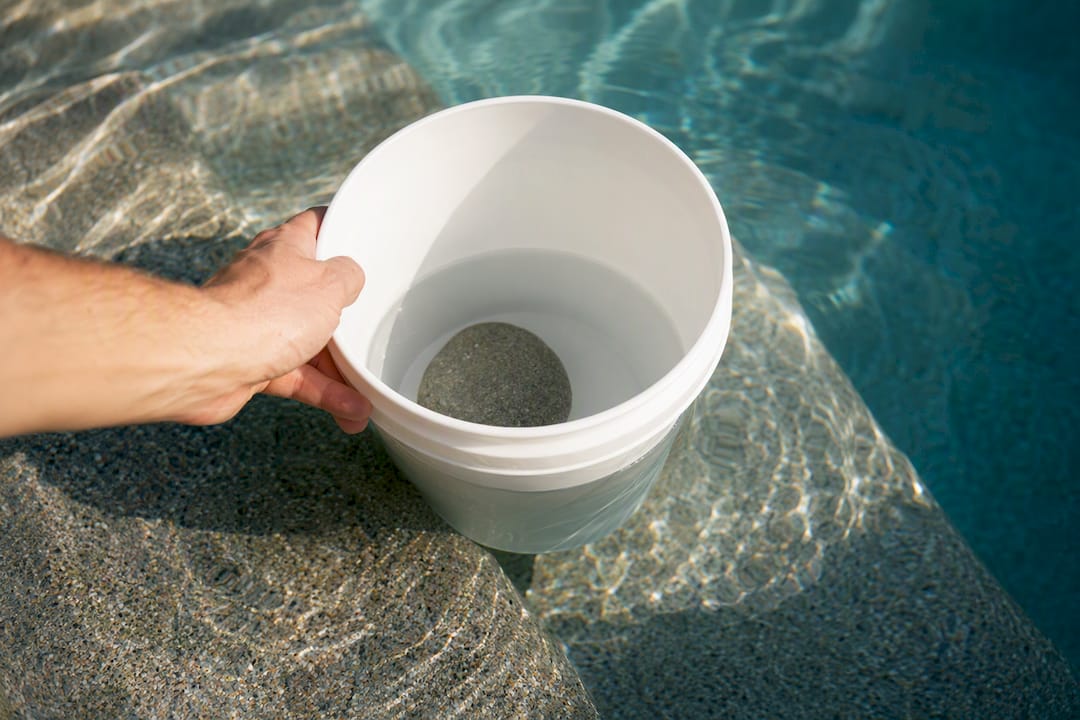
- Set up the bucket test. Fill a five-gallon bucket with pool water, weigh it down so it doesn’t float away, and set it on a step where it stays submerged a few inches. Mark the water line inside the bucket and the line on the pool wall.
- Log what changed recently. Did you run the heater more than usual? Backwash the filter? Host a pool party with a lot of splashing? All of those move the needle without a leak being involved.
- Walk the perimeter. Look for wet or spongy soil, water pooling against the decking, cracked coping, or a drip trail near equipment pads.
Give the bucket test a full 24 hours before you draw conclusions. Anything shorter gets thrown off by wind gusts or a stray splash. If the pool line drops noticeably more than the bucket line, the bucket test is telling you something real is escaping that isn’t just sun and air doing their job.
How Much Water Should a Pool Lose to Evaporation?
Four things drive evaporation: air temperature, water temperature, humidity, and wind. Hot, dry, windy days pull water off the surface fast. Cool, humid, still days barely touch it. That’s why a pool can lose a quarter inch one week and three quarters of an inch the next without anything mechanical changing at all.
Under normal conditions, industry benchmarks put daily evaporation somewhere between a quarter inch and half an inch. Heated pools, pools with waterfalls or fountains, and pools exposed to constant wind can climb toward a full inch a day, especially in arid, high heat conditions. None of that is a leak. It’s just physics doing what physics does.
To translate inches into gallons, you need the pool’s surface area. A standard formula works for most rectangular or near-rectangular pools:
Gallons lost = surface area (sq ft) × inches lost × 0.623
Here’s what that looks like for a typical 400 square foot pool, based on seasonal evaporation modeling:
| Daily Evaporation | Gallons per Day (400 sq ft pool) | Gallons per Month |
|---|---|---|
| 1/4 inch | 25 gallons | 1,000 gallons |
| 1/2 inch | ~125 gallons | ~3,740 gallons |
| 1 inch | 100 gallons | 5,000 gallons |
Multiply your own pool’s square footage against that formula and you’ll have a realistic baseline before you ever suspect a leak.
What Are the Signs of an Actual Pool Leak?
Evaporation is invisible. A leak usually leaves fingerprints somewhere on the property, and once you know where to look, they’re hard to miss.
- Wet or soggy soil near the shell, especially in one consistent spot rather than spread evenly around the pool.
- Sinking or cracking decking, which often means water has been undermining the base beneath it for a while.
- Continuous bubbles coming from return jets, even when the pump has been running steadily with no air in the lines.
- Autofill running constantly, or chemistry that won’t hold steady even though you haven’t added extra water or chemicals.
- Cracked coping, missing grout, liner tears, or gaps at the tile line, particularly around the skimmer and light fixtures.
Wet spots, unstable chemical readings, and visible cracks around fittings are the classic trio professional leak inspectors look for first, because they’re the fastest way to rule evaporation out.
Pro Tip: If your chemistry keeps drifting even though you’re not adding fresh water, don’t just keep dosing chemicals to compensate. Diluted water from a hidden leak eats through your sanitizer and stabilizer levels fast, and you’ll burn through chemical budget chasing a symptom instead of the source.
What’s the Best Way to Test for a Pool Leak Myself?
Run these in order. Each one narrows the possibilities before you spend money on a professional.
- The 24-hour bucket test. Fill and mark the bucket, mark the pool line, kill the autofill, and wait a full day. If the pool drops more than the bucket, water is leaving somewhere it shouldn’t.
- Pump on vs. pump off. Run the bucket test again, but this time compare loss with the pump running versus the pump off. Loss that’s worse with the pump running usually points to a pressure-side plumbing leak. Loss that’s worse with the pump off often means a suction-side or shell issue. Losing water both ways usually means the shell itself or a fitting at the waterline.
- Dye testing. With the pump off and water still, squeeze a small amount of leak-detection dye near suspected trouble spots: the skimmer throat, return fittings, light niches, and any visible crack. If the dye gets pulled in or disappears into a gap, you’ve found your entry point.
- Water meter check. If your home has a separate meter or a smart water monitor, compare usage against your normal baseline. A jump that doesn’t match new fill-ups or backwashing is a red flag.
One number worth remembering: pool professionals commonly use one inch of loss per day as the threshold where evaporation stops being a reasonable explanation, though some set the early-warning line as low as a quarter inch depending on climate and pool features.
The most common mistakes homeowners make during these tests? Testing during or right after rain, forgetting to shut off the autofill, and confusing normal splash-out or backwash discharge with an actual leak. Any one of those will send you chasing a leak that doesn’t exist.
When Should You Call a Pool Leak Detection Professional?
Call a professional when the bucket test confirms loss beyond evaporation, when you’ve found wet soil or sinking decking, or when daily loss is creeping past that one-inch mark consistently. At that point, DIY testing has done its job and it’s time for equipment that can see what you can’t.
Professionals typically use a mix of these methods:
- Pressure testing the plumbing lines to isolate pressure-side leaks section by section.
- Acoustic detection, which listens for the sound of water escaping under pressure.
- Thermal imaging, which can reveal cooler wet zones behind walls or under decking.
- Targeted excavation, used once the leak’s general location is confirmed, to avoid tearing up the whole yard.
Expect a detection visit to run roughly $200 to $500, depending on your market and how straightforward the leak turns out to be. That’s a small number compared to what a slow, unaddressed leak can cost in wasted water, chemical loss, and eventually structural repair to the shell or surrounding deck. A water seepage investigation uses similar acoustic and pressure-based techniques to trace moisture intrusion around structures, which is useful context if you’re also seeing water issues near foundations or retaining walls close to the pool.
Before the technician arrives, have your bucket test results written down, note whether loss changed with the pump on or off, and take a few photos of any wet spots or cracks. That prep alone can shave real time off the visit.
How Can You Cut Evaporation and Stop False Alarms?
A surprising amount of “is my pool leaking” panic disappears once you address ordinary evaporation instead of chasing a phantom leak.
- Use a pool cover. Manual covers, automatic covers, and even simple solar or chemical surface covers meaningfully cut water loss. EPA and DOE guidance puts the reduction in make-up water needs at roughly 30 to 50 percent with regular cover use.
- Rethink your heater habits. Heated water evaporates faster, so running the heater constantly during shoulder seasons quietly inflates your water loss numbers.
- Time your backwashing. Backwash discharge looks like water loss on paper but isn’t a leak, so track it separately rather than folding it into your evaporation estimate.
- Inspect autofill valves regularly. A stuck-open or miscalibrated autofill valve can mask a real leak for months by constantly refilling the pool before you notice anything’s wrong.
- Check equipment after freezes. Post-freeze cracks in plumbing or fittings are common in Central Texas winters and show up as sudden water loss once things thaw.
Pro Tip: An automatic cover is one of the few upgrades that pays you back twice: it cuts evaporation and it keeps debris and chemical demand down at the same time. If you’re weighing the cost, our breakdown of automatic pool cover pricing walks through what drives the range.
If you want a fuller prevention checklist, our luxury pool maintenance guide covers the seasonal habits that keep small issues from becoming expensive ones, and our evaporation control page goes deeper on cover options and behavioral fixes.
What Longhorn Pools Sees in the Field
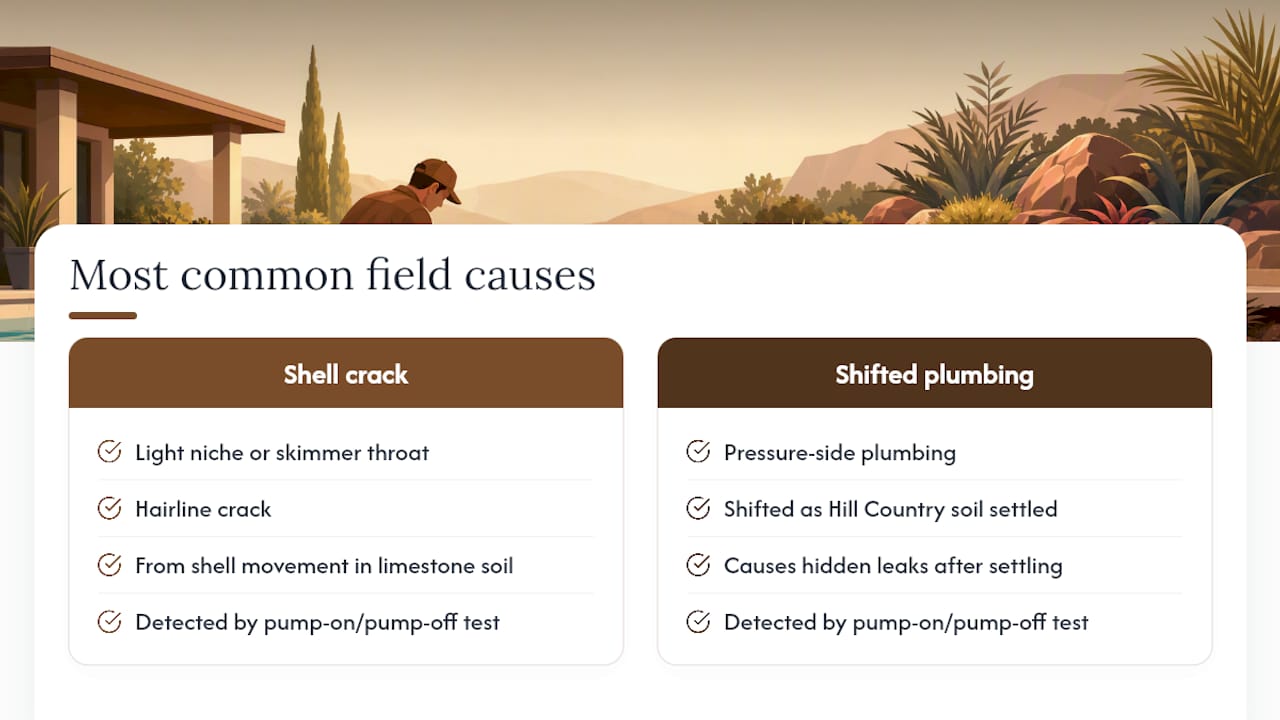
Central Texas heat, wind, and limestone-heavy soil make evaporation rates higher than a lot of national averages suggest, and they also make shell movement more common than homeowners expect. In renovation and inspection work, we regularly find the two culprits behind most “mystery” water loss: a hairline crack at a light niche or skimmer throat, and pressure-side plumbing that shifted slightly as Hill Country soil settled around it. Neither shows up until you run the pump-on, pump-off comparison. If you’re in a windy, high heat area, run your bucket test on a calmer day for a cleaner baseline, then repeat it during a typical hot afternoon to see how much of your loss is genuinely weather driven.
A Homeowner’s Note on Testing Before You Panic
Run the simple tests first. They cost nothing, they remove the guesswork, and they’ll save you from paying for a leak repair you didn’t actually need. Write down your bucket test numbers, note whether the pump was on or off, and resist the urge to patch something before you know what’s actually wrong. Most of the time, what looks alarming is just Texas summer doing its job. When the evidence points somewhere specific, that’s your cue to bring in someone who can confirm it and fix it properly.
— Mark
Get a Professional Leak Check or Renovation Quote
If your bucket test and walk-around point to a real problem, don’t keep patching symptoms. Experienced pool contractors handle structural repairs, plumbing fixes, and full renovations, and small cracks ignored for a season can turn into much bigger repair bills.

A consultation starts with what you already have: your bucket test results, photos of wet spots or cracks, and notes on how the loss behaved with the pump on versus off. That information lets us scope the visit accurately instead of guessing on-site. From there, we’ll walk you through what pool structural repair actually involves for your specific situation, whether that’s a targeted fix or a broader renovation. If the shell or plumbing has been compromised for a while, it’s worth exploring a full pool renovation rather than a patch that buys you another season. Reach out to schedule a consultation and get a straight answer on what’s actually going on with your pool.
Sources
- Pool Leak Detection cost and methods — Angi
- How to Find a Leak in a Pool — Bob Vila
- Pool leak or evaporation — Total Leak Detection
- EPA WaterSense / Outdoor Pool guide (DOE/EPA document)
FAQ
How Do I Know if My Pool Is Leaking or Just Evaporating?
Run the 24-hour bucket test with the autofill off. If the pool’s water level drops noticeably more than the bucket’s, you likely have a leak rather than ordinary evaporation.
Can You Fix a Pool Leak Without Draining the Pool?
Many leaks, especially plumbing and fitting leaks found through pressure testing or dye testing, can be repaired without a full drain; shell or deep structural repairs sometimes require partial draining depending on location.
Where Is the Most Common Place for a Pool Leak to Occur?
Leaks show up most often at the skimmer throat, light niches, return fittings, and cracks in the tile line or coping, which is exactly where dye testing and visual inspection should start.
How Many Gallons Does a Pool Lose to Evaporation?
A 400 square foot pool losing a typical half inch per day evaporates roughly 125 gallons daily, or about 3,740 gallons a month, though hot, windy, or heated conditions can push that higher.
When Should I Call a Professional Instead of Testing Myself?
Call a professional once your bucket test confirms excess loss, you spot wet soil or sinking decking, or daily loss consistently exceeds about one inch, since those signs point to a real leak rather than weather-driven evaporation.