
Correct pool deck drainage starts with slope, not products: get the deck sloping properly away from the house and toward safe discharge points, then add channel drains, slot drains, or point drains at the low spots that slope alone can’t fix. New construction can use forming-stage systems; retrofits rely on slot or modular channel drains cut or surface-mounted into existing concrete. Start by checking your current slope and flagging where water actually pools.
TL;DR:
- Proper pool deck drainage relies on correct slope and strategic placement of channel, slot, or point drains to prevent pooling and protect underlying surfaces.
- Combining multiple drain types, such as channel drains for perimeter runoff and point drains for low spots, optimizes water management.
- Installation options vary for new construction, which can integrate drains during pouring, and retrofits, which require cutting or surface mounting existing systems.
- Regular maintenance, including weekly inspections and seasonal cleanings, is essential to prevent clogs, sediment buildup, and system failure.
- Designing and planning drainage before construction or repair ensures compliance with local codes and reduces long-term safety and environmental risks.
Table of Contents
- Why Pool Deck Drainage Matters More Than You’d Think
- What Are the Best Drain Types for a Pool Deck?
- Which Materials Hold Up Best Around a Pool?
- New Construction vs. Retrofit: Which Systems Fit Your Project?
- How Do You Plan a Pool Deck Drainage System?
- How Do You Maintain and Troubleshoot Pool Deck Drains?
- Does Cold Weather Affect Pool Deck Drainage?
- What Building Codes Apply to Pool Deck Drainage?
- How Does Pool Deck Drainage Affect the Environment?
- How Does Drainage Affect Pool Deck Safety?
- A Builder’s Take: What Actually Prevents Drainage Headaches
- Get Integrated Pool Deck Drainage Done Right the First Time
- Where to Find Manufacturer Specs and Installation Guides
- Sources
- FAQ
Why Pool Deck Drainage Matters More Than You’d Think
Standing water on a pool deck isn’t just annoying. It’s a slip hazard, and wet concrete near a pool edge is exactly where a fall does the most damage. Pooled water also carries chlorine, sunscreen, and dirt back toward the pool or into the yard, undercutting your water chemistry and your landscaping in one move.
There’s a slower, quieter problem too. Water that sits on or under a deck freezes and expands in cold snaps, and it builds hydrostatic pressure against the pool shell and deck slab year-round. Over a few seasons, that pressure cracks concrete, lifts pavers, and stains surfaces that should have lasted decades. Treating drainage as one connected system, from the point water lands to the point it leaves your property, protects both the people walking on the deck and the investment underneath it.
What Are the Best Drain Types for a Pool Deck?
Most decks need more than one drain style, because runoff behaves differently at the perimeter than it does at a low spot near the equipment pad. Here’s how the common options stack up:
- Channel drains: Long, linear grates that intercept sheet flow before it reaches the pool. Residential setups commonly use channels sized appropriately for heavier runoff areas, with narrower profiles along the coping for lighter perimeter capture.
- Slot drains: A thin, nearly invisible slot instead of a visible grate, favored on premium decks for a clean look. The tradeoff is a smaller opening, which means slot drains can be more prone to clogging and demand more precise slope work during installation.
- Point or area drains: Small, localized drains for a single low spot, a downspout landing, or an equipment pad where a full channel run isn’t necessary.
- Micro-channel and modular trench systems: Narrow, modular runs like the NDS Micro Channel drain, built around 1.25 inches wide with an integrated grate, designed for lighter flows and for easy retrofitting into existing decks.
Plenty of decks end up using two or three of these at once. A channel drain along the deep end, a point drain at the equipment pad, and a short micro-channel run near a low corner solve more problems together than any single system solves alone.
Which Materials Hold Up Best Around a Pool?
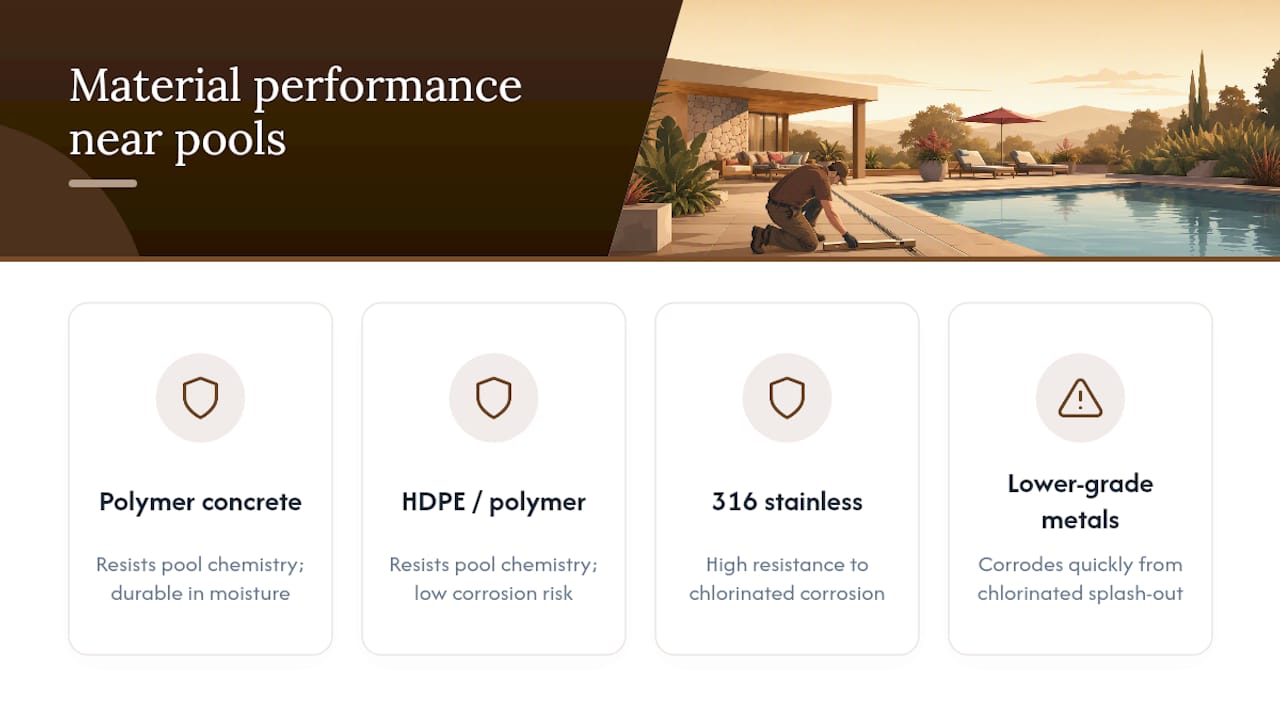
Chlorine, sunscreen, and constant moisture are hard on hardware. Polymer concrete, HDPE and polymer channel bodies, and 316 stainless steel are the materials that consistently hold up in that environment. Bare or lower-grade metals corrode fast once chlorinated splash-out gets into the joints, so skip anything that isn’t rated for pool chemistry.
Grates matter as much as the channel body. Look for narrow slot widths that won’t catch a heel or small toy, plus a slip-resistant surface texture. Public and commercial pools generally need to meet ADA accessibility standards for grate openings and surface flushness, so that’s a non-negotiable line item on any commercial project.
UV stability matters too, since these grates sit in direct Central Texas sun for years without a break. If you’re setting furniture, planters, or occasionally rolling a golf cart or maintenance equipment over a run, choose a load class rated for that traffic instead of the lightest-duty option on the shelf.
New Construction vs. Retrofit: Which Systems Fit Your Project?
If you’re pouring a new deck, you have options a retrofit can’t match. Systems like DECK-O-DRAIN install during the forming stage, before concrete goes in, and the profile actually doubles as a screed rail for finishing the slab. That means minimal trenching and a drain that’s structurally part of the deck from day one, not something bolted on afterward.
Retrofitting an existing deck means working around concrete that’s already cured. Your practical choices:
- Slot drains cut into existing concrete, which requires saw cutting and patching but keeps the surface nearly invisible.
- Surface-mounted channel drains, faster to install and less invasive, though they sit slightly proud of the deck surface.
- Modular micro-channel systems tied into new piping runs, a good middle ground for decks that need drainage added without a full tear-out.
Every retrofit option adds cost for cutting, patching, or resurfacing, plus the piping work to tie into a discharge point or a dry well. On outlet sizing, match the drain’s outlet to the manufacturer’s spec, typically a 1.5 to 4 inch PVC run, and upsize the pipe when you’re consolidating water from several drains into one line.
How Do You Plan a Pool Deck Drainage System?
Before picking a single product, walk the deck and build a runoff map: where roof leaders dump water, which direction the yard slopes uphill of the pool, where coping and doors sit, and where the equipment pad lives. That map reveals secondary low points that a quick glance at the deck would miss.
- Mark every water source: roof downspouts, uphill grade, sprinkler overspray, and splash-out zones around the pool edge.
- Verify actual elevations and set spot grades rather than guessing at slope by eye.
- Target a minimum slope of 1/8 inch per foot, which structural engineers cite as a baseline, and aim for 1/4 inch per foot where the budget allows, especially in heavy rain climates.
- Pick your primary collection points and a safe discharge destination, whether that’s a swale, a dry well, or an approved storm connection, plus a secondary overflow path for the rare downpour that exceeds capacity.
- Specify removable grates and cleanout access up front so maintenance doesn’t require tearing anything out later.
Pro Tip: Walk your deck during an actual rainstorm before you finalize any plan. Photos of where water actually pools beat any amount of guessing at grade lines on a dry afternoon.
If you’re still in the design phase for a new pool, this is the exact planning stage where drainage should get locked in alongside your pool design phases.
How Do You Maintain and Troubleshoot Pool Deck Drains?
A drainage system is only as good as its last cleaning. Blocked outlets and saturated soil around discharge points are the most common causes of drainage failure, and both are preventable with a short routine.
- Do a quick visual check weekly, especially after storms, for standing water or debris sitting on grates.
- Pull grates and clear channels monthly, more often during fall when leaves and yard debris pile up fast.
- Flush cleanouts and check flo-well outlets each season, watching for slow drainage that could signal root intrusion or sediment buildup.
- Treat sudden sedimentation, water routing toward the house, or ponding that shows up after every rain as signs the system needs a real look, not just a cleaning.
Repeated ponding in the same spot after cleaning usually means a grading problem, not a maintenance problem. That calls for a professional regrade or a drain repositioned to match how water actually moves, not how the original plan assumed it would.
Does Cold Weather Affect Pool Deck Drainage?
Freeze-thaw cycles are hard on any drainage system, and Central Texas gets just enough hard freezes each winter to matter. Water trapped in a channel drain, a crack, or standing on a poorly sloped deck expands as it freezes, and that expansion is what turns a hairline crack into a real one over a few winters.
The fix isn’t complicated: a deck that drains properly in summer generally handles winter freezes fine too, because water isn’t sitting long enough to freeze in place. Problems show up on decks that already pond, where a puddle that would evaporate in July instead sits through a January cold snap and works its way into every seam it touches.
Before the first freeze, clear grates and cleanouts of leaves and debris so water has somewhere to go instead of backing up against a cold slab. Check that discharge pipes aren’t holding standing water either, since a section of pipe that freezes solid can crack or block flow for the rest of the season. If your area sees hard freezes regularly, look at whether your dry well or discharge point sits below the frost line. Buried components below frost depth keep working through cold snaps that would otherwise freeze a shallow line solid.
Seasonal transitions are also a good trigger for a maintenance pass. Spring runoff after winter rain and snowmelt tends to be heavier than a typical summer storm, and a system that’s been neglected over winter often reveals itself the first time it’s actually tested hard.
What Building Codes Apply to Pool Deck Drainage?
Pool deck drainage isn’t purely a design preference. It’s governed by building codes that set minimum slope requirements and discharge rules, and those codes vary by jurisdiction. The Florida Building Code is a commonly cited example that sets a 1/8 inch per foot minimum slope for pool decks, a baseline many engineers point to even outside Florida because it reflects a widely accepted minimum for positive drainage.
Local codes typically address more than slope. Expect requirements around where discharge water is allowed to go (never directly onto a neighbor’s property, and rarely straight into a storm sewer without approval), setback distances for dry wells from structures and property lines, and permit requirements for tying into an existing storm drain system. Commercial and HOA pools often carry additional requirements tied to ADA accessibility for grates and walking surfaces, since public pool decks are held to a stricter standard than a private backyard.
Because these rules differ by city and county, the smartest move before cutting concrete or connecting to a storm line is a call to your local building department or a contractor who already knows the local permitting process. Retrofits that involve rerouting discharge or adding new piping connections are exactly the kind of work that can trigger a permit requirement even on an existing pool, so it’s worth confirming before the work starts rather than after an inspector flags it.
How Does Pool Deck Drainage Affect the Environment?
Where your pool deck water ends up matters beyond your own property line. Runoff carrying chlorine, sunscreen chemicals, and cleaning residue can affect soil and, in some cases, local waterways if it’s routed carelessly into a storm drain system that empties into a creek or lake.
Directing overflow toward a dry well or a properly designed swale lets water percolate back into the ground slowly, which is generally better for local water quality than sending it straight into a storm sewer. Dry wells also help recharge groundwater rather than sending every drop of rain and pool overflow off-site as wasted runoff.
Water conservation is part of this picture too. A pool deck that drains efficiently, rather than losing water to evaporation while it sits in puddles for days, keeps more of that water usefully absorbed into landscaping instead of stagnating on concrete. Choosing native or drought-tolerant landscaping near discharge points can also put that overflow to work rather than treating it as pure waste.
None of this requires exotic engineering. It’s mostly a matter of choosing a discharge destination deliberately instead of letting water find the path of least resistance, which is usually the path that causes problems for a neighbor, a storm drain, or your own foundation.
How Does Drainage Affect Pool Deck Safety?
A pool deck with poor drainage is a slip-and-fall risk hiding in plain sight, and it’s one of the more overlooked safety issues around residential and commercial pools. Standing water on textured concrete or pavers reduces the friction that keeps bare feet from sliding, and that risk climbs sharply near the coping where people are already moving carefully around a wet edge.
Proper slope moves water off the walking surface before it becomes a hazard, and the right grate style keeps the drain itself from becoming a tripping or pinching risk. Heel-safe slot widths on grates matter here, since a grate opening wide enough to catch a child’s toe or a flip-flop strap creates a new hazard while solving the drainage problem.
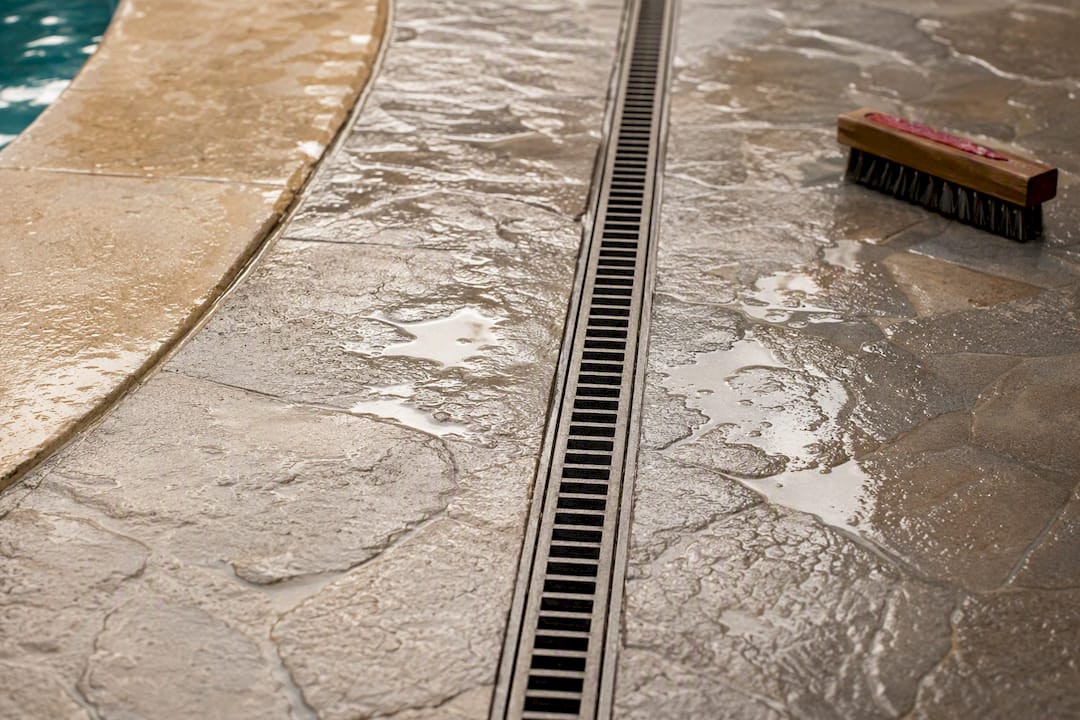
Slip resistance and drainage work together, not separately. A deck surface with excellent slip-rated texture still turns dangerous if water has nowhere to go and sits three inches deep after a storm. Conversely, a deck that drains fast but uses a slick, low-traction finish is still a fall waiting to happen. Getting both right, slope plus surface texture plus safe grates, is what actually keeps a pool deck safe in wet conditions, not any one fix in isolation.
A Builder’s Take: What Actually Prevents Drainage Headaches
Every drainage failure I’ve seen traces back to skipping the runoff map. Homeowners want to jump straight to picking a drain product, but that single planning exercise, walking the deck and marking where water actually goes, catches most retrofit mistakes before they get expensive.
Here’s what surprises people: a small slope correction often fixes a pooling problem more cheaply than ripping out concrete for a bigger channel system. Don’t assume you need the most aggressive drain on the market when the real issue is a deck that was never sloped correctly in the first place.
If you’re looking at a permanent fix, whether that’s a full resurfacing or a deck rebuild, expect the scope to include pipe routing and cleanout placement, not just a new drain dropped into the old grade.
— Mark
Get Integrated Pool Deck Drainage Done Right the First Time
Some pool builders design drainage into the deck from the start, rather than treating it as an afterthought added after the concrete pour. This approach means one contractor manages slope, drain placement, and discharge routing together, avoiding coordination issues between different contractors.

Whether you’re planning a new pool and want drainage engineered into the deck from day one, or you’re dealing with a chronically wet deck that needs a real fix during a resurfacing project, this is exactly the kind of work that benefits from a contractor who handles the whole scope. Complex regrades, discharge routing, and any permit-triggering connection work are best left to a team familiar with local soil conditions and permitting requirements. Start with a conversation about your residential pool construction project, or if you’re addressing drainage on an existing deck, ask about how pool renovation services can fold a drainage fix into your resurfacing plan.
Where to Find Manufacturer Specs and Installation Guides
- DECK-O-DRAIN product and installation details — W. R. Meadows
- NDS Micro Channel Drain product page
- NDS installation manual for Micro Channel systems (PDF)
FAQ
What Are the Best Drains for a Pool Deck?
The best choice depends on the deck: channel drains handle heavier perimeter runoff, slot drains give a near-invisible finish for premium decks, and modular systems like the NDS Micro Channel drain work well for lighter flows and retrofits. Most decks end up combining two types to handle both perimeter sheet flow and isolated low spots.
How Does a Pool Deck Drain Work?
A pool deck drain intercepts water at a low point or along a slope before it can pool, channels it through a grate into a pipe or trough, and routes it to a discharge point like a dry well or storm connection. The system only works if the surrounding concrete is sloped correctly, generally at least 1/8 inch per foot, so water actually reaches the drain instead of sitting beside it.
What Are Pool Deck Drains Called?
They go by several names depending on the style: channel drains, slot drains (sometimes called linear drains), point drains or area drains, and micro-channel or trench drain systems. All of them fall under the broader category of surface drainage systems designed for hardscape and pool deck applications.
What Is the Best Under-Deck Drainage System for Existing Decks?
For decks built over a raised structure like a deck surrounding an above-ground pool or a second-story patio, under-deck systems capture water before it drips through the structure below, similar in concept to products like Trex RainEscape used on residential decks. On existing at-grade concrete pool decks, retrofit options like slot drains or modular micro-channel systems tied into new piping tend to work better, since they don’t require the full structural cavity that under-deck systems rely on.
How Much Slope Should a Pool Deck Have for Drainage?
Most engineers recommend a minimum slope of 1/8 inch per foot away from the pool and any structures. Designers often push that to 1/4 inch per foot where the budget allows, particularly in areas that see heavy rainfall, since the steeper slope moves water off the surface faster and reduces ponding during intense storms.