
Travertine wins for most Central Texas backyards because it stays cool underfoot and offers real slip resistance. Porcelain is the best modern, low-maintenance option. Light-colored poured or precast concrete is the smart budget pick, while brick and premium natural stone suit traditional or high-end designs. The deciding factors always come down to the same five things: heat, slip resistance, saltwater exposure, budget, and whether your installer actually knows what they’re doing.
TL;DR:
- Proper installation is more critical than material choice, with key factors including slope, mortar, movement joints, and sealing affecting longevity.
- Locally sourced, light-colored materials like travertine or concrete are recommended for Texas climates for better heat management and lower environmental impact.
- Dense, non-porous materials such as porcelain and granite are ideal for saltwater pools due to their resistance to chemicals and salt corrosion.
- Experienced installers who can explain their methods and adhere to best practices significantly extend coping durability regardless of material costs.
Table of Contents
- What’s the Best Pool Coping Material for Most Homeowners?
- Pros, Cons, and Real-World Performance by Material
- How Do You Choose an Edge Profile?
- What Does Correct Coping Installation Actually Require?
- What Does Coping Actually Cost, and How Long Does It Last?
- What Should You Ask Any Pool Coping Installer?
- Does Coping Material Choice Affect the Environment?
- Does Coping Need to Match Your Pool Shell and Decking?
- What Coping Colors and Styles Are Popular Right Now?
- Does Coping Material Affect Pool Water Chemistry?
- Why Installer Quality Beats Material Choice Every Time
- Ready to Choose the Right Coping for Your Pool?
- Sources
What’s the Best Pool Coping Material for Most Homeowners?
If you want one answer and nothing else, go with travertine. It handles Texas summers better than almost anything else on the market, and it looks the part on both a plunge pool and a full resort-style backyard. But “best overall” isn’t the same as “best for you,” so here’s the quick breakdown before we get into the weeds.
- Best overall: Travertine. Naturally textured, cool underfoot, and forgiving on bare feet even in July.
- Best for modern, low-maintenance builds: Porcelain. Nearly zero water absorption and a crisp, uniform look that barely changes over the years.
- Best on a budget: Light-colored poured concrete. You control the color and finish, and it costs less than stone or porcelain per linear foot.
- Best for traditional style: Brick. Warm, classic, and a natural match for older Hill Country homes.
- Best for extreme durability: Granite or other dense natural stone. Built to take a beating from weather, chemicals, and decades of pool parties.
One thing that doesn’t change no matter which you pick: premium materials need a mortar-set specialist or an experienced tile contractor. A gorgeous slab of travertine installed by a crew that normally pours driveways is a problem waiting to surface, usually about two Texas summers later.
Pros, Cons, and Real-World Performance by Material
Every coping material trades off comfort, cost, and upkeep differently, and the differences matter more than most homeowners realize until they’re standing on hot stone in July.
Travertine is the heat champion of this list. On a 95 degree day, travertine can run 20 to 30 degrees cooler than concrete or darker stone, which is the single biggest reason it dominates warm-climate pool builds. Its naturally pitted surface also gives bare feet real grip, even when wet. The catch: it’s porous, so it needs periodic sealing (roughly every two to three years depending on sun exposure and pool chemistry), and it runs on the higher end of the cost spectrum. For saltwater pools, stick with dense, premium-grade travertine rather than a soft, budget-grade batch.
Porcelain has become the go-to for homeowners who want a clean, contemporary edge and want to stop thinking about maintenance. It offers near-zero water absorption and strong resistance to chemicals and staining, so salt, chlorine, and sunscreen residue don’t sink in and discolor it over time. The tradeoff is installation precision. Porcelain needs a polymer-modified thinset rather than a thick mortar bed, and any installer unfamiliar with the material can leave hollow spots or crack tiles during setting.
Poured and precast concrete remain the most flexible and affordable options. You can tint it, stamp it, or texture it to mimic stone at a fraction of the price. The catch is heat: dark gray or brown concrete coping can get uncomfortably hot, so if you go this route in a sunny climate, choose a lighter tint and a textured (not smooth-troweled) finish for grip.
Brick brings warmth and a traditional look that pairs naturally with older homes and formal landscaping. It handles moderate heat reasonably well, though the mortar joints require more upkeep than a monolithic material, and those joints are exactly where water intrusion tends to start if they’re not maintained.
Natural stone beyond travertine, like granite, bluestone, and limestone, sits at the premium end. Granite is exceptionally dense and durable, making it one of the better choices for saltwater systems alongside porcelain and premium travertine, since dense materials resist the crystallizing effects of salt far better than soft, porous stone does. Limestone and bluestone offer beautiful color variation but can be more vulnerable to freeze-thaw cycling in colder regions, which matters less here but is worth knowing if you’re comparing options from out-of-state suppliers.
Tile and pavers give you the widest range of colors and patterns, but slip rating is non-negotiable. A glossy tile that looks stunning in a showroom can turn a pool deck into a hazard the moment it’s wet. Grout or epoxy joints also need regular inspection, since failed grout is one of the more common, and more preventable, coping headaches.
How Do You Choose an Edge Profile?
Material gets most of the attention, but the edge profile you pick changes how the coping actually feels day to day.
- Bullnose: A rounded edge that’s gentle on hands, elbows, and swimmers holding onto the wall. It’s the most forgiving choice for families with kids.
- Square edge: A crisper, more modern look, especially popular on porcelain and precast concrete. Ask for slightly eased corners so it isn’t sharp underfoot.
- Rolled or safety edge: Similar comfort benefits to bullnose, with a subtle lip that helps swimmers get a better grip when climbing out.
- Cantilever: Creates a seamless, continuous look between coping and deck, typically done in poured concrete or certain stone applications. It’s a striking design choice but requires a skilled crew to execute the overhang correctly.
Profile and material work together more than people expect. A square edge in raw porcelain can feel stark underfoot; the same profile in travertine feels warmer and softer because of the material’s natural texture. If comfort is the priority, lean toward bullnose or rolled edges regardless of material.
What Does Correct Coping Installation Actually Require?
This is where most coping problems start, and it has almost nothing to do with which material you picked.
- Bond beam prep. The concrete bond beam needs to be properly cured and cleaned before coping goes down. Skipping this step is asking for cracking later.
- Consistent overhang. Industry standard calls for a 1½ to 2 inch overhang past the pool edge, applied evenly around the entire perimeter. Uneven overhangs are one of the most common visual giveaways of a rushed job.
- Slope away from the pool. Coping should slope roughly 1 to 2 percent, or about 1/8 inch per foot, away from the water. Without it, rainwater and splash-out pool back toward the shell instead of draining off.
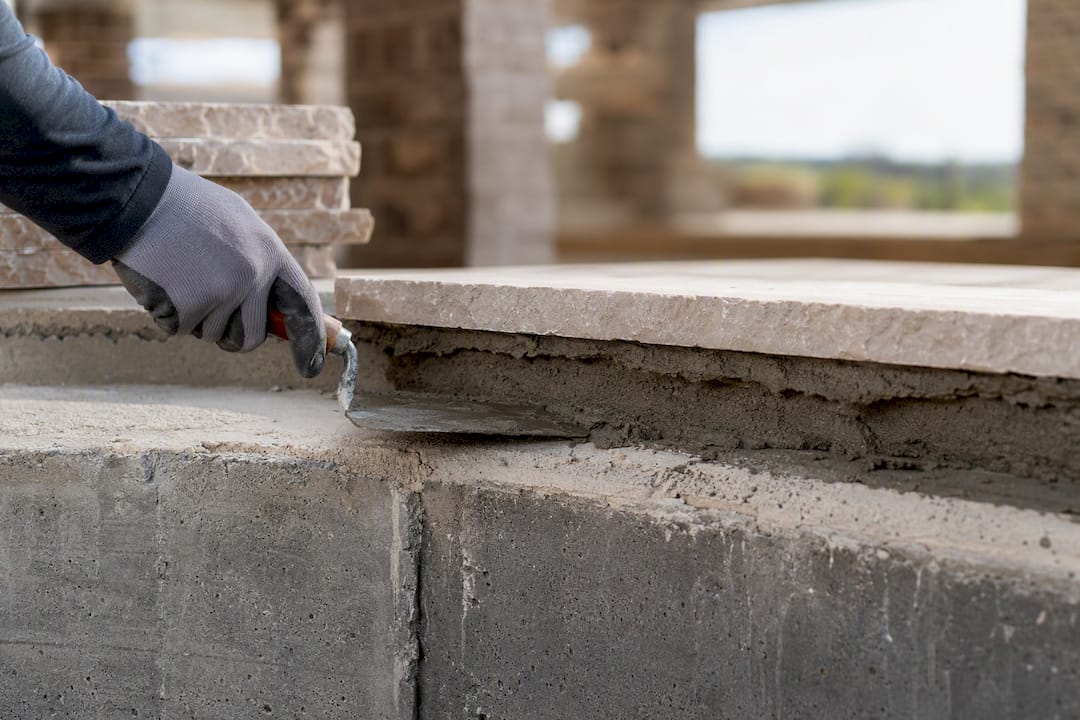
- Full mortar coverage. Stone materials need back-buttering and full coverage, not dabs of mortar at the corners. Porcelain needs polymer-modified thinset instead of a thick mortar bed because of its density and low absorption.
- Movement joints. Flexible joints, placed according to standards like TCNA EJ171, let coping expand and contract with temperature swings without cracking. Skipping movement joints is a common cause of coping failure, and it’s invisible until the damage shows up months later.
Hollow spots under cantilevered coping, inconsistent overhangs, missing expansion joints, and the wrong grout for the material are the four failures that show up again and again in coping repair calls. When you’re comparing bids, ask each contractor directly about mortar type, joint placement, slope confirmation, and whether workmanship is covered under warranty. A contractor who can’t answer clearly is telling you something.
Pro Tip: Ask to see a photo of the mortar bed before it’s covered. A good installer will have documentation of their own work; a corner-cutting one usually won’t.
What Does Coping Actually Cost, and How Long Does It Last?
Budgeting for coping means thinking in linear feet, not square feet, since that’s how the material wraps the pool’s perimeter.
- Poured concrete: Lowest cost per linear foot, generally the most budget-friendly option available.
- Precast concrete: A step up in cost with more consistent finish quality than poured.
- Brick: Mid-range cost, with mortar joint maintenance factored into long-term upkeep.
- Travertine: Mid to upper range, with resealing recommended every two to three years.
- Premium natural stone (granite, bluestone): Among the higher-cost options, offset by exceptional durability.
- Porcelain: Runs toward the top of the range, especially for custom colors or large-format tiles.
Overall, installed coping typically runs $20 to $70 per linear foot, depending on material, finish, and regional labor costs. For a typical residential pool with medium to large perimeter, coping costs can range from a few thousand to several thousand dollars, before decking, water features, or equipment upgrades enter the picture. Lifespan tracks closely with maintenance: sealed stone and well-grouted tile can last decades, while neglected joints or skipped resealing cut that timeline short regardless of how much the material cost going in.
What Should You Ask Any Pool Coping Installer?
Experienced local pool builders know that the material you pick matters less than who installs it. A beautiful slab of travertine, poorly set, fails faster than a modest concrete edge installed correctly. That’s the uncomfortable truth most coping guides skip.
Here’s the checklist we’d hand any homeowner heading into a quote conversation:
- Confirm the slope away from the pool, ideally in writing, before the crew starts.
- Ask what mortar or thinset they’re using, and whether it matches the material’s absorption rate.
- Require full back-butter coverage on stone, not spot-mortaring.
- Confirm movement joint placement and spacing before pouring or setting anything.
- Get the sealing plan in writing, including who’s responsible for the first reseal.
For our Central Texas climate, we lean toward light-colored travertine or a light-tinted concrete for anything that sits in direct sun most of the day. For saltwater systems, dense stone or porcelain earns its higher price tag by resisting the corrosion that eats through softer materials over time.
Pro Tip: If a contractor can’t tell you their mortar type off the top of their head, that’s not a small gap. It’s a sign they’re not thinking about your coping as a system.
Does Coping Material Choice Affect the Environment?
Coping materials differ quite a bit in their environmental footprint, and it’s worth factoring in if sustainability matters to your build.
Natural stone like travertine, granite, and limestone requires quarrying and long-distance shipping in many cases, which adds transportation emissions before it ever reaches your backyard. On the plus side, natural stone lasts for decades when sealed properly, so its environmental cost gets spread across a long service life rather than repeated replacement cycles.
Concrete has a notably heavy production footprint. Cement manufacturing is one of the more carbon-intensive processes in construction materials generally, though poured or precast concrete coping typically uses far less material than a full slab foundation, which softens the comparison somewhat.
Porcelain sits in an interesting middle ground. Manufacturing is energy-intensive, but the material’s durability and near-zero absorption mean it rarely needs replacement or resealing, which cuts down on the resource use tied to ongoing maintenance.
Brick, especially reclaimed or locally sourced brick, tends to have a smaller footprint than quarried stone shipped cross-country, and it’s one of the more recyclable coping materials if a pool ever gets demolished or renovated.
If sustainability is a priority, ask suppliers where the material is quarried or manufactured. Shorter shipping distances and locally sourced stone or brick generally beat imported material on total environmental impact, even when the raw material itself is similar.
Does Coping Need to Match Your Pool Shell and Decking?
Coping doesn’t exist in isolation. It has to bond structurally with your pool’s bond beam and visually with whatever decking surrounds it.
Structurally, coping sits directly on the bond beam, the reinforced concrete edge that caps the pool shell. That connection needs to flex with temperature changes without cracking, which is exactly why movement joints matter as much between coping and shell as they do between coping and deck.
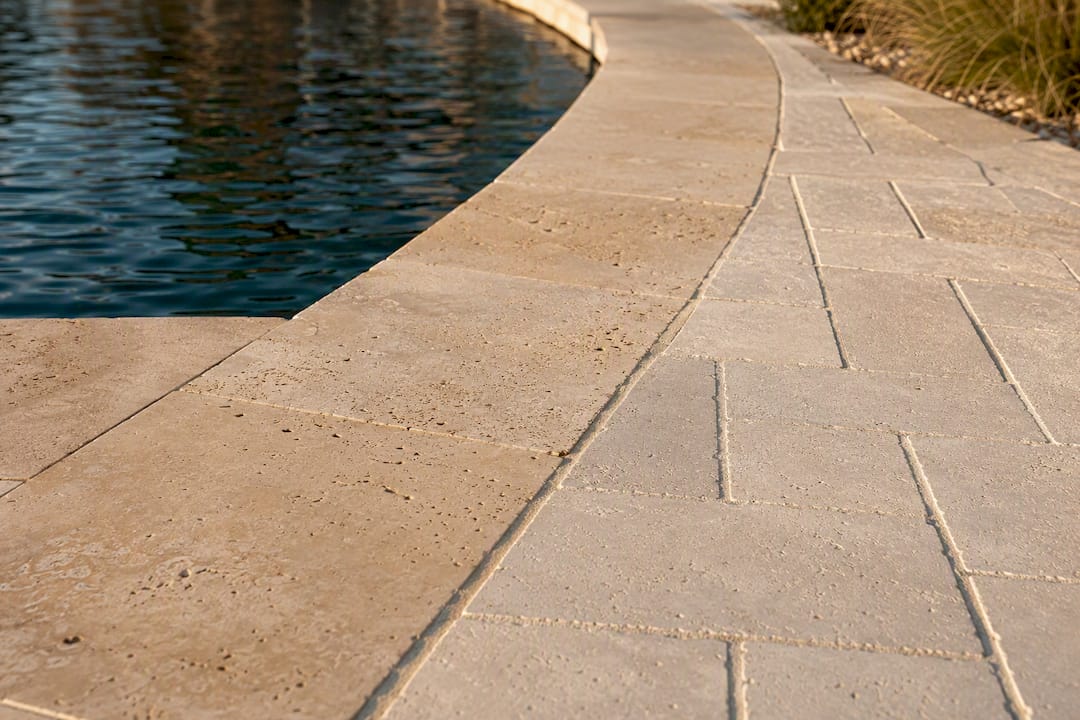
Visually, coping and decking should feel like they were chosen together, not stapled on separately. Travertine coping paired with a travertine or light-toned paver deck creates a seamless look and keeps surface temperatures consistent across the whole area, which matters more than people expect when you’re walking barefoot from the grass to the pool edge. Pairing a cool-toned material like travertine with a much darker deck creates uncomfortable hot-cold transitions right where bare feet notice it most.
Compatibility also comes down to expansion behavior. Concrete decking and concrete coping expand and contract at similar rates, which simplifies joint planning. Mixing very different materials, like a rigid porcelain coping edge against a flexible paver deck, requires more careful joint design to prevent cracking where the two meet. If you’re weighing deck material alongside coping, it’s worth reviewing how different deck materials handle heat and safety before locking in either choice, since the two decisions really should happen together, not sequentially.
What Coping Colors and Styles Are Popular Right Now?
Light and warm tones dominate current coping trends, and it’s not purely aesthetic. Homeowners have gotten smarter about heat, and lighter colors simply perform better underfoot.
Cream and ivory travertine remains the most requested look for Hill Country builds, largely because it splits the difference between staying cool and looking upscale. Gray-toned porcelain in large format tiles has also picked up momentum for homeowners chasing a minimalist, resort-style edge, particularly around modern architecture with clean lines throughout the backyard.
Textured, tumbled finishes are edging out polished ones in most new installations, driven almost entirely by slip resistance concerns rather than fashion. A honed or polished stone might photograph beautifully, but it’s a liability the moment somebody exits the pool with wet feet.
Darker coping hasn’t disappeared, but it’s increasingly reserved for shaded pools or evening-use designs where heat underfoot is less of a concern. For pools that sit in full sun most of the day, dark coping is one of the more common regret purchases homeowners mention after their first full summer with it.
Does Coping Material Affect Pool Water Chemistry?
Coping sits at the waterline, so it interacts with your pool chemistry more than most homeowners assume when they’re picking finishes.
Porous materials like unsealed limestone or budget-grade travertine can absorb pool chemicals and, over time, leach minerals back into the water or develop calcium deposits along the edge. That’s part of why sealing matters beyond aesthetics. It’s a chemical barrier, not just a shine enhancer.
Dense materials like porcelain and granite barely interact with pool chemistry at all, which is a big part of why they’re recommended for saltwater systems. Salt systems are particularly rough on porous stone, since salt crystals can work into small pores and degrade the material from the inside over repeated wet-dry cycles.
Cleaning routines shift by material too. Porcelain and dense stone typically need nothing more than routine rinsing and occasional scrubbing to prevent algae or scale buildup at the waterline. Porous stone requires more attention, including periodic acid washing (carefully, and only when appropriate for the specific stone) to remove calcium scale, plus more frequent resealing to keep the surface from absorbing chemical residue in the first place.
Why Installer Quality Beats Material Choice Every Time
Here’s the take that most coping guides won’t say directly: the material you choose matters less than most homeowners think, and the installer matters more.
Every material on this list, travertine, porcelain, concrete, brick, granite, can perform well or fail badly depending entirely on execution. A budget concrete coping installed with proper slope, full mortar coverage, and correctly placed movement joints will outlast a premium travertine edge set by a crew that skipped back-buttering to save time. That’s not a popular opinion in an industry that loves to sell materials as the answer, but it’s the honest one.
Where conventional advice falls short is treating coping selection like picking a paint color: pure aesthetics, pick what you like. It’s a structural component sitting on top of a bond beam, exposed to Texas heat swings and, for a lot of homeowners, saltwater chemistry. Skipping the installer conversation to focus entirely on material comparisons is backwards.
If you’re planning a build or renovation, prioritize in this order: find an installer who can explain their slope, mortar, and joint approach without hesitation, then pick the material that fits your climate and budget from that shortlist. Reverse that order at your own risk.
— Mark
Ready to Choose the Right Coping for Your Pool?
Picking a material off a list is one thing. Getting it installed correctly on Hill Country soil, with the right slope, joints, and mortar for your specific climate, is what really matters. Professional pool builders handle material selection, sourcing, and installation oversight for new pool builds and full renovations, ensuring every coping job comes with a clear plan for slope, movement joints, and sealing before installation begins.

A quote from Longhorn Pools typically starts with a site visit, where we walk your yard, talk through material samples in person, and map out an installation plan that accounts for your pool’s exposure and water chemistry. If you’re still comparing materials for a new build or renovation, our pool construction material options guide is a good next stop. When you’re ready to talk specifics for your own backyard, reach out to a qualified pool builder to get a site visit scheduled.
Sources
- Pool Coping Ideas: Materials, Edges & Costs for 2026 | PoolPad
- How to install pool coping — Unilock contractor installation guide (PDF)
- How to install travertine pool coping — Texas Travertine
- How to install pool coping | NT Pavers
- Best coping material for saltwater pools — Solid Shape blog