
Most in-ground pools take 8 to 16 weeks of active construction once permits clear, though the full process from signed contract to first swim usually runs 3 to 6 months. The biggest swing factors are pool type (gunite versus fiberglass versus vinyl), how fast your municipality and HOA approve permits, your site’s soil and access conditions, and the season you start. Begin design conversations and permit prep at least 4 to 6 months before you want to swim.
TL;DR:
- Permit and site conditions are the biggest delays, with approval times ranging from two to eight weeks and weather factors potentially extending the schedule.
- Gunite pools require 12 to 22 weeks from permit to swim due to curing, while fiberglass pools can be completed in as little as three to four weeks under ideal conditions.
- Early homeowner decisions on design, add-ons, and material choices can significantly reduce delays during permitting and construction phases.
- Limestone soil and groundwater in Central Texas demand geotechnical assessments beforehand and extra excavation days, affecting the overall timeline.
- Expect at least three to six months from signing a contract to swimming, with realistic project completion times often exceeding eight weeks once all variables are considered.
Table of Contents
- Pool Construction Timeline: Phase by Phase
- How Long Does Each Pool Type Take to Build?
- What Causes Pool Construction Delays?
- When Should You Start Planning for a Summer Pool?
- Your Pre-Construction Checklist to Avoid Delays
- What Central Texas Soil Does to Your Schedule
- A Builder’s Honest Note on Timelines and Trust
- Ready to Start Your Pool Project?
- Sources
Pool Construction Timeline: Phase by Phase
A pool build isn’t one long sprint. It’s a series of short work bursts separated by waiting periods you can’t rush, even if you want to.
Here’s how the phases typically break down once you’ve picked a builder:
- Design and contract. You’re finalizing shape, depth, finish, decking, and equipment during this stretch, which can take from a couple of weeks to over a month depending on decision speed. The faster you make decisions, the faster your builder can finalize engineered drawings and submit for permits.
- Permitting (2 to 8 weeks, sometimes longer). This is the least predictable phase. Some Central Texas municipalities turn around residential pool permits in two weeks; others, especially with HOA review layered on top, take six to eight. Submit complete, accurate drawings the first time. Incomplete packets get bounced back and restart the clock.
- Excavation and site prep. Crews dig the hole, haul off spoil, and rough-grade the site. Challenging terrain or restricted access can extend this phase beyond a few days.
- Steel, plumbing, and electrical rough-in (3 to 7 days). Rebar goes in first, followed by plumbing lines and electrical conduit for lights, pumps, and any automation.
- Shell application and curing (1 day to apply, 28 days to cure). Gunite or shotcrete gets sprayed in a single day. What follows is a mandatory structural curing period, commonly 28 days, that no contractor should shortcut.
- Tile, coping, and decking (1 to 3 weeks). This work often overlaps with the tail end of curing, since it doesn’t require water in the shell.
- Interior finish, fill, and startup (3 to 10 days). Plaster, pebble, or quartz finish goes on, the pool fills, and your builder balances water chemistry before handing you the keys.
- Final inspections and walkthrough. The last step includes local inspections that can take several days up to a couple of weeks before final approval.
Pool Construction by the Numbers: Industry data shows most standard in-ground pools run 8 to 12 weeks from excavation to startup, but realistic totals climb to 8 to 16 weeks once permitting and site conditions get factored in. Add design time on the front end, and 3 to 6 months from contract to swim is a fair planning window.
For a deeper look at the decisions that shape this schedule, our pool design phases guide walks through what happens before the shovels ever hit dirt.
How Long Does Each Pool Type Take to Build?
Shell material changes your timeline more than almost any other decision you’ll make. Here’s the honest breakdown.
- Gunite/concrete: The most customizable option, and the slowest. Expect roughly 12 to 22 weeks from permit to swim, driven largely by that fixed 28-day cure window plus rebar and plumbing rough-in.
- Fiberglass: The speed champion. Shells arrive premanufactured, and excavation and shell setting can wrap in a day or two, with total time after permit approval sometimes as short as 3 to 4 weeks in ideal conditions. The trade-off is fewer shape and size options.
- Vinyl liner: Typically requires a moderate amount of time after permit approval before completion. Delivery lead times for custom liners can also contribute to delays.
Curing Is Non-Negotiable: Gunite’s structural strength depends on that curing window. Rushing it, or pouring decking and backfilling too soon, risks cracking and can void your warranty.
If speed matters more to you than a fully custom shape, fiberglass wins. If you want a specific depth profile, tanning ledge, or attached spa built to exact dimensions, gunite is worth the extra weeks. Some builders focus primarily on gunite and shotcrete pools to offer custom geometry tailored to individual lots rather than standard shapes.
What Causes Pool Construction Delays?
Every delayed pool has a paper trail, and it usually traces back to one of five things.
- Permit and HOA holdups. Incomplete drawings, missing setback calculations, or an HOA architectural review board that meets monthly instead of weekly. Submit early and double check every required document before it leaves your builder’s office.
- Weather. Heavy rain halts excavation and can delay gunite application, since shotcrete needs a dry surface. Winter builds in Texas rarely stall for cold, but summer thunderstorms are a real factor.
- Inspection scheduling. A failed inspection can add one to two weeks depending on how backed up your local inspector’s calendar is. Getting rough-in work right the first time avoids this entirely.
- Material and equipment lead times. Pumps, heaters, and specialty tile have had intermittent supply delays since 2021. Order equipment the moment your design locks.
- Site surprises. Limestone shelves, unexpected groundwater, or a gate too narrow for excavation equipment can add days or weeks if discovered mid-dig instead of beforehand.
Pro Tip: Ask your builder for a written geotechnical or site assessment before signing. Catching a rock shelf on paper costs nothing. Catching it with an excavator costs time and money.
When Should You Start Planning for a Summer Pool?
If you want to swim by Memorial Day or July 4th, work backward from that date using contractor bookout windows and permit timing, not wishful thinking.
- 6 months out (fall): Start design conversations and site evaluation. Fall and early winter are the best months to sign a contract, since builders have more open slots and permit offices see lower volume.
- 5 months out: Finalize design and submit permits. This gives cushion for the 2 to 8 week municipal review window.
- 3 to 4 months out: Excavation and shell construction begin, including the 28-day cure.
- 2 to 4 weeks before your target date: Finish work, fill, startup, and final inspections.
A homeowner targeting July 4th who signs a contract in late December or January, rather than waiting until March, gives their build room to absorb a slow permit office or a rainy April without missing summer entirely.
Your Pre-Construction Checklist to Avoid Delays
Most schedule slippage traces back to decisions homeowners could have made earlier. Here’s what to lock down before your builder ever breaks ground.
Before signing your contract:
- Finalize pool shape, finish material, decking scope, and equipment package.
- Decide on add-ons now (spa, water feature, lighting) rather than mid-build.
During permitting and construction:
- Gather HOA architectural submission documents and municipal permit requirements as a packet, not piecemeal.
- Stay reachable for inspection scheduling. Missed inspection windows push everything behind them.
- Set a change-order policy with your builder upfront and keep a contingency buffer of both time and budget for the unexpected.
- Save every permit, inspection report, and warranty document at handover for future reference.
Pro Tip: Homeowners who respond to design and material questions within a day or two consistently move through the pre-construction phase faster than those who take weeks to decide. For a full walk-through of what to prepare, see our pool build planning checklist.
What Central Texas Soil Does to Your Schedule
Limestone shelves and high water tables aren’t rare here. They’re closer to the norm, and they change how excavation and scheduling actually play out on the ground.
A builder who hasn’t dug in Hill Country limestone will underbid the excavation phase every time. Rock doesn’t care about your printed schedule. What matters is catching it in a site survey before the contract is signed, not after the excavator hits it.
The fixes are procedural, not mysterious:
- Order a geotechnical assessment before finalizing the contract, not after.
- Build extra excavation days into the schedule for known rock or high water table zones.
- Sequence steel, plumbing, and electrical rough-in only after excavation is confirmed clean.
- Treat the 28-day cure as fixed. No shortcuts, regardless of how tight the calendar gets.
An experienced local builder coordinates permitting, engineering, and crew scheduling as one system rather than three separate handoffs, which is where a lot of timeline slippage quietly happens on less experienced jobs.
A Builder’s Honest Note on Timelines and Trust
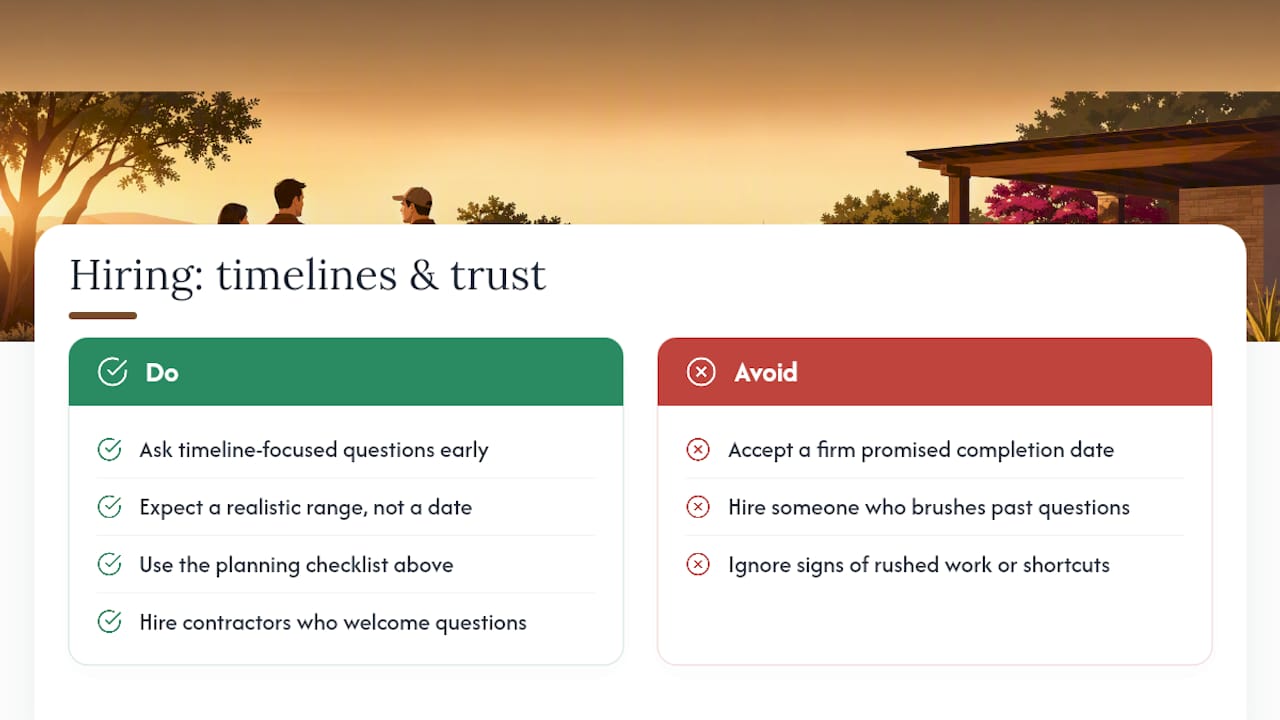
Every pool builder has faced the question: “Can you have it done by?” The honest answer is usually a range, not a date, and a builder who promises otherwise is often setting you up for either disappointment or shortcuts you won’t see until years later, when a rushed cure shows up as a crack.
Ask timeline-focused questions early. Use the checklist above. A contractor who welcomes those questions instead of brushing past them is one worth trusting with a project you’ll live with for decades.
— Mark
Ready to Start Your Pool Project?
Experienced builders handle custom gunite pool construction and renovation in Central Texas, including permit coordination, site evaluation, and scheduling built around realistic timelines instead of rushed ones. If you’re weighing size and layout options, our inground pool size guide is a solid starting point, and our excavation preparation guide covers what to expect once digging starts. Working with an existing pool instead? Our renovation process guide breaks down that timeline separately.
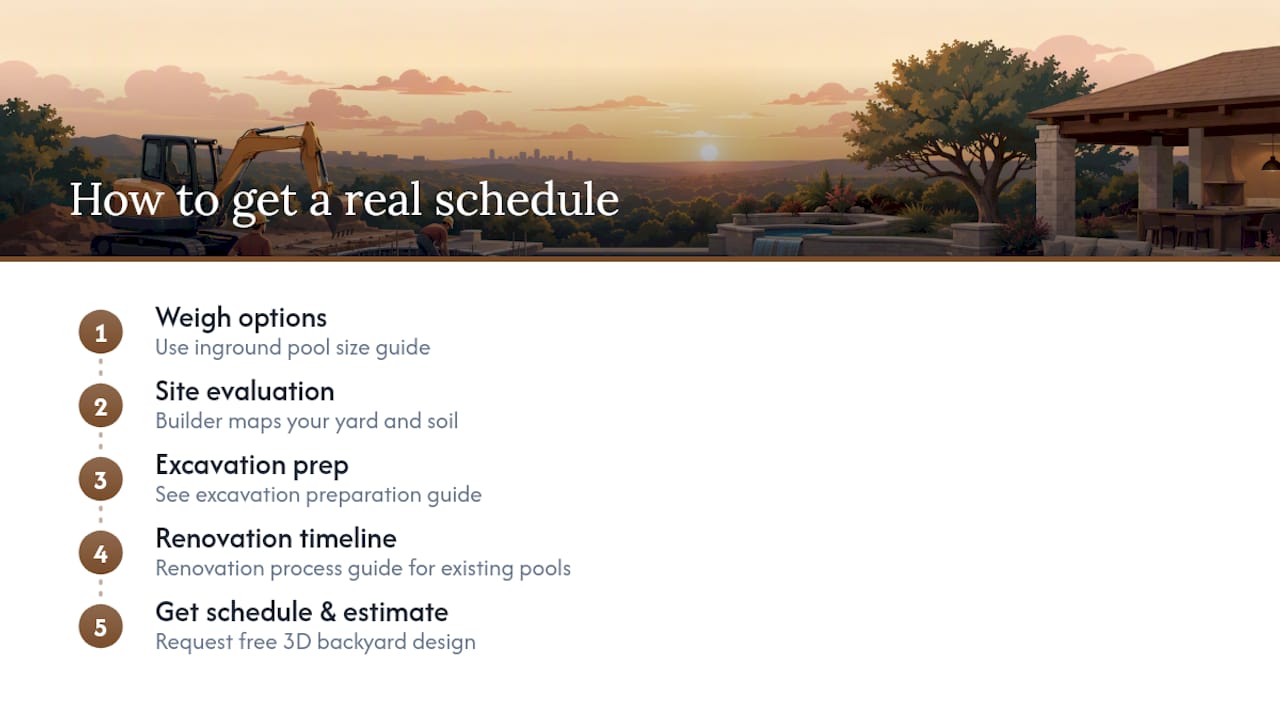
The best way to get a real schedule instead of a guess is to see your own yard mapped out. Request a free 3D backyard design from Longhorn Pools and get a concrete estimate for your specific site, soil, and season.
Sources
- Swimmingpool
- Pool Building Timeline: How Long Does It Take to Build a Pool? – Angi
- How Pool Construction Works: A Step-by-Step Process Guide – NIP Group
- How Long Does It Take to Build a Pool? (A Realistic Timeline) | Beltway Pools