
Use a layered approach: color-capable in-pool LEDs, warm low-voltage landscape fill, and focused accent lighting on your water features, installed to meet NEC zone rules and GFCI safety requirements. Layered lighting gives you both the safety a pool needs and the atmosphere you actually want at night. Skip any one layer and you either end up with a glaring floodlit patio or a pretty but unsafe pool edge.
TL;DR:
- Installing enough evenly spaced underwater LED fixtures at the appropriate depth ensures consistent illumination and reduces glare, improving nighttime safety.
- Building a lighting plan that prioritizes water and entry-point safety fixtures before adding decorative or color features prevents costly modifications later.
- All underwater fixtures must have a submersible IP68 rating, and any within 5 feet of the pool edge require wet-location IP65 or higher, with GFCI protection mandatory within 20 feet.
- DIY installation is suitable for solar floaters and plug-in path lights outside the 20-foot GFCI zone, while underwater or hardwired fixtures near the pool need a licensed electrician.
- A layered lighting approach with LED, accent, and landscape fixtures creates depth and atmosphere without compromising safety or code compliance.
Table of Contents
- What Are the Three Lighting Layers Around a Pool?
- How Many Pool Lights Do You Need and Where Do They Go?
- Which Fixtures, LEDs, and Controls Actually Hold Up?
- What Electrical Codes Apply to Pool Lighting?
- What Can You Install Yourself vs. Hire a Pro For?
- What Are the Best Lighting Scenes for a Backyard Pool?
- A Builder’s Notes on What Actually Works
- What Homeowners Get Wrong About Pool Lighting
- Ready to Design Your Pool’s Lighting the Right Way?
- Sources
- FAQ
What Are the Three Lighting Layers Around a Pool?
Think of your pool the way a photographer thinks about a portrait: one key light, a few accents, and a soft background fill. That’s the model worth following for landscape lighting around a pool, and it maps directly to three practical layers.
- Water/hero layer: submersible LED fixtures inside the pool shell. These do the heavy lifting for both visibility and color, and they’re the reason nighttime swims feel safe instead of spooky.
- Feature/accent layer: spot and flood fixtures aimed at waterfalls, fire bowls, statues, or a raised spa wall. This layer adds drama without adding much brightness to the water itself.
- Landscape/deck fill layer: path lights, well lights, and string lighting across the deck, plantings, and walkways. This layer keeps feet safe and ties the pool into the rest of the yard.
Safety leans hardest on the water layer and the deck fill around steps and entries. Mood leans on the accent layer. Miss the fill layer and you’ll have a glowing pool surrounded by a black void, which is disorienting for anyone walking the deck after dark.
How Many Pool Lights Do You Need and Where Do They Go?
Even illumination beats a few bright hot spots, and the numbers back that up. Design guidance from lighting manufacturers recommends more, lower-wattage fixtures spaced evenly rather than fewer high-output ones.
- Start with the water surface. Plan for an appropriate number of lights spaced evenly to ensure a consistent glow, following typical manufacturer guidance for spacing underwater fixtures along straight walls.
- Set your depth carefully. Fixtures are generally placed below the waterline at a depth that avoids glare and preserves light effectiveness. Too shallow and you get glare off the surface; too deep and the light loses punch.
- Light the transition zones first. Tanning shelves, steps, swim-up bars, and islands need dedicated fixtures, not spillover from a light 15 feet away, because these are exactly where people misjudge depth in the dark.
- Adjust for vanishing edges. These need grazing light along the edge itself so the drop-off is visible from the water and the yard below.
- Account for your interior finish. Dark plaster or pebble finishes swallow light and may need one extra fixture per zone. Bright white or glass-bead finishes bounce light around and can get by with less.
Which Fixtures, LEDs, and Controls Actually Hold Up?
LED is the default now for good reason. The Department of Energy points to LED’s efficiency and long service life over halogen, and in a pool environment, where swapping a bulb means draining water or diving for a fixture, longevity matters more than the electric bill.
Color-changing LED systems have become the standard homeowner request, mostly because they let one fixture do the job of three. A layered pool lighting plan built around color-capable LEDs gives you white light for evening swims and color for parties, without running separate circuits.
A few things separate a fixture that lasts from one you’ll be replacing in three years:
- Look for external drivers rather than sealed all-in-one units. When a driver fails, you swap the driver, not the whole fixture buried in your pool shell.
- Keep landscape and deck fixtures around 2,700 to 3,000K, a warm white that flatters skin tone, stone, and wood decking.
- Let the pool itself run cooler or color-shifting, since that contrast between warm deck and cool or colored water is what creates depth at night.
- Choose a system with app or panel-based scene control so dimming and color presets don’t require rewiring later.
Pro Tip: Before you commit to a fixture brand, ask your installer whether the driver is field-replaceable. That one question separates a system you’ll service for a weekend project from one that requires re-plumbing the whole light circuit.
What Electrical Codes Apply to Pool Lighting?
Pool lighting isn’t a lighting decision so much as an electrical one, and the rules aren’t optional. NEC and ISPSC zone requirements break the area around your pool into rated zones, each with its own fixture and protection requirements.
By the numbers: Any fixture submerged in the pool needs a submersible IP68 rating. Anything within 5 feet of the water’s edge needs a wet-location rating of IP65 or higher. GFCI protection is mandatory for any outlet or hardwired fixture within 20 feet of the pool, no exceptions.
Those aren’t suggestions from a lighting catalog. They’re code, and inspectors check them. If you’re running any wiring within 5 feet of the water, or touching anything that connects to pool-adjacent circuits, that’s a licensed electrician’s job and usually requires a permit. The mistake we see most often on renovation walkthroughs: a homeowner’s outdoor-rated (but not wet-location-rated) fixture installed a couple feet from the coping, working fine for a year, then corroding fast once splash and pool chemicals get into a housing it was never built to seal.
What Can You Install Yourself vs. Hire a Pro For?
Some of this is a Saturday project. Some of it is a call to a licensed electrician, full stop.
- DIY-friendly: Solar floaters, plug-in low-voltage path lights on transformers already outside the 20-foot GFCI zone, and swapping bulbs in existing fixtures that don’t require opening a sealed housing.
- Pro-required: Anything underwater, anything hardwired within 5 to 20 feet of the pool, and any new circuit run from your panel.
- Retrofit smart: If you’re adding fixtures to an existing system, size the transformer with about 20% headroom so you’re not maxed out the day you add one more accent light, and balance your runs so voltage doesn’t sag on the far end of a long wire.
Budget tiers vary widely by pool size and fixture count, but the pattern holds: basic setups cover a few underwater LEDs and path lighting; mid-range adds accent lighting on water features and full deck coverage; premium tiers bring in color-changing systems, app-based scene control, and lighting integrated into a full outdoor living renovation.
Pro Tip: Floating solar lights are a fine way to test a color scheme before committing to hardwired fixtures, but they’re noticeably dimmer and less reliable on overcast days than a permanent LED system. Treat them as a trial run, not a final answer.
What Are the Best Lighting Scenes for a Backyard Pool?
Good pool lighting design isn’t about maximum brightness. It’s about hiding the source and showing the effect. Uplighting a palm or oak from below, grazing a stone wall to bring out its texture, and moonlighting (mounting a fixture high in a tree to cast dappled light down) all create depth without a single visible bulb.
- Relaxed evening swim: warm white deck lighting at 2,700K, pool LEDs on a soft white or pale blue, water feature lights on low.
- Party mode: color-changing pool LEDs cycling slowly, accent lights bright on any water features, deck lighting still warm so food and faces don’t look off-color.
- Family safety mode: every step, ledge, and entry point lit, pool lights on full white, deck fill bright enough that no one misjudges a step down.
Landscape lights near the pool should stay warm even when the water goes cool or color, because that warm-cool contrast is what makes the whole scene read as intentional rather than mismatched.
A Builder’s Notes on What Actually Works
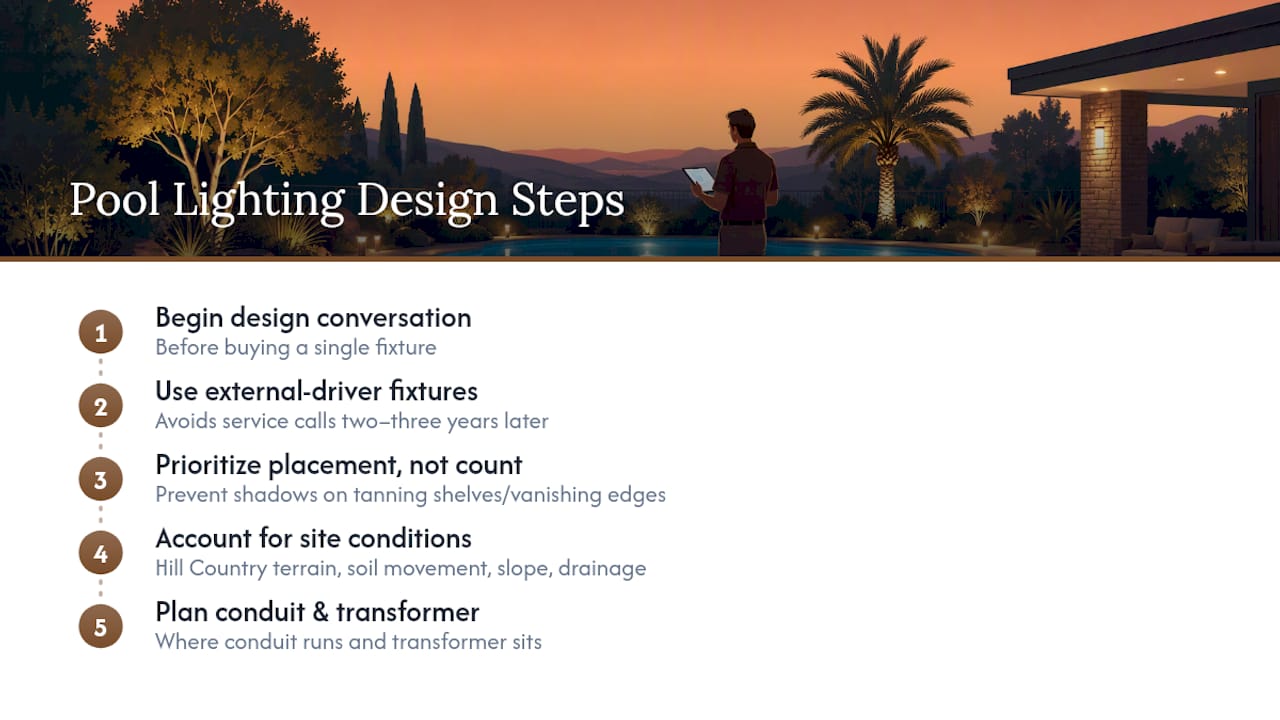
Custom inground pools often incorporate lighting as part of the initial design conversation rather than treating it as an afterthought. The lessons repeat across installs: fixtures with external drivers save homeowners a service call two or three years down the line, and placement matters more than fixture count, especially on pools with tanning shelves or vanishing edges where a single misplaced light creates a shadow exactly where you need visibility most. Site conditions in Hill Country terrain, soil movement, slope, and drainage, also affect where conduit can run and how a transformer gets positioned. If you’re planning new construction or a lighting retrofit, that’s worth a design conversation before you buy a single fixture.
What Homeowners Get Wrong About Pool Lighting
Most guides treat pool lighting like a shopping list: pick LED, pick a color temperature, done. That undersells how much placement and code compliance drive the actual result. A gorgeous color-changing fixture installed too close to the coping without the right IP rating isn’t a design win, it’s a liability waiting for a wet season.
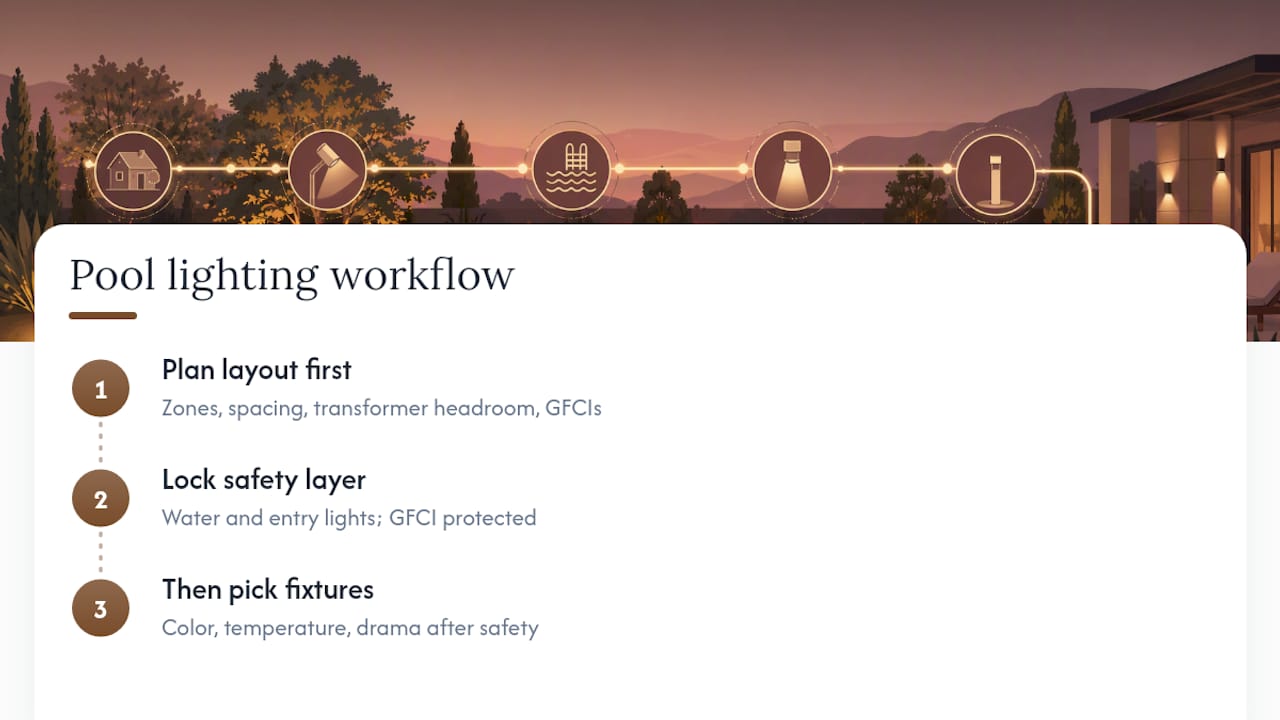
The bigger blind spot is sequencing. Homeowners often shop for fixtures before they’ve mapped zones, spacing, and transformer capacity, then discover mid-install that their dream scene needs three more circuits than planned. Design the layout first, including where GFCI protection has to sit and how much transformer headroom you’ll want for future additions, and the fixture selection gets a lot easier.
If there’s one priority to fix first, it’s this: treat the water and entry-point lighting as the non-negotiable safety layer, then treat everything else, color, warmth, drama, as the part you get to have fun with. Homeowners who reverse that order end up with pools that look stunning in photos and feel unsafe to actually swim in after dark.
— Mark
Ready to Design Your Pool’s Lighting the Right Way?
A DIY solar floater or a big-box path light kit can get you started, but neither solves the harder problem: mapping zones, sizing a transformer with real headroom, and running wiring that passes inspection the first time. Longhorn Pools handles custom pool design from the ground up, which means your lighting plan gets built alongside your pool shell, decking, and water features instead of bolted on afterward.

That matters most on renovation projects, where an existing electrical layout might not support the scene you’re picturing. Our pool renovation services cover lighting upgrades, surface refinishing, and equipment updates together, so your new LED system doesn’t end up fighting an outdated panel or a transformer that’s already maxed out. If you’re building new, our residential pool construction process folds lighting into the design phase from day one. Reach out for a design consultation, and we’ll walk your site, talk through zones and scenes, and give you a plan built for Central Texas conditions instead of a generic catalog spec.
Sources
For code details, see the National Pool Safety Authority and ESFI’s pool and spa safety guidance. For efficiency standards, check the Department of Energy’s LED lighting page.
FAQ
What Is the Best Lighting for Around a Pool?
A layered mix of underwater LED fixtures, accent lighting on water features, and warm 2,700 to 3,000K landscape lighting works best. LED wins on both energy use and lifespan compared with halogen, according to the Department of Energy, and color-capable systems let you shift from bright white for swimming to colored light for evening gatherings.
What Is the Code for Lighting in a Swimming Pool?
NEC and ISPSC zone rules require submersible IP68-rated fixtures for anything underwater, and wet-location IP65 or higher for fixtures within 5 feet of the pool edge. GFCI protection is required for any outlet or hardwired fixture within 20 feet of the water, as outlined by the National Pool Safety Authority.
Can You Put LED Lights Around a Pool?
Yes, and it’s the recommended choice. LED fixtures rated for wet or submersible locations handle deck lighting, path lights, and underwater fixtures, and they last far longer than halogen alternatives. Just match the fixture’s IP rating to its distance from the water, since a light rated for a dry patio won’t hold up 3 feet from the coping.
Do I Need an Electrician for Pool Lighting?
Any wiring within 5 to 20 feet of the pool, and anything underwater, requires a licensed electrician and typically a permit. DIY is fine for solar floaters or plug-in path lights placed well outside that zone, but hardwired work close to the water is not a weekend project.
How Much Does Pool Lighting Cost to Install or Upgrade?
Costs vary by pool size, fixture count, and whether it’s new construction or a retrofit. Longhorn Pools doesn’t publish flat pricing since every project scope differs; current pricing and design consultations are available through the renovations page.