
Swap a single-speed pump for a variable-speed pump, add a heat pump or solar heater where your climate is appropriate, switch to LED lighting, and start using a cover consistently. Those four moves, backed by smart scheduling, typically cut whole-pool energy costs by 40 to 80%, with the pump upgrade alone paying for itself in one to three seasons. Everything below explains why, in order of impact.
TL;DR:
- Replacing a single-speed pump with a variable-speed model can reduce energy use by up to 90%, with a typical payback of one to three years.
- Heat pumps are most effective in mild climates and lose efficiency at temperatures below 50°F, making gas or hybrid heaters better options in colder regions.
- LED pool lights and automatic covers offer quick, low-cost savings, often recouping costs within months and significantly cutting evaporation losses.
- Upgrading filtration equipment and adding robotic cleaners help reduce pump workload and energy costs by preventing backpressure from dirty filters.
- Conducting a professional assessment and sequencing system upgrades ensures equipment compatibility and maximizes energy savings during renovations.
Table of Contents
- Which Energy Efficient Pool Upgrades Pay Off Fastest?
- Variable-Speed Pool Pumps: Where the Real Savings Live
- Heat Pumps, Solar, and Hybrid Heaters Compared
- LED Pool Lighting: The Easiest Upgrade on This List
- Pool Covers: The Cheapest Way to Stop Losing Heat and Water
- Filtration and Robotic Cleaners That Ease the Pump’s Workload
- Automation That Shifts Your Pool to Off-Peak Hours
- How To Prioritize Your Upgrade List
- Costs, Savings, and Finding Rebates
- Installation and Maintenance: Protecting the Savings You Paid For
- Insulation Options for Pools to Retain Heat Efficiently
- Energy-Efficient Pool Design: Shape, Size, and Depth
- Smart Sensors and Monitoring for Real-Time Energy Optimization
- Water-Efficient Features That Also Cut Energy Use
- Longhorn Pools Perspective: How We Approach Energy-Efficient Renovations
- Ready to Upgrade Your Pool the Right Way?
- Sources
Which Energy Efficient Pool Upgrades Pay Off Fastest?
If you only fix one thing this year, fix your pump. It’s the single biggest energy hog in most backyards, and it’s also the fastest payback. Here’s how the rest stack up when you’re deciding where to spend first.
- Variable-speed pump: Cuts pump energy use dramatically and often pays back within one to three seasons, especially with a rebate.
- Heat pump or solar heater: Slashes heating costs in mild to moderate climates, though payback stretches longer in cold-winter regions.
- LED lighting: Cheap, quick to install, and pays for itself in months, not years.
- Pool cover: Low upfront cost with an outsized effect on both heat retention and water loss.
- Automation and scheduling: Amplifies savings from everything above by trimming run time and shifting load to off-peak hours.
Your climate changes the math. A heat pump in South Texas earns its keep fast; the same unit in a colder region needs backup heat and a longer view on payback.
Variable-Speed Pool Pumps: Where the Real Savings Live
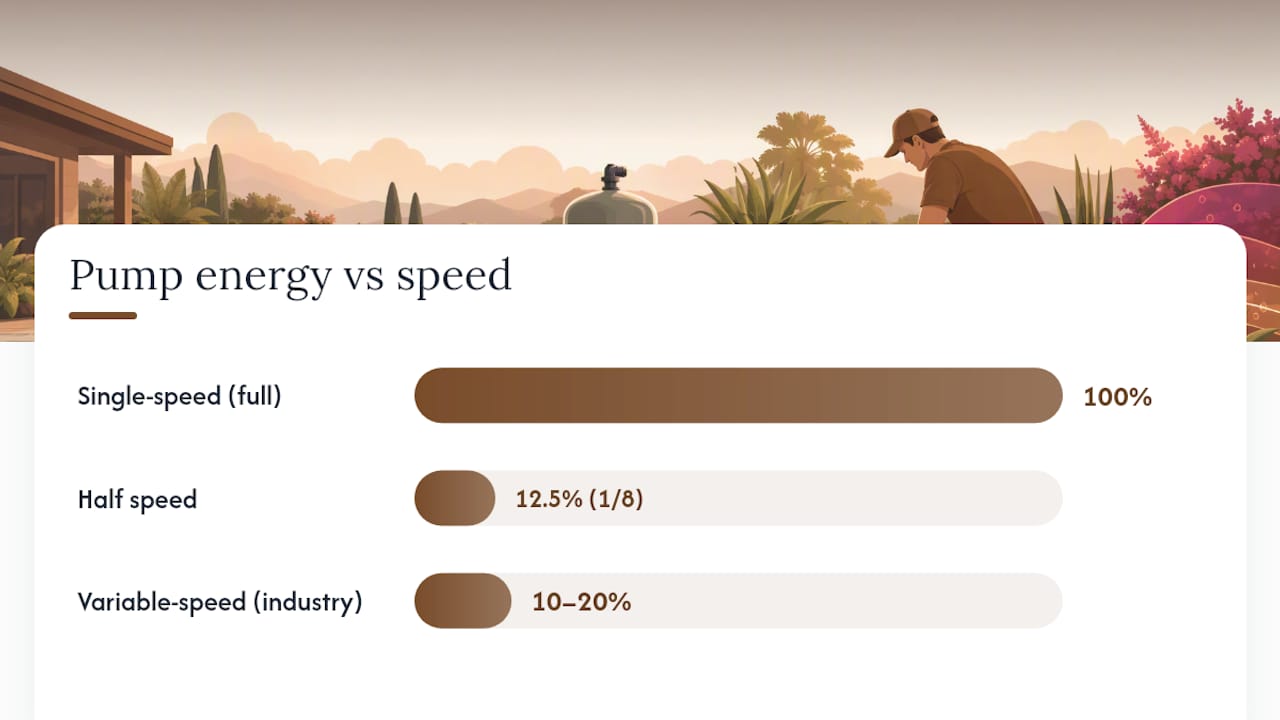
A single-speed pump runs at full throttle around the clock, whether your pool needs that flow or not. A variable-speed pump slows down for routine filtration and only ramps up for tasks like vacuuming or heating. That matters because of a physics rule called the pump affinity law: energy use drops with the cube of the speed reduction. Cut the speed in half, and you’re using roughly one-eighth the energy, not half.
By the Numbers: Industry data shows variable-speed pumps can reduce pump energy consumption by up to 80 to 90% compared with single-speed models, and combined efficiency upgrades can cut total pool energy costs substantially.
The efficiency label to look for is WEF, or Weighted Energy Factor, which measures how much water a pump moves per unit of energy across a range of speeds. A higher-horsepower variable-speed pump can still be more efficient overall than a smaller single-speed unit, because it spends most of its life running slow.
Pro Tip: Before you buy, check that your plumbing, filter, and automation controller are all compatible with a variable-speed motor. Energy also covers correct sizing, which matters more than raw horsepower.
Heat Pumps, Solar, and Hybrid Heaters Compared
Not every heater fits every backyard. The right pick depends on how much sun you get and how cold your nights run.
- Heat pumps pull warmth from the surrounding air and multiply it, rather than generating heat directly. That efficiency is measured as COP, or coefficient of performance, and a well-matched unit often delivers several units of heat for every unit of electricity it draws.
- Gas heaters measure efficiency differently, through thermal efficiency ratings, and they heat fast regardless of outside temperature.
- Solar heaters run on sunlight and cost almost nothing to operate once installed, but they need roof or ground space and predictable sun exposure.
By the Numbers: Heat pump efficiency drops noticeably at low ambient temperatures; in climates with regular nights below about 50°F, a hybrid or high-efficiency gas unit often delivers better year-round value.
Hybrid units, like Pentair’s UltraTemp, switch between heat pump and gas modes automatically, giving you fast heat-up when it’s cold and efficient operation the rest of the time. Pairing any of these with an automation controller lets you schedule heating around off-peak electricity rates.
LED Pool Lighting: The Easiest Upgrade on This List
If you’re intimidated by pump math and heater comparisons, start here. LED retrofit kits are inexpensive, install in an afternoon in most cases, and don’t require rethinking your whole equipment pad.
- LEDs use a fraction of the electricity that incandescent pool lights draw, and they last many times longer.
- Retrofitting is usually a drop-in swap into the existing niche, though a licensed electrician should confirm your wiring meets UL safety standards for wet-niche fixtures.
- Payback tends to land in months rather than years, and most LED kits add color-changing effects at no extra energy cost.
Pool Covers: The Cheapest Way to Stop Losing Heat and Water
Evaporation is the quiet budget killer. An uncovered pool loses heat, chemically treated water, and warmth simultaneously, all night long.
- Solar blankets float on the surface and trap heat during the day, at the lowest price point of the three cover types.
- Automatic covers retract on a track with the push of a button, combining convenience with strong heat and evaporation control.
- Safety covers are built primarily for child and pet safety but still cut evaporation meaningfully when closed.
A cover can reduce evaporation losses dramatically since it blocks the surface contact that drives water loss. The trade-off is convenience. A manual solar blanket is cheap but a chore; an automatic cover costs more upfront but gets used every single night, which is where the real savings show up.
Filtration and Robotic Cleaners That Ease the Pump’s Workload
Your filter and cleaner affect your pump’s energy use more than most homeowners realize. A clogged filter or an undersized filter cartridge forces the pump to work against more back-pressure, which burns extra electricity even on a variable-speed system.
- Match filter size to your pool’s flow rate. Undersized filters restrict flow and force the pump to compensate.
- Robotic cleaners run on their own low-wattage motor and don’t touch your main pump’s cycle at all.
- Pressure-side and suction-side cleaners, by contrast, rely on your main pump running, which adds to its load and its energy bill.
- Watch your filter’s pressure gauge. A reading several pounds above baseline means it’s time to clean or replace the media.
Pro Tip: A robotic cleaner costs more upfront than a suction-side model, but it runs independently of your main pump, which means it doesn’t add a single watt to your filtration system’s workload.
Automation That Shifts Your Pool to Off-Peak Hours
Automation doesn’t generate savings on its own. It multiplies the savings from every other upgrade by controlling exactly when and how hard your equipment runs.
- Schedule your variable-speed pump for long, low-speed daytime runs instead of short bursts at high speed.
- Set your heater on a setback schedule so it’s not maintaining temperature when nobody’s swimming.
- Use weather-based automation to skip heating cycles ahead of a hot forecast.
- Confirm your controller talks to your specific pump, heater, and lighting brands before you buy; not every system integrates cleanly, and smart home platforms are increasingly built to bridge that gap.
How To Prioritize Your Upgrade List
Not every homeowner needs to do everything at once. Here’s the order that gets you the most savings per dollar spent, based on typical impact and payback speed.
- Replace a single-speed pump first. It’s the highest energy draw in most systems and the fastest payback of any upgrade here.
- Add LED lighting and a cover next. Both are low-cost, fast, and easy to schedule around other renovation work.
- Upgrade filtration and add a robotic cleaner. This protects the gains you just made on the pump.
- Tackle heating last, unless your current heater is failing, since it’s usually the priciest single-line item.
Before you call anyone, gather your pool’s volume, the age of your current equipment, your local climate pattern, and your electric or gas rate structure. That’s the information a contractor needs to size equipment correctly.
Pro Tip: When you call a pro for a quote, ask them to check your existing plumbing diameter and your electrical panel capacity before recommending a pump size. Skipping that step is how homeowners end up with equipment that’s undersized for their actual pool.
Costs, Savings, and Finding Rebates
Rough installed costs vary by region and pool size, but the pattern holds across most markets: pumps and LEDs pay back fast, heating and covers pay back over a longer horizon.
- Variable-speed pumps often qualify for utility rebates that shorten payback further.
- Heat pumps cost more upfront than gas heaters but cost less to run monthly in mild climates.
- Covers and LEDs carry the lowest upfront cost of any item on this list relative to their savings.
By the Numbers: Utility rebate programs and ENERGY STAR qualification often make variable-speed pumps and heat pumps net-cost-effective within one to three seasons once the rebate is factored in.
Check the ENERGY STAR pool pump finder for certified models, search your utility’s own rebate page, and use Energy.gov’s savings search tool to find local incentives before you commit to a purchase.
Installation and Maintenance: Protecting the Savings You Paid For
An efficient pump installed wrong performs like an inefficient one. Sizing, plumbing diameter, and electrical permitting all affect real-world performance, which is why professional commissioning matters, especially where you place the equipment on the pad.
- Have a licensed installer verify voltage, breaker size, and plumbing compatibility before startup.
- Clean or backwash filters on a regular schedule; a dirty filter forces every downstream component to work harder.
- Service heat pumps and gas heaters annually, particularly before peak season.
- Replace worn cover straps and check automatic cover tracks for debris that stops full closure.
The most common mistake is buying the right equipment and then running it on the old schedule. A variable-speed pump set to run at high speed all day saves almost nothing.
Insulation Options for Pools to Retain Heat Efficiently
Insulation gets overlooked because it’s invisible once the concrete goes down, but it directly affects how hard your heater has to work. Heat escapes through the pool shell into surrounding soil, not just through the surface.
Insulated pool walls and floors use rigid foam board or insulating concrete forms installed before shotcrete or gunite application. This step happens during construction or a full renovation, not as a retrofit on a finished pool, which is why it’s worth raising before your Hill Country soil is disturbed for other work.
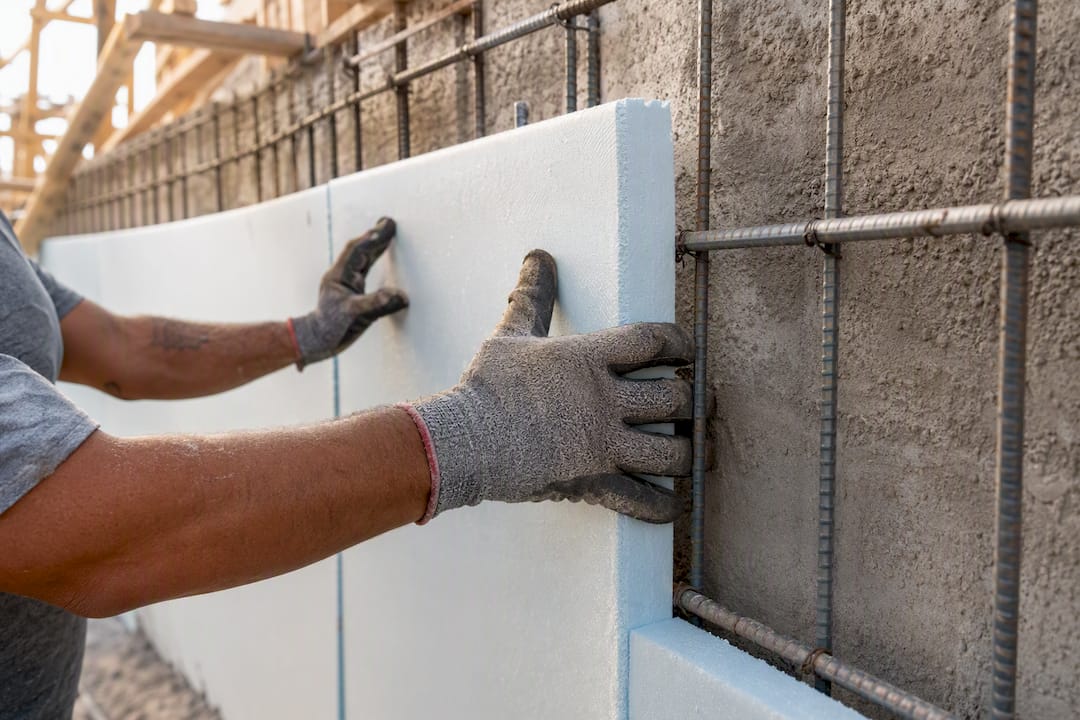
Perimeter insulation targets the area where the pool deck meets the shell, a common heat-loss point that’s easy to miss. Foam insulation boards placed along this edge during construction reduce the thermal bridge between the warm water and the cooler surrounding ground.
Plumbing insulation wraps exposed pipe runs between the equipment pad and the pool, cutting heat loss as water travels back and forth during heating cycles. This is one of the few insulation upgrades that can be added after the fact, since the pipe runs sit above ground near the equipment pad.
Deck material choice plays a role too. Dense materials like travertine hold and release heat differently than concrete, which affects how much ambient warmth radiates back toward the water’s surface overnight.
For homeowners planning a renovation, insulation is one of those upgrades that makes far more sense to address while the shell is already exposed than to attempt later. It’s a permanent efficiency gain that a cover or heater setting can’t replicate.
Energy-Efficient Pool Design: Shape, Size, and Depth
Design decisions made before construction affect your energy bill for the life of the pool. A pool’s shape, size, and depth all change how much surface area is exposed to evaporation and how much water there is to heat.
Surface area drives heat loss. A long, narrow pool with a lot of perimeter loses more heat per gallon than a compact pool with the same volume, because evaporation happens at the surface. Freeform shapes with lots of edges and coves look striking but carry a higher surface-to-volume ratio than a simple rectangle.
Depth matters more than most homeowners expect. Deep pools hold more water, which means more thermal mass to heat and more volume for your pump and filter to circulate. A pool built with a moderate, consistent depth rather than one deep end costs less to condition and less to run day to day.
Size should match actual use, not aspiration. A pool sized for lap swimming and light entertaining, rather than one built to accommodate rare large gatherings, needs less energy to heat and circulate year-round. This is worth discussing early if you’re weighing size options during a new build or a major remodel.
Sun exposure and placement influence natural heat gain. A pool positioned to catch afternoon sun retains warmth longer into the evening, reducing the load on mechanical heating. Shade from mature trees keeps a pool cooler in summer but adds heating cost in shoulder seasons, so placement decisions involve real trade-offs depending on your priorities.
Smart Sensors and Monitoring for Real-Time Energy Optimization
A pool automation system without sensors is just a timer. Sensors give the system information to react to, which is where actual energy optimization happens.
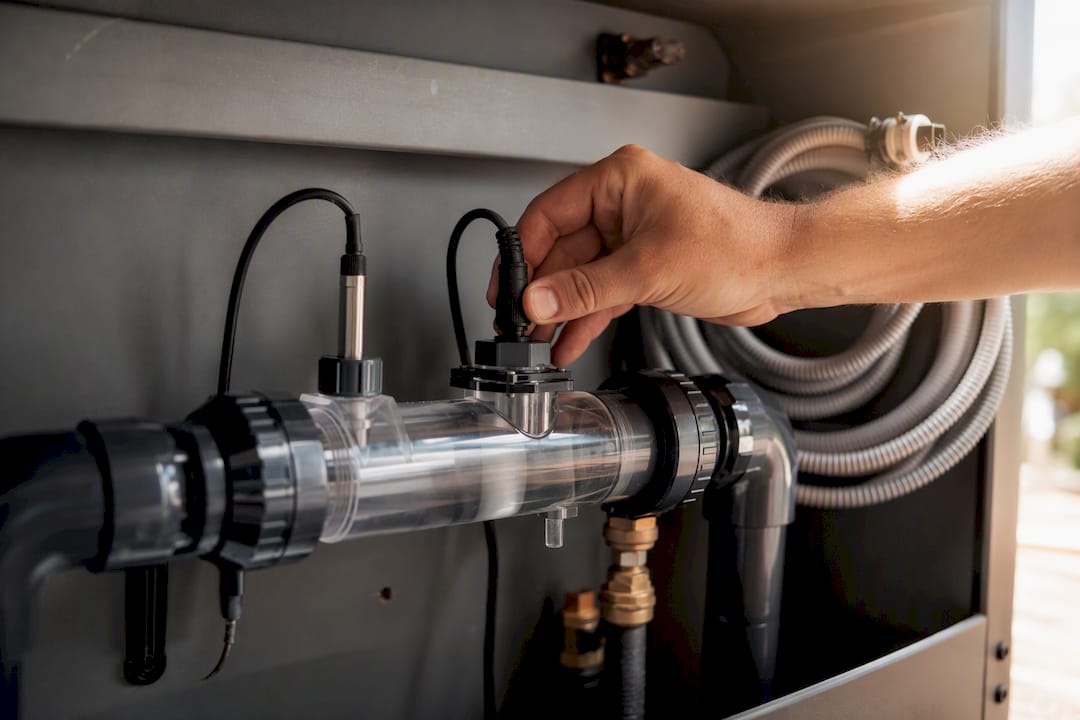
Water temperature sensors let your heater or heat pump respond to real conditions instead of running on a fixed schedule regardless of whether the pool has already reached temperature.
Flow sensors detect when circulation is restricted, often the first sign of a clogging filter, and can alert you before the pump starts working harder to push water through a partial blockage.
Weather-integrated controllers pull local forecast data and adjust heating and pump schedules ahead of temperature swings, skipping a heating cycle before a hot afternoon or extending pump runtime before a cold front stirs up debris.
Chemical and water-quality sensors reduce unnecessary pump cycling triggered by manual chemistry checks, since the system can confirm water balance without running extra filtration passes just to be safe.
Monitoring platforms that track energy use over time also matter, because they show you which piece of equipment is actually driving your bill. Without that visibility, most homeowners guess, and the guess is usually wrong; it’s rarely the pump that surprises people, it’s an aging heater running longer than anyone realized. A smart automation system installed during a renovation can fold all of this into one dashboard instead of juggling separate apps for the pump, heater, and lights.
Water-Efficient Features That Also Cut Energy Use
Water conservation and energy savings overlap more than most people assume. Every gallon lost to evaporation or leaks is a gallon your system reheats and re-filters once it’s replaced.
Covers, already covered above, do double duty here. Reducing evaporation means less makeup water, and less makeup water means less energy spent bringing new water up to temperature.
Variable-speed pumps also reduce water waste indirectly. Gentler flow rates put less stress on plumbing joints and reduce the wear that leads to slow leaks over time.
Leak detection systems catch water loss before it becomes a visible problem. A slow leak wastes water and forces your heater to work overtime warming replacement water that shouldn’t have needed replacing.
Efficient backwash filters, including cartridge and regenerative media systems, use less water per cleaning cycle than older sand filters that backwash heavily. Less backwash water means less water to reheat afterward.
Rain and overflow management, such as a properly graded deck and a functioning overflow line, keeps stormwater from diluting your pool chemistry, which otherwise triggers extra chemical dosing and filtration cycles to rebalance the water.
Taken together, these features reduce water use, which drives down the water heating your equipment has to do year-round, especially on pools that run a heater on a regular schedule.
Longhorn Pools Perspective: How We Approach Energy-Efficient Renovations
We size equipment to the pool’s actual volume and usage, not a generic chart, and sequence upgrades so the pump and plumbing changes happen before automation is layered on. If you’re weighing which upgrades to prioritize during a renovation, that’s a conversation worth having before demo day, not after.
— Mark
Ready to Upgrade Your Pool the Right Way?
Retrofitting a pump or heater in isolation only gets you so far when the plumbing, filter, and controller behind it weren’t built to work together. Equipment should be sized to your actual pool volume and upgrades sequenced so the pump, heater, cover, and automation changes perform as a system instead of a patchwork bolted on over the years. That’s the advantage of working with a builder who does full pool renovations across the Austin metro and Texas Hill Country, rather than piecing together separate equipment purchases yourself.
If your current setup is a mix of aging, mismatched parts, request an assessment and get a clear picture of which upgrades will actually move your energy bill, and in what order.