
Turnover rate measures how long it takes your circulation system to push a pool’s entire volume through filtration and treatment once. Most U.S. commercial pools are generally designed with a turnover rate target around six hours, while spas typically require much shorter turnover times, and wading pools usually fall into an intermediate range. Exact requirements depend on local health codes. Those numbers are common starting points, not universal law. Your local health department’s adopted code is the final word, and it wants measured flow, not a number pulled off the pump’s nameplate.
TL;DR:
- Local health codes often require measured flow readings for verifying turnover rates, not just pump nameplate data, and amendments can affect compliance.
- The primary formula involves dividing pool volume by measured flow in GPM and then by 60 to determine actual turnover hours, which should be compared to the required standard.
- Common causes of low turnover include dirty filters, trapped debris, misset valves, worn impellers, air leaks, or undersized plumbing, all fixable through routine maintenance.
- Real-time digital monitoring systems can track flow continuously, helping prevent violations and ensuring ongoing compliance with turnover requirements.
- Achieving and maintaining the correct turnover rate is about implementing proper measurement, logging, and equipment margins, not merely meeting the minimum code standard.
Table of Contents
- What Sets the Commercial Pool Turnover Rate Standard in the U.S.?
- How to Calculate Turnover Rate (Formula and Worked Examples)
- Measuring and Verifying Actual Flow and Volume in the Field
- Why Turnover Fails and How to Fix It Fast
- What Inspectors Expect: Records and Compliance Readiness
- Longhorn Pools on Designing Out Turnover Problems Before They Start
- How Turnover Rate Shapes Water Quality and Swimmer Safety
- Turnover Rate and Chemical Treatment: Why the Two Depend on Each Other
- Adjusting Turnover Rates for Season and Bather Load
- Industry Standards vs. Best Practices: Where the Line Actually Sits
- Advanced Monitoring Technology for Real-Time Turnover Tracking
- Editorial Take: What the Turnover Rate Playbook Actually Requires
- Get a Turnover Compliance Check From Longhorn Pools
- Sources
- FAQ
What Sets the Commercial Pool Turnover Rate Standard in the U.S.?
There’s no single federal turnover law. What exists instead is a patchwork of state and county health codes, most of which borrow heavily from two national models.
The CDC’s Model Aquatic Health Code (MAHC) is the reference document most state health departments lean on when they write or update their own pool regulations. It’s not itself enforceable everywhere. Think of it as the template that gets copied, trimmed, and occasionally rewritten by individual states.
The other major reference is the 2021 International Swimming Pool and Spa Code (ISPSC), which lays out specific turnover hour formulas by pool classification in Chapter 4. Plenty of counties adopt the ISPSC wholesale, or fold its Section 407.2 language into their own municipal code with local tweaks.
Here’s where operators get tripped up: your state or county almost never adopts either code word for word. Amendments are common, and they can change the exact number you’re required to hit.
- Some states shorten the standard pool turnover window below the typical 6 hours for high-bather-load facilities like water parks or hotel pools.
- Spa and wading pool turnover minimums vary more by jurisdiction than the main pool number does.
- Amendment dates matter. A code adopted in 2018 and never updated may still reference older MAHC language.
- Counties sometimes layer extra requirements on top of the state code, particularly for public schools or apartment complexes.
Before you assume a 6-hour standard applies to your facility, pull your state’s actual administrative code section on public pools and read the turnover language word for word. Note the effective date and any local amendments. That’s the version an inspector will cite, not the MAHC or ISPSC text on its own.
How to Calculate Turnover Rate (Formula and Worked Examples)
The pool turnover calculation comes down to one formula: turnover hours equal pool volume in gallons divided by flow rate in gallons per minute (GPM), divided by 60.
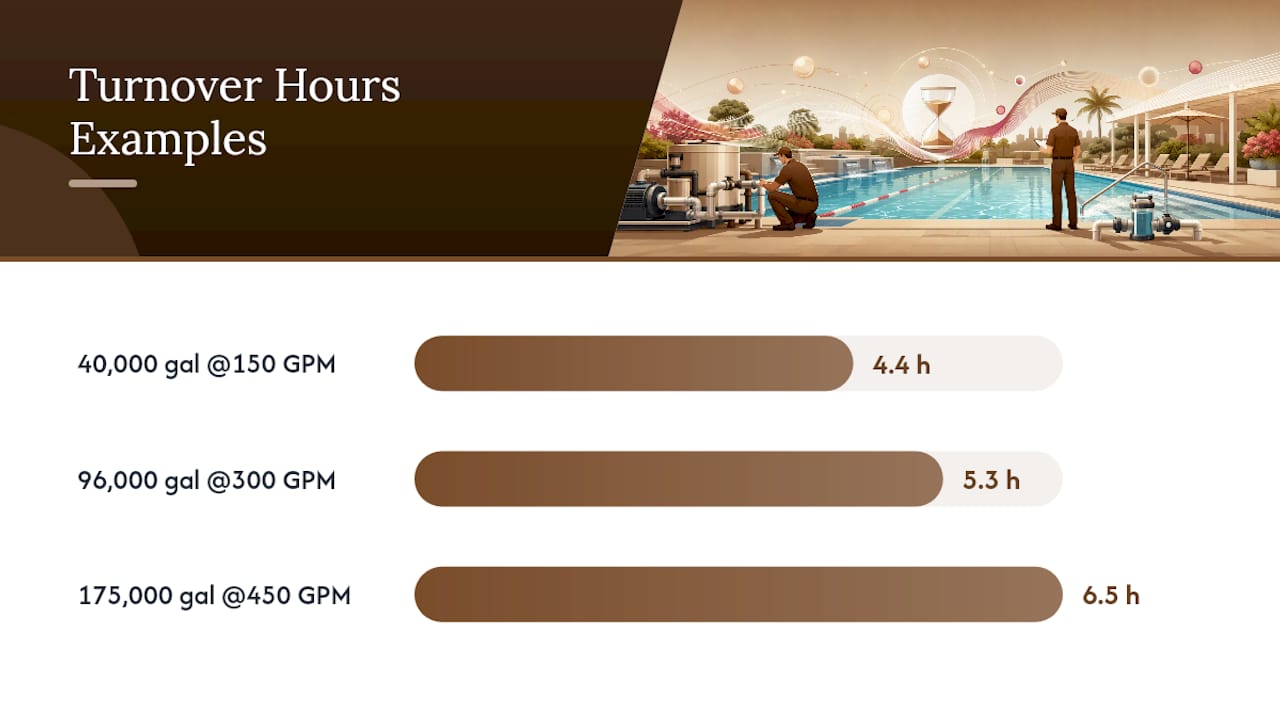
Turnover Hours can be approximated by dividing the pool volume in gallons by the flow rate in gallons per minute, then dividing the result by 60 to convert to hours, though precise values depend on actual measurements.
Run it in reverse when you already know your target turnover time and need to find the flow rate that satisfies it:
Required GPM = Volume (gallons) ÷ Turnover Hours ÷ 60
That second formula is the one facility managers actually use most, since it tells you what flow rate to design or verify against before a pump ever gets specified.
Pro Tip: Run both formulas whenever you evaluate a facility. The forward formula tells you what turnover you’re actually getting today; the reverse formula tells you what flow rate you need for the turnover you’re supposed to have. Comparing the two numbers is often how a shortfall gets caught before an inspector finds it.
Three worked examples, using round numbers you’ll recognize from typical commercial pool volumes:
- 40,000-gallon pool at 150 GPM: 40,000 ÷ 150 ÷ 60 = 4.4 hours turnover.
- 96,000-gallon pool at 300 GPM: 96,000 ÷ 300 ÷ 60 = 5.3 hours turnover.
- 175,000-gallon pool at 450 GPM: 175,000 ÷ 450 ÷ 60 = 6.5 hours turnover, just outside a 6-hour target.
Volume gets trickier with sloped bottoms, vanishing edges, or irregular shapes. For a sloped-floor pool, calculate the volume as if it were split into a shallow rectangular section and a deep sloped wedge, then add them together. Round numbers up, never down, when a shape is ambiguous.
Surge tanks and separately plumbed features deserve their own scrutiny. If a surge tank holds water that passes through the same filtration loop as the main pool, it typically counts toward total system volume. A detached splash pad or a decorative fountain running its own pump and filter usually does not count toward your main pool’s turnover, even if it shares a deck with the pool.
Measuring and Verifying Actual Flow and Volume in the Field
Inspectors want measured flow, not an estimate. That distinction is worth understanding early, because it’s the single most common reason a facility fails a walkthrough it thought it would pass.
An inline flow meter, installed on the return line after the filter and heater, gives you a real-time GPM reading while the system runs in its normal configuration. Paddlewheel meters and magnetic flow meters are the two types you’ll see most often in commercial equipment rooms, and both are accepted by health departments as long as they’re calibrated and reading in the expected range.
A field verification checklist looks like this:
- Confirm the water level is at normal operating height before taking any measurement.
- Verify pool dimensions against the original design plans or a physical remeasurement if plans aren’t available.
- Read the flow meter while the system runs in its standard, non-bypassed configuration.
- Log filter pressure (in psi) and pump motor amperage at the same time as the flow reading.
- Record the date, time, and who took the reading.
Pump nameplate GPM is not a substitute for a measured reading, and this is where a lot of otherwise well-run facilities get caught. A pump’s rated output assumes ideal conditions. Real-world flow is almost always lower because of Total Dynamic Head (TDH), the resistance created by pipe friction, filter media, elevation changes, and fittings between the pump and the pool. A pump rated at 300 GPM on the box might deliver 220 GPM once it’s actually plumbed into your system.
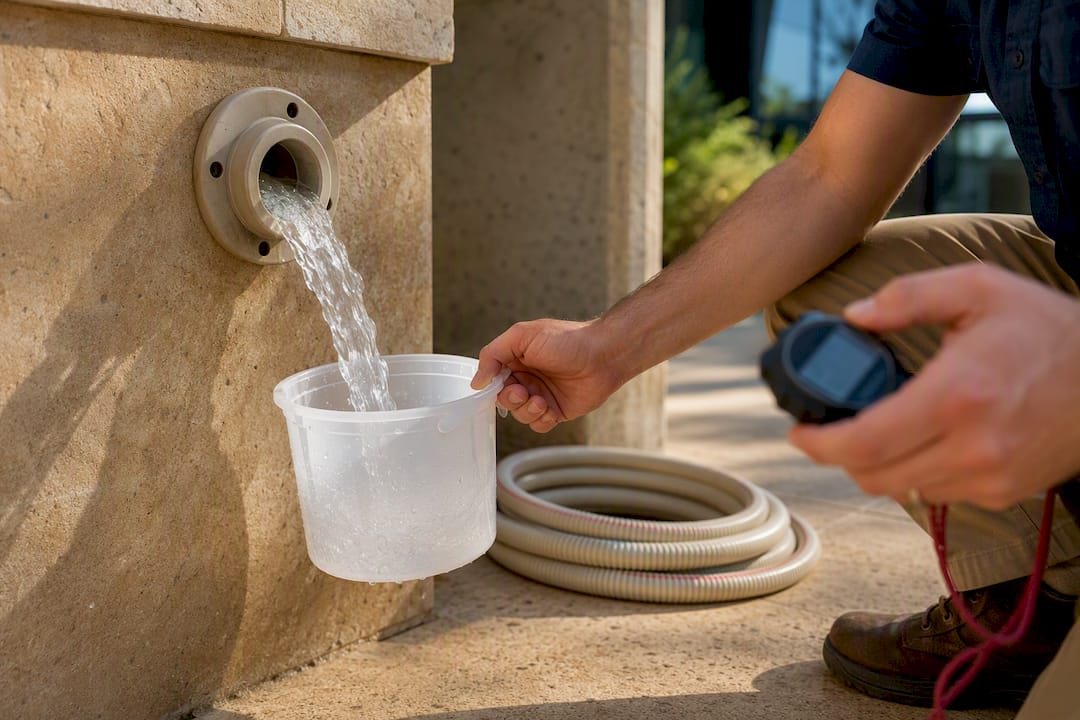
If you don’t have a flow meter installed, a temporary bucket-and-stopwatch test on a return line can give you a rough estimate, but it’s not something most inspectors will accept as your official compliance record. Treat it as a stopgap while you schedule a permanent meter installation, not a long-term solution.
Why Turnover Fails and How to Fix It Fast
Low turnover almost always traces back to one of a handful of causes, and most of them are things a maintenance team can diagnose in an afternoon.
- Clogged or dirty filters restrict flow and raise filter pressure. Backwashing sand or DE filters, or cleaning cartridge elements, is often the fastest fix.
- Debris trapped in skimmer baskets or pump strainers chokes flow before it even reaches the filter. Check these daily on busy commercial pools.
- Misset or partially closed valves are a surprisingly common culprit, especially after any maintenance work that required shutting the system down.
- Worn or damaged impellers reduce pump output even when the motor sounds fine. This usually shows up as a gradual decline in GPM over weeks or months.
- Air leaks on the suction side cause the pump to lose prime intermittently, which shows up as fluctuating rather than steadily low flow.
- Undersized plumbing relative to the pump and filter is a design flaw, not a maintenance issue, and no amount of cleaning will fix it.
Start troubleshooting with the cheapest, fastest checks first: backwash the filter, clear the strainer baskets, and confirm every valve is in its correct operating position. If filter pressure and pump amperage both look normal but flow is still low, that points toward a worn impeller or an undersized line, which usually means it’s time to call a contractor rather than keep chasing it in house.
Facilities running variable-speed pumps on energy-saving schedules need to check their math carefully. Dropping to a lower speed overnight saves real money on the electric bill, but the combined daily circulation still has to add up to the turnover your code requires. A schedule that looks efficient on paper can quietly put you out of compliance if nobody checks the total.
What Inspectors Expect: Records and Compliance Readiness
Clear water is not proof of compliance. Inspectors are trained to ask for the paper trail behind it, and facilities that can’t produce one get cited even when the water looks fine.
At minimum, your logs should include:
- Dated flow meter readings alongside the calculated turnover hours for that reading.
- Filter pressure recorded at the same time as each flow reading.
- Backwash and filter service entries, including the date and what was done.
- Any corrective action taken when a reading fell short of target, with a follow up date.
Operator credentials matter too. A Certified Pool Operator (CPO) certification, or your state’s equivalent credential, should be posted or readily available for an inspector to see. It signals that whoever is running the mechanical room actually understands what the numbers mean.
Build a simple verification packet you can hand over in under a minute: the last several weeks of flow and pressure logs, a printout or photo of the flow meter reading, and notes on any recent service work. Digital logging tools, including automated monitoring platforms, can generate this packet automatically and flag a problem before an inspector ever shows up. Keep at least a year of records on hand, since many jurisdictions expect that history during an annual license renewal.
Longhorn Pools on Designing Out Turnover Problems Before They Start
A lot of turnover failures trace back to decisions made at the design table, years before an inspector ever walks in. At Longhorn Pools, we see the same handful of mistakes repeatedly on commercial retrofits: pumps sized for average bather load rather than peak, filters undersized to save a few dollars upfront, and flow meters installed somewhere nobody can actually read them during a normal shift.
Getting turnover right at the design phase means:
- Sizing pumps and filters against peak occupancy, not an average day.
- Installing flow meters in accessible, visible locations on the return line.
- Keeping feature pumps (fountains, splash elements) on separate loops so they’re never mistaken for contributing to filtered circulation.
We cover the construction side of this in more detail in our breakdown of common commercial pool construction mistakes. When a facility’s plumbing is genuinely undersized rather than just poorly maintained, renovation is usually the more sensible call than repeated repairs. A Longhorn verification visit produces a written report and a prioritized estimate, so you know exactly what’s driving the shortfall before committing to a fix.
How Turnover Rate Shapes Water Quality and Swimmer Safety
Turnover rate is the mechanism, not the goal. The actual goal is water that’s safe to swim in, and turnover is one of the biggest levers you have to get there.
Every gallon that passes through your filter gets stripped of particulates and re-dosed with sanitizer before it returns to the pool. A pool turning over every 4 hours cycles contaminants out of the water twice as often as one turning over every 8 hours. That difference shows up fast in water clarity, and slower to the eye in things like chlorine demand and pathogen load.
County public-health guidance treats slow-moving or stagnant pool water as a genuine risk, not a cosmetic problem. San Diego County’s guidance on stagnant pools points out that poor circulation creates conditions for algae growth and mosquito breeding, both of which are public-health concerns that go well beyond murky-looking water.
Swimmer safety ties in more directly than most operators realize. Slow turnover means contaminants introduced by bathers, sweat, sunscreen, body oils, occasional accidents, linger longer before filtration removes them. That’s exactly the environment where recreational water illnesses take hold. A pool that looks clear can still be circulating poorly if the turnover math doesn’t add up, which is exactly why inspectors check the number instead of just glancing at the water.
Turnover Rate and Chemical Treatment: Why the Two Depend on Each Other
Chemical treatment only works as fast as the water carrying it moves. A pool with excellent chlorine levels but poor circulation still develops dead zones where sanitizer never fully reaches, particularly in corners, behind ladders, and near inlets positioned too far from return jets.
Faster turnover means sanitizer gets distributed more evenly and gets a chance to reach every part of the pool within a shorter window. It also means chlorine demand from fresh contaminants, sunscreen, sweat, urine, gets neutralized faster rather than sitting in the water building disinfection byproducts.
There’s a practical operational link here too. Facilities running borderline turnover often compensate by running higher chemical doses to make up for slower distribution. That’s an expensive workaround, and it doesn’t actually fix the underlying circulation problem. It just masks it, usually at the cost of a higher chemical budget and more frequent pH swings that come with heavier dosing.
Industry guidance on aquatic operations frames turnover as a continuous, 24/7 compliance metric rather than something you hit once and forget. Chemical treatment follows the same logic. A facility that treats both turnover and sanitizer levels as ongoing, connected metrics, rather than two separate boxes to check, tends to run more stable water chemistry overall. When you’re troubleshooting a chlorine problem that won’t resolve with normal dosing adjustments, checking your actual measured flow rate is often a faster diagnosis than testing water chemistry again.
Adjusting Turnover Rates for Season and Bather Load
Code minimums are fixed, but the wear on your system isn’t. A pool serving fifteen swimmers on a Tuesday morning in March and two hundred on a Saturday in July is putting very different demands on the same filtration loop.
Many commercial facilities run their systems at or near the code minimum turnover during off-peak months, then need to confirm the same equipment can actually deliver adequate turnover when summer bather loads spike. This isn’t usually a matter of changing your code requirement. Your jurisdiction’s turnover standard for a given pool classification doesn’t flex with the calendar. What changes is how much margin you have between what your equipment can produce and what the code demands.
A pool that measures a comfortable 5.5-hour turnover in April with light usage can effectively perform worse in July, not because the flow rate changed, but because higher bather counts introduce more contaminant load for the same circulation to handle. That’s why some facility managers schedule a flow verification check specifically before peak season starts, rather than relying on a reading taken during a slower month.
Variable-speed pumps complicate this further. A facility that drops pump speed at night to save energy needs a documented operating plan showing that combined daily circulation still satisfies code, even during high-occupancy stretches. If your facility runs a splash pad or a spa that gets substantially heavier use in summer, verify each system’s turnover separately going into the season rather than assuming last year’s numbers still hold.
Industry Standards vs. Best Practices: Where the Line Actually Sits
The code minimum and genuinely good operating practice are not always the same number, and conflating them is one of the more common mistakes facility managers make.
A 6-hour turnover might satisfy your jurisdiction’s minimum requirement for a standard commercial pool. That doesn’t mean 6 hours is the target every well-run facility should aim for. Plenty of experienced operators build in a margin, targeting 4 to 5 hours where equipment allows, specifically so that normal filter fouling, minor valve drift, or a slightly underperforming pump doesn’t push them below the legal minimum on a bad day.
Spas are a clear example of where the gap between “meets code” and “runs well” tends to widen. A 30-minute spa turnover might be the legal floor, but spas carry higher bather density per gallon and higher water temperatures, both of which accelerate contaminant buildup and chlorine demand. Operators managing spas at busy hotels or fitness clubs often run turnover meaningfully faster than the minimum simply because the margin for error is thinner.
The honest way to think about it: code compliance tells you what keeps you licensed. Best practice tells you what keeps water quality consistent even on your facility’s busiest, hottest, most heavily used day of the year. Facilities that only ever aim for the bare minimum tend to be the ones that fail an inspection during an unexpected bather-load spike, not because they broke a rule, but because they never built in room to absorb one.
Advanced Monitoring Technology for Real-Time Turnover Tracking
Manual logging still works, but it has an obvious blind spot: it only tells you what flow looked like at the moment someone wrote it down. A pump that starts losing prime at 2 a.m. won’t show up in a log taken at 9 a.m.
Digital monitoring platforms close that gap. Ecolab’s AquaIQ program, for example, captures continuous performance data and sends alerts when measured flow or other tracked parameters drift outside target ranges, which means a developing problem gets flagged hours or days before it would otherwise surface during a routine check or, worse, an inspection.
Automated systems like this reduce compliance risk in a fairly direct way: they preserve a continuous record instead of a handful of daily snapshots, and they catch deviations while there’s still time to fix them before they become a citation. For a facility running multiple pools, spas, and features across one property, that kind of centralized monitoring also cuts down on the labor of manually logging every system every shift.
That said, technology doesn’t replace the fundamentals. An inline flow meter still has to be installed correctly and calibrated on schedule for any of this data to mean anything. Automated alerts are only as good as the sensor feeding them. Facilities considering an upgrade should treat monitoring technology as a way to extend good manual practices, not a substitute for having a properly measured, well-maintained circulation system in the first place.
Editorial Take: What the Turnover Rate Playbook Actually Requires
The research here points to a conclusion a lot of facility managers resist: turnover compliance isn’t really about hitting a number once. It’s about building a system, measurement, logging, and equipment margin, that keeps hitting that number without someone scrambling before every inspection.
Where conventional advice falls short is treating the 6-hour standard as gospel. It’s a common baseline, not a universal one, and plenty of facilities are running equipment that technically meets code with almost no margin for a dirty filter or a summer bather-load spike. That’s a fragile way to run a commercial pool.
If there’s one priority worth putting ahead of everything else, it’s this: install a readable inline flow meter and start logging measured readings consistently, before you worry about anything else on this list. Nameplate math and clear-looking water have both let good operators down. Measured flow, logged over time, is the only thing that holds up when an inspector, or a heavy bather-load Saturday, puts your system to the actual test.
— Mark
Get a Turnover Compliance Check From Longhorn Pools
Reading your flow meter and comparing it against code is one thing. Fixing an undersized filtration loop or a poorly placed feature pump is a different job entirely, and it’s the kind of work Longhorn Pools has built its commercial practice around across Austin and the Texas Hill Country.

A site visit for a commercial facility typically includes measured flow verification at the existing equipment, a written report explaining where the numbers stand against local code, and a prioritized estimate if corrective work or a retrofit is the right call. No guessing, no upsell on work you don’t need. Before scheduling, have your pool’s design volume, your most recent flow readings if you have them, and any known trouble spots (a pump that’s been acting up, a filter that’s needed more frequent backwashing) ready to share. It speeds up the visit considerably.
If your facility is due for a deeper look, whether that’s a full renovation or a targeted equipment upgrade, visit our commercial pool services page to request a consultation and get a firm next step scheduled.
Sources
For ongoing reference, keep these on hand: the CDC’s MAHC landing page for model code guidance, the ISPSC 2021 turnover chapter for specific code language, and Whatcom County’s pool calculation examples for worked, real-world math.
FAQ
What Is Turnover Rate in a Pool?
Turnover rate is the time it takes a pool’s circulation system to filter and treat a volume of water equal to the entire pool once. Most U.S. commercial pools target roughly a 6-hour turnover, though spas and wading pools require much faster cycles, and the exact number depends on your local health code.
How Do I Calculate My Pool’s Turnover Rate?
Divide your pool’s volume in gallons by your measured flow rate in GPM, then divide that result by 60 to get turnover hours. A 96,000-gallon pool running at 300 GPM calculates to about 5.3 hours, for example. Always use a measured flow meter reading rather than the pump’s nameplate rating.
Is Pump Nameplate Flow the Same as Measured Flow?
No, and this is one of the most common compliance mistakes. Real-world flow is almost always lower than the nameplate rating because of Total Dynamic Head, the resistance created by pipes, filters, and fittings, so inspectors require an inline flow meter reading instead.
What Counts as a Good Turnover Rate?
A turnover rate that meets or beats your jurisdiction’s adopted code, with some margin built in, counts as good. Many operators aim for 4 to 5 hours on standard pools even when their code allows 6, specifically to absorb filter fouling or unexpected bather-load spikes without slipping out of compliance.
Does Longhorn Pools Handle Commercial Turnover Compliance Issues?
Yes. Longhorn Pools performs measured flow verification, written compliance reports, and prioritized retrofit estimates for commercial facilities across Austin and the Texas Hill Country. Details on scope and booking are available on the commercial pool services page.