
For most Central Texas homeowners, chlorine done consistently, whether from liquid, tablets, or a salt-chlorine generator, is the safest primary sanitizer and the one we recommend building your system around. A salt system gives you steadier dosing with less handling of chemicals. UV or ozone can supplement that base if chloramine odor or skin irritation bothers your family, but almost every pool still needs a real residual sanitizer running underneath it. We walk clients through this exact decision on every build we do.
TL;DR:
- Saltwater chlorine generators are often the best choice for steady disinfection with less chemical handling, but they can cause corrosion on metal fixtures needing mitigation.
- UV and ozone systems boost water quality and swimmer comfort but do not provide residual protection, so they must supplement a chlorine or bromine residual in the pool.
- The pool finish and environment influence sanitizer compatibility, with plaster, fiberglass, and indoor pools requiring specific considerations for corrosion and gas management.
- Homeowners should budget for ongoing replacement parts like salt cell and UV bulb replacements, as lifecycle costs often exceed initial equipment expenses.
- The optimal system depends on household needs, water chemistry tolerance, and maintenance preferences, making professional consultation essential for complex or retrofit projects.
Table of Contents
- Choosing a Pool Sanitation System: What Each Type Actually Does
- Weighing Safety, Comfort, Corrosion, and Cost
- How to Pick the Right System: A Homeowner’s Checklist
- Testing, Maintenance Routines, and Real Lifetime Costs
- Matching Sanitizers to Your Pool’s Finish and Setting
- What Longhorn Pools Recommends and Why
- What We See Homeowners Actually Prioritize
- When to Bring in a Pro for Your Sanitation Setup
- Sources
- FAQ
Choosing a Pool Sanitation System: What Each Type Actually Does
Before you can weigh options, you need to know what you’re actually comparing. Some of these systems disinfect the water directly and keep working between cleanings. Others just knock down contaminants for a moment and then stop. That distinction is the whole ballgame when you’re choosing a pool sanitation system, so let’s break down each type.
- Liquid chlorine and cal-hypo: Added by hand or through a feeder, these dissolve into free chlorine that keeps disinfecting as long as a residual is present. Cheap to buy, but they demand routine dosing and careful storage.
- Chlorine tablets (trichlor): Slow-dissolving pucks in a floater or feeder. Convenient, but they add cyanuric acid every time, which can build up and weaken chlorine’s punch if you’re not watching your numbers.
- Saltwater chlorine generators (SWG): A cell runs electricity through dissolved salt to manufacture chlorine on-site. It’s still a chlorine pool. The saltwater system just makes its own supply instead of you buying it in jugs.
- Bromine: Common in spas and some indoor pools because it holds up better in warm water and produces less of that sharp chlorine smell. It costs more per gallon treated and isn’t as widely used in Texas backyard pools.
- UV systems: Water passes through a UV lamp chamber that scrambles the DNA of bacteria and breaks down chloramines. It only works on water flowing through that chamber at that moment. No residual protection reaches the rest of the pool.
- Ozone: An ozone generator injects a powerful oxidizer into the plumbing to blast organic waste. Like UV, it treats water in the pipe, not the pool, and dissipates fast once it leaves the equipment pad.
- Mineral systems and ionizers: Copper and silver ions suppress algae and reduce how much chlorine you need day to day. They don’t disinfect on their own and won’t replace a residual sanitizer.
- AOP/hybrid systems: These pair ozone or UV oxidation with a low-dose chlorine or bromine feed, aiming for the comfort of supplemental oxidation with the safety net of a true residual.
Weighing Safety, Comfort, Corrosion, and Cost
Here’s the trade-off nobody explains clearly enough: every sanitizer choice pulls on three ropes at once, safety, comfort, and workload, and tightening one usually loosens another.
Safety comes down to residual protection. The CDC’s healthy swimming guidance is blunt about this: maintaining a disinfectant residual and balanced water chemistry is what actually prevents recreational water illness. UV and ozone are excellent oxidizers, but neither one leaves anything behind in the water once it passes through the equipment. That’s why we never recommend them as a standalone system, only as a supplement riding on top of chlorine or bromine.
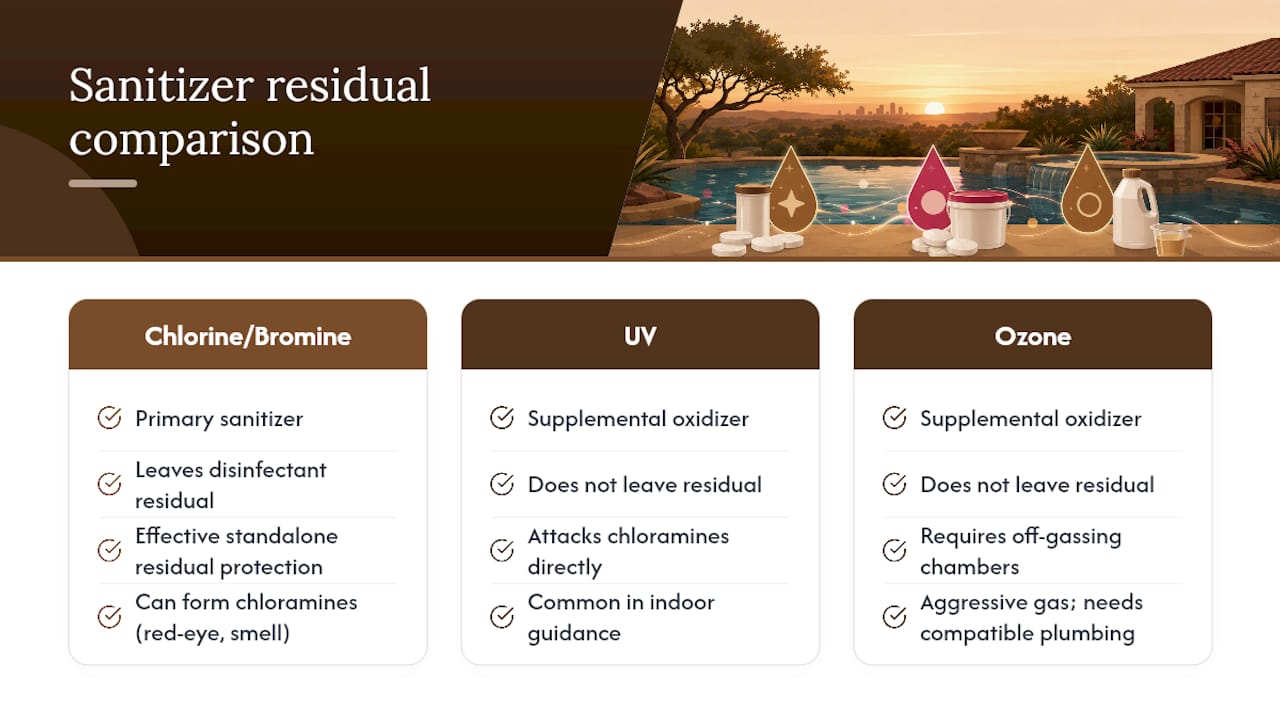
Comfort is where salt and hybrid systems earn their reputation. Traditional chlorine pools that run high on chloramines (the byproduct of chlorine reacting with sweat, sunscreen, and body oils) are the ones causing that red-eye, chemical-smell experience everyone associates with “too much chlorine.” Ironically, that smell usually means you need more chlorine, not less, to burn off the chloramines. Salt systems tend to feel gentler because the chlorine gets produced and used more evenly. UV supplementation attacks chloramines directly, which is one reason it shows up so often in indoor commercial pool guidance.
Corrosion is the trade-off salt owners need to plan for. Saltwater is genuinely harder on metal, ladders, heater cores, light fixtures, and rebar if your gunite shell has thin coverage. It’s manageable with the right fixtures and a sacrificial anode, but it’s not nothing. Ozone systems introduce their own engineering wrinkle: the gas is aggressive enough that it requires off-gassing chambers and compatible plumbing materials.
Homeowners often underestimate lifetime part costs. A salt cell typically needs replacement every few years, and UV bulbs have their own burn-out clock. Budgeting only for the upfront equipment, and ignoring what the cell or lamp will cost down the road, is the single most common miscalculation we see homeowners make.
Maintenance workload is where hybrid systems shine. They combine oxidation with a low-level primary sanitizer, which tends to cut chemical demand and reduce swimmer irritation, at the cost of a higher purchase price. If your goal is fewer weekend trips to the pool store, that upfront spend often pays for itself in aggravation saved.
How to Pick the Right System: A Homeowner’s Checklist
Choosing a pool sanitation system isn’t about finding the “best” one in the abstract. It’s about matching a system to your pool, your household, and your tolerance for chores. Here’s the framework we walk clients through before any equipment gets specified.
- Identify your pool’s finish and structure. Plaster and gunite handle salt reasonably well with the right precautions. Vinyl liners are more sensitive to imbalanced water, and fiberglass generally tolerates salt without issue but still needs monitoring.
- Decide indoor or outdoor. Indoor pools trap chloramine gas, which is why UV supplementation and real ventilation matter far more indoors than in an open Texas backyard.
- Estimate your bather load. A pool that hosts weekly parties needs more oxidation capacity than one used by two adults a few times a week.
- Be honest about swimmer sensitivity. If someone in your household has asthma or sensitive skin, that shifts the calculation toward hybrid or UV-supplemented setups.
- Set your maintenance appetite. Some owners enjoy the Saturday-morning chemistry ritual. Others want to test twice a month and move on with their lives.
- Match your budget to lifecycle cost, not sticker price. Factor in cell replacement, bulb replacement, and chemical spend over five years, not just the install quote.
When you’re vetting an installer, ask direct questions: What’s the warranty on the salt cell or UV lamp, and what’s the expected replacement cycle? How will you mitigate corrosion on my specific equipment and finish? Does this system integrate with app-based monitoring or automation? Industry guidance consistently points toward matching the sanitizer to pool type and bather load rather than chasing a single universal answer, and a good installer should be doing exactly that math with you.
Pro Tip: Walk away from anyone who pitches “chlorine-free” without a clear explanation of what residual protection replaces it. If they can’t answer that in one sentence, they don’t have a real plan.
Testing, Maintenance Routines, and Real Lifetime Costs
Consistency beats intensity here. Test free chlorine and pH two to three times a week in swim season, and add combined chlorine and alkalinity checks weekly. If you’re running stabilized chlorine tablets, check cyanuric acid monthly since it creeps up over a season and needs periodic dilution.
- Salt cells generally need replacement every several years, depending on usage and water balance.
- UV lamps have a rated burn life and dim gradually, so plan a look-ahead replacement rather than waiting for a failure.
- A cloudy pool, algae bloom, or stubborn odor is usually a symptom of drifting chemistry, not a random equipment failure, chase the cause, not the smell.
Smart monitors and automated feeders cut down on reactive scrambling because they catch drift before it becomes a problem you can smell or see. For a full walkthrough of testing cadence and balancing routines specific to Central Texas water, our guide on pool maintenance in Austin covers the week-to-week reality, and our water balancing guide breaks down the pH and alkalinity math step by step.
Matching Sanitizers to Your Pool’s Finish and Setting
Not every system plays equally well with every pool shell. Saltwater is workable on plaster and fiberglass but demands compatible metal fixtures and, often, a sacrificial anode to protect against corrosion.
- Vinyl liners tolerate salt but are more sensitive to chemistry swings than plaster or fiberglass.
- Indoor pools need UV supplementation and genuine ventilation to control chloramine buildup, since there’s no open air to dilute it.
- Ozone systems require dedicated off-gassing equipment, which is a bigger ask on a retrofit than a new build.
- Retrofitting an older pool for salt or ozone often means swapping metal fixtures or upgrading plumbing before the new sanitizer ever gets turned on. Our pool construction materials guide covers finish compatibility in more depth.
What Longhorn Pools Recommends and Why
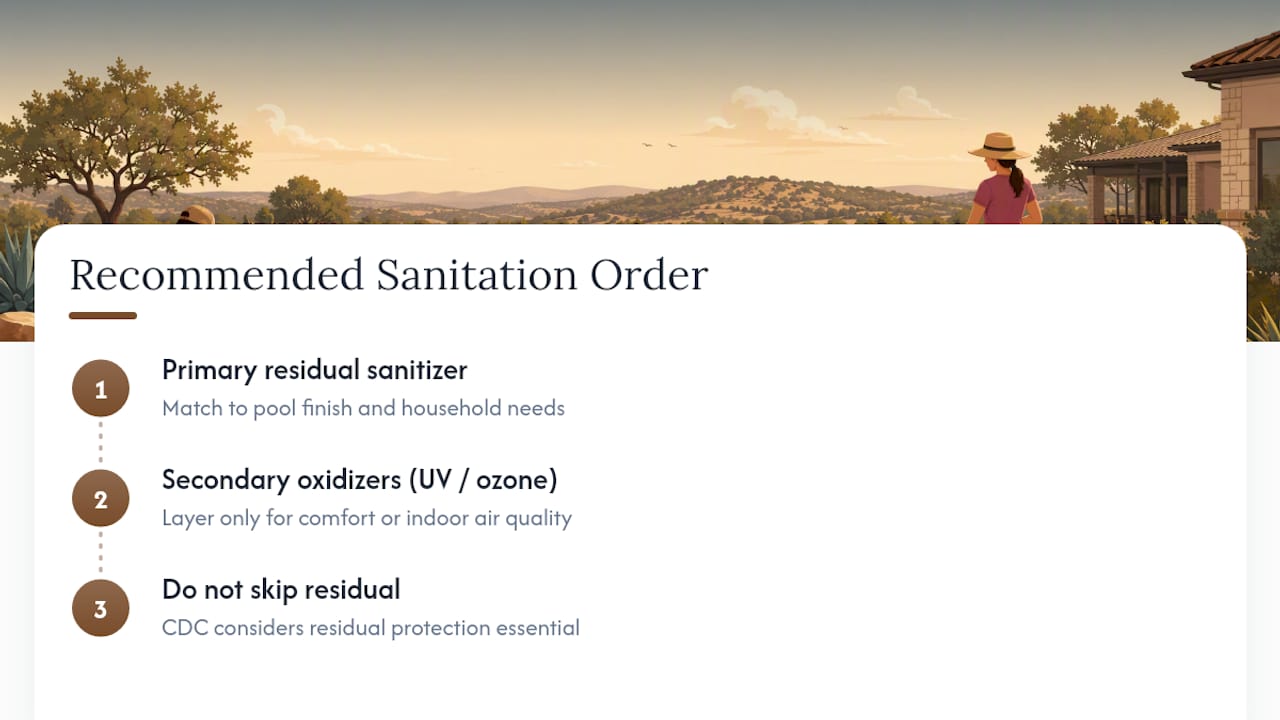
Our approach is straightforward: match a primary residual sanitizer to your pool’s finish and household needs first, then layer UV or ozone on top if comfort or indoor air quality is a priority. That order matters. Skipping the residual sanitizer to chase a “chemical-free” promise leaves you without the protection the CDC considers essential.
For homeowners planning a new build or a retrofit, our Smart Pool Technology Installation Guide and Complete Pool Education Guide go deeper into equipment pairing and long-term operation.
What We See Homeowners Actually Prioritize
Most homeowners come in wanting all three things: low irritation, low maintenance, and low cost, and they’re usually surprised to learn those three pull against each other. In practice, the trade-off almost always lands on comfort versus workload, since cost differences even out over a few years of ownership. My advice stays consistent: keep a real residual sanitizer running no matter what else you add, and if your pool is indoor or sees heavy daily use, loop in a professional before you commit to equipment.
— Mark
When to Bring in a Pro for Your Sanitation Setup
Some sanitation decisions are simple enough to handle with a pool store consultation. Others aren’t, and pretending otherwise costs homeowners money down the line.

Indoor pools, corrosion-prone equipment pads, major retrofits, and anyone who wants a genuinely low-maintenance system all benefit from a professional eye before equipment goes in the ground. Some custom pool builders specify sanitation systems as part of the build, not as an afterthought bolted on later. That means your salt cell, UV chamber, or hybrid setup gets engineered around your actual finish, plumbing layout, and household needs from day one. If you’re planning new construction or considering a renovation that includes upgraded equipment, start with our pool construction material options guide to see how finish choice and sanitation system fit together, then reach out for a consultation on your specific project.
Sources
- Healthy Swimming | CDC
- Choosing the Right Pool Sanitizer: Chlorine, Saltwater, Bromine, UV, and Ozone Compared – Beatbot
- Choosing the Right Pool Sanitizer: Chlorine, Bromine, UV and Ozone – Pool Trove
- Ozone vs Salt Water Pools: Salty, Sour or Well-Balanced Sweet Water — Clear Comfort
FAQ
What Is the Most Effective Pool Sanitation System?
Chlorine, whether added directly or generated by a salt system, remains the most widely supported primary disinfectant because it provides continuous residual protection across nearly every pool type. UV and ozone can improve comfort and air quality but work best as supplements, not replacements.
What Are the Three C’s of Pool Cleaning?
Pool professionals commonly refer to circulation, cleaning, and chemistry as the three pillars of keeping water safe and clear. Skipping any one of the three, even with a great sanitizer, tends to produce cloudy or unbalanced water.
Are UV Pool Sanitizers Worth It?
UV systems are worth considering if you want lower chloramine odor and gentler water, especially for indoor pools or households with sensitive skin, but they don’t replace the need for a residual sanitizer like chlorine. Think of UV as a comfort upgrade layered onto your primary system, not a standalone solution.
What Is the Best Filtration System for a Pool?
The right filter depends on your pool size, bather load, and how much fine debris you need to capture, with cartridge, sand, and DE filters each offering different trade-offs in filtration fineness versus maintenance effort. Filtration and sanitation work together, so a well-matched filter reduces the workload on whichever sanitizer you choose. For guidance on how equipment choices fit into a full build, Longhorn Pools’ pool education guide covers the full system, not just the chemistry side.