
Expect an installed automatic pool cover to run somewhere between $12,000 and $30,000, with most Central Texas homeowners landing in the $15,000 to $25,000 band. The biggest factors affecting cost are pool size, track style (deck-mounted versus recessed), and how much deck or electrical work your yard needs. Retrofitting an existing pool is doable, but site work on an older deck can increase costs.
TL;DR:
- Recessed track installations typically cost more than deck-mounted options due to additional demolition and deck work.
- Larger or irregularly shaped pools with features like steps or spas can increase costs up to 30,000 dollars or more.
- Electrical upgrades and drainage modifications often add thousands of dollars beyond the basic installation price.
- Building the cover system during new pool construction is generally cheaper and more straightforward than retrofitting onto an existing pool.
- The primary cost drivers include track style, pool shape, fabric choice, and electrical scope, which can cause wide variation in quotes.
Table of Contents
- How Much Do Automatic Pool Covers Cost?
- What Changes Your Automatic Pool Cover Pricing?
- Is a New Installation Cheaper Than a Retrofit?
- What Hidden Costs Should You Budget For?
- Quick Cost Estimator by Pool Size and Complexity
- Do Automatic Pool Covers Actually Save Money Over Time?
- How Do You Get an Accurate Quote?
- When Does an Automatic Cover Actually Make Sense?
- Build It Right the First Time With Longhorn Pools
- Where These Numbers Come From
- Sources
How Much Do Automatic Pool Covers Cost?
Automatic pool cover pricing splits into three rough tiers, and knowing which tier you’re in changes how you shop for quotes.
On the low end, smaller pools with straightforward deck-mounted tracks and no electrical surprises can come in around $12,000 to $16,000. The typical middle band, where most Central Texas installs land, runs in the mid-price range, according to Angi’s 2026 cost data, which puts the national average around $15,000 with a wide spread depending on cover type and size. High-end installs with recessed tracks, custom deck integration, or freeform pools can push past $25,000 and occasionally reach $30,000.
Quick stat: Automatic covers sit at the top of the pool cover price spectrum. A basic solar or winter cover might cost a few hundred dollars, but automatic systems commonly average around $15,000 installed, per Angi.
“Installed” isn’t just the fabric. A real installed quote should bundle:
- The cover fabric itself (mesh or solid vinyl)
- Track hardware, whether surface-mounted or recessed into the deck
- The motor and drive mechanism
- A housing unit or vault to store the cover when retracted
- Basic electrical hookup and standard labor
For a common 16×32 pool, Fixr’s cost comparison shows a mesh cover running around $2,700 installed versus roughly $3,700 for a solid cover, though that gap widens fast once you move from basic residential covers to full automatic systems with motorized tracks. That size difference matters because pool dimensions directly shape component costs, and a bigger surface area means longer tracks, a stronger motor, and more fabric.
What Changes Your Automatic Pool Cover Pricing?
Two pools of the exact same square footage can get wildly different quotes. Here’s what actually moves the number.
Track style is usually the single biggest lever. Deck-mounted tracks sit on top of your existing deck and are cheaper to install because they don’t require cutting into concrete. Recessed tracks disappear into a groove in the deck, which looks cleaner and keeps the mechanism out of foot traffic, but it means more demolition, more labor, and a bigger bill. Cover-Dream’s 2026 pricing breakdown lists track style alongside deck and electrical scope as the primary drivers behind most quotes.
Fabric and motor choice matter too. Mesh fabric is lighter, cheaper, and lets rain pass through, but it doesn’t block debris as well as solid vinyl. Solid covers cost more partly because they need a pump system to remove puddled rainwater, a detail Fixr calls out directly in its mesh-versus-solid comparison.
Other cost drivers worth flagging before you call a contractor:
- Pool shape: Rectangular pools are the cheapest to cover; freeform shapes, L-shapes, and pools with attached spas or tanning ledges add complexity and cost.
- Steps and benches: Any in-pool feature that interrupts a clean track line means custom fabrication.
- Electrical scope: A new dedicated circuit, trenching to the motor location, and proper bonding are common add-ons that surprise homeowners who assumed electrical was “included.”
- Motor upgrades: Smart-home compatible motors and app-based controls cost more than a basic switch-operated system, something worth weighing if you’re already exploring smart pool technology.
Is a New Installation Cheaper Than a Retrofit?
Building the cover into a new pool almost always beats retrofitting one onto an existing pool, and the reason comes down to sequencing, not the hardware itself.
When tracks get set before the deck pour, your contractor avoids cutting into finished concrete, resetting pavers, or matching existing coping. That single difference is often what separates a $25,000 to $30,000 new-install range from the same job costing more once a mature pool deck is involved.
Retrofits aren’t automatically expensive, though. If your existing deck has room and the pool shape is simple, replacing an aging system or fabricating tracks for the first time can be significantly cheaper, per Beltway Pools’ installer data. The hardware itself doesn’t change much between new and retrofit jobs. What changes is deck restoration.
Plan for lead time either way:
- Measurement and site evaluation: 1 to 2 weeks
- Fabrication of custom tracks and fabric: 3 to 6 weeks
- Electrical coordination and installation: adds 1 to 3 weeks if new circuits are needed
What Hidden Costs Should You Budget For?
Quotes that look identical on paper can hide very different scopes of work. Before you compare bids, ask about these line items specifically.
- Deck demolition and pour-back, needed for recessed tracks, typically $1,000 to $4,000 depending on deck material and area.
- Paver or coping reset, if your deck uses natural stone or pavers that need to be lifted and replaced around the track.
- Drainage adjustments, since a recessed track vault can trap water if grading isn’t corrected.
- Permits and inspections, which vary by municipality but almost always apply to electrical work.
- Site access, meaning equipment staging space, since tight side yards can add labor hours.
Walking your yard with a contractor before you get a written quote catches most of these early — and if you want to learn more about maintenance budgeting ahead of time, check out this essential guide to preventive maintenance for homeowners. Bring measurements, a rough sketch of your deck, and note anything blocking equipment access.
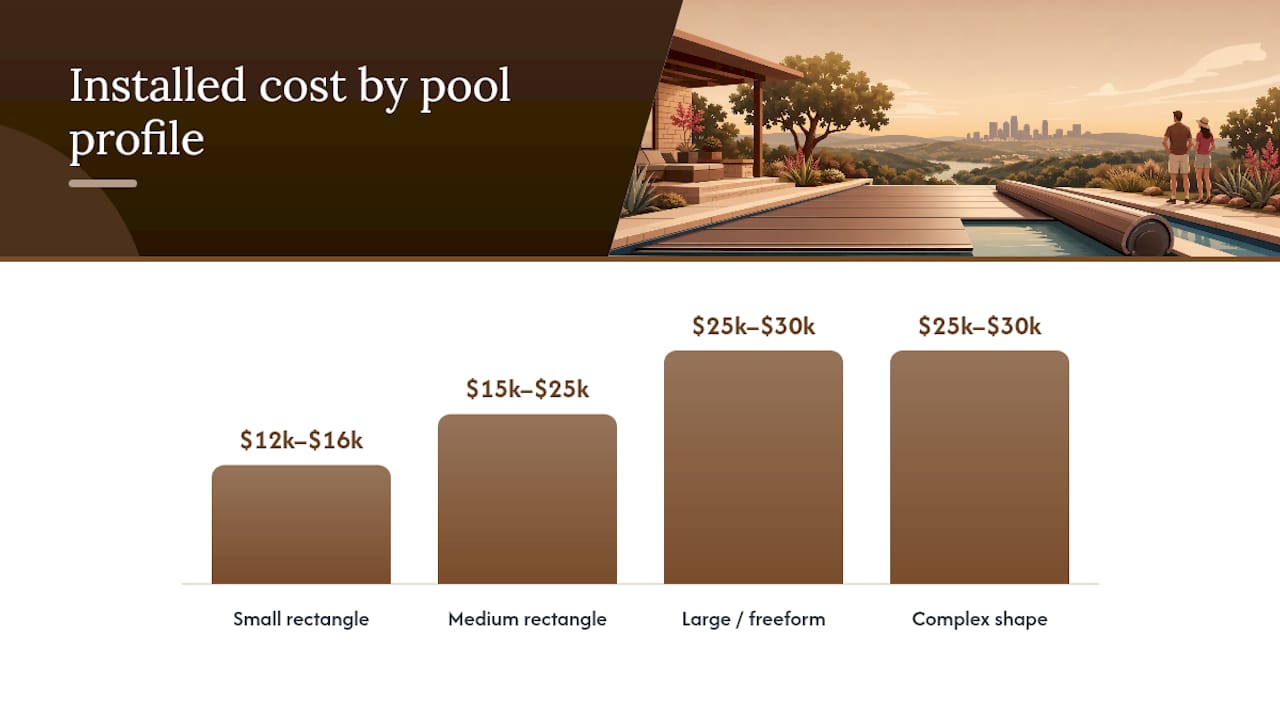
Quick Cost Estimator by Pool Size and Complexity
Use this table as a budgeting guardrail, not a final number. Every quote still depends on your specific deck, track style, and electrical situation.
| Pool profile | Ballpark installed range |
|---|---|
| Small rectangle (up to 400 sq ft), deck-mounted track, simple electrical | $12,000 to $16,000 |
| Medium rectangle (around 400 sq ft, e.g., 16×32), deck-mounted track | $15,000 to $25,000 |
| Large or freeform pool, recessed track, standard motor | $25,000 to $30,000 |
| Complex shape with steps, benches, or attached spa, recessed track | $25,000 to $30,000 |
These figures assume a standard motor, deck-mounted or basic recessed track, and no major demolition beyond what’s typical for the track type. Add cost if your electrical panel needs upgrading or if drainage work is required.
Pro Tip: Ask every contractor to break their quote into fabric, track, motor, electrical, and deck work as separate line items. If one bid is thousands less than the others, that’s usually where the missing scope is hiding, not where you got a deal.
Do Automatic Pool Covers Actually Save Money Over Time?
They save money, just not fast enough to call it a payback strategy. Treat the savings as a real, ongoing benefit rather than a reason to justify the upfront cost.
Energy confirms that covers reduce heat loss and evaporation, which lowers heating bills, chemical use, and water top-off needs on heated or actively used pools. The savings show up in three places:
- Heating costs: Less overnight heat loss means your heater runs less, especially on gas or heat pump systems.
- Chemical costs: Covered water loses chlorine and other chemicals to UV exposure and evaporation more slowly.
- Water costs: Evaporation is one of the biggest sources of water loss in an outdoor pool, and a cover cuts that significantly.
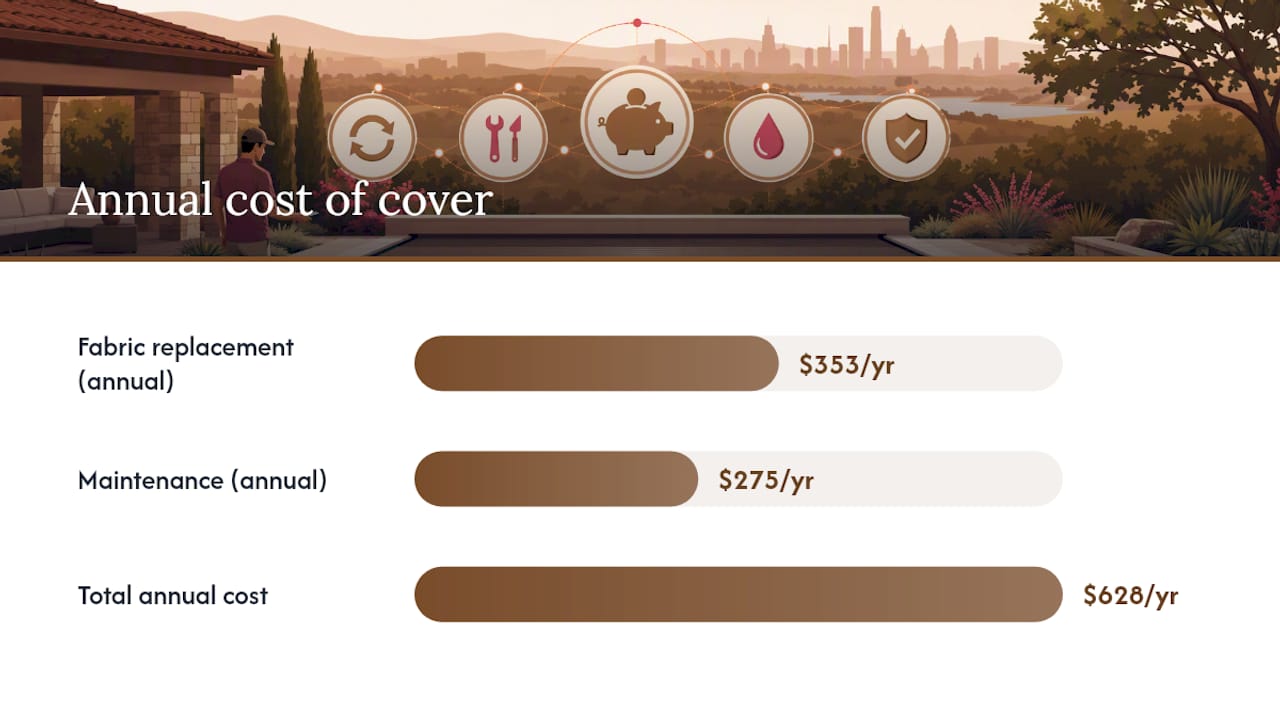
Fabric itself has a service life. Most automatic cover fabric needs replacing every 7 to 10 years depending on sun exposure and water chemistry, with replacement typically running $2,000 to $4,000 depending on pool size and fabric type. Budget another $150 to $400 a year for basic maintenance like track cleaning, lubrication, and motor inspection, or fold it into a service contract if you’d rather not handle it yourself.
How Do You Get an Accurate Quote?
A vague ballpark turns into a real number once you show up prepared. Bring these to your first contractor meeting:
- Pool dimensions and a rough drawing, including step and bench locations
- A cross-section or description of your deck material and thickness
- Photos of your electrical panel and its distance from the pool
- Notes on any tight access points equipment would need to pass through
Ask every contractor the same set of questions so you’re comparing apples to apples:
- What’s covered under warranty, and for how long?
- Who handles the electrical work: your team, a licensed sub, or is it excluded?
- What motor brand and type is included, and is it upgradeable later?
- What’s the fabric replacement policy, and is there a maintenance plan available?
Pro Tip: Lay every quote side by side and highlight what’s excluded, not just what’s included. The bid that looks cheapest on the total often excludes electrical or deck restoration, which you’ll pay for anyway once the real scope shows up.
If you’re already planning a new pool installation, building the cover into that timeline from the start avoids the retrofit premium entirely.
When Does an Automatic Cover Actually Make Sense?
An automatic cover earns its cost in a few specific situations, and honestly, in others it’s a nice-to-have you could skip.
If you’ve got young kids or pets, the safety case alone often justifies the spend regardless of energy savings. Heated pools that run most of the year also benefit more directly, since you’re fighting evaporation and heat loss on a near-daily basis rather than seasonally. Same goes for yards under heavy tree cover, where debris management becomes a real time cost, not just an aesthetic one.
Here’s the part most sales pitches skip: energy and water savings rarely pay back a $20,000 installation quickly. Treat those savings as a genuine bonus, not the reason to buy. If you’re building new or already renovating, sequencing the cover into that project, before deck pours or coping goes down, is where the real savings show up.
— Mark
Build It Right the First Time With Longhorn Pools
Custom pool builders in Austin and the Texas Hill Country often note how much a cover retrofit costs when it’s an afterthought versus when it’s planned from day one. When building new pools, integrating track conduit, electrical routing, and deck design before the concrete is poured can help keep costs down. For existing pools, renovation teams typically handle deck restoration and track retrofitting as part of a coordinated project rather than separate contractors.

Quotes commonly start with a site visit and measurement, followed by options that bundle deck work, electrical, and cover integration into one clear scope. If you’re weighing a new build against a renovation, our pool renovation process guide walks through what that sequencing looks like. Ready to see real numbers for your yard? Start planning your Austin pool project with a Longhorn Pools site visit.
Where These Numbers Come From
- How Much Does a Pool Cover Cost? 2026 Data — Angi
- Automatic Pool Cover Cost 2026 — Cover-Dream
- Automatic Pool Cover Benefits and Cost — Beltway Pools
- Mesh vs Solid Pool Cover — Fixr
Sources
- How Much Does a Pool Cover Cost? 2026 Data | Angi
- Automatic Pool Cover Cost (2026): Pricing, Options, and What Impacts Your Quote
- Automatic pool cover benefits and cost | Beltway Pools
- Mesh vs Solid Pool Cover | Fixr