
Yes, you can add a heater to an existing in-ground pool, and for most Central Texas backyards it’s a straightforward retrofit. Your three realistic options are gas, electric heat pump, or solar, and the choice usually comes down to how fast you want heat and whether your gas line or electrical panel has room to spare. That utility capacity, not the pool itself, is the thing most likely to slow you down or change your budget.
TL;DR:
- Gas heaters are ideal for quick heating on demand but come with higher operating costs and noise during startup.
- Electric heat pumps are more energy-efficient but perform poorly when air temperatures drop below 50°F, limiting their usefulness in colder weather.
- Solar heating offers near-zero operating costs but depends heavily on weather and roof or yard space, making it unsuitable for quick temperature adjustments.
- Proper sizing relies on accurate calculations based on pool area, desired temperature increase, and seasonal length, with oversizing or undersizing risking inefficiency or insufficient heating.
- Utility capacity, including gas meter and electrical panel size, is often the main constraint, requiring site checks before choosing the heater type.
Table of Contents
- How Do You Add a Heater to an Existing Pool?
- How Do You Size a Pool Heater Correctly?
- What Site and Utility Requirements Matter Most?
- What Are the Installation Steps, and Which Ones Need a Licensed Pro?
- What Does It Cost to Add a Heater to a Pool?
- How Do You Vet a Contractor and Avoid Bad Bids?
- What Longhorn Pools Sees in Real Retrofit Projects
- Is Adding a Heater Actually Worth It?
- Ready to Add a Heater to Your Pool the Right Way?
- Sources
- FAQ
How Do You Add a Heater to an Existing Pool?
Retrofitting an existing pool with a heater almost always means picking one of three heater families, then working backward to see what your property can actually support. Each type solves the “heat existing pool” problem differently, and the right pick depends less on preference and more on your gas meter, your panel, and how much sun your roofline gets.
Gas heaters (natural gas or propane) burn fuel to heat water fast, often raising pool temperature several degrees within hours. They deliver the highest BTU output of the three options, which makes them the go-to when you want the pool ready for a weekend party on short notice, or you’re only heating occasionally rather than running the pool warm all season. The tradeoff is operating cost. Gas is the most expensive fuel to run continuously, and it’s also the noisiest of the three at start-up.
Electric heat pumps work more like a reverse air conditioner, pulling heat from the surrounding air and transferring it into the water. They’re dramatically more efficient to run than gas, but they’re “low and slow,” and their performance depends heavily on air temperature. Heat pumps perform best when ambient air sits above roughly 50°F; once nights get cold, output drops and gas becomes the more reliable choice for fast, on-demand heat.
Solar heating routes pool water through rooftop or ground-mounted collectors, where the sun does the actual heating. Once installed, running cost is close to nothing beyond pump power, but performance is entirely weather-dependent and it can’t deliver quick results on a cloudy week.
Small plug-in electric resistance heaters aren’t included here on purpose. They’re built for spas and small above-ground pools, not the water volume of a typical in-ground pool, and trying to use one on a full-size pool wastes money without meaningfully raising temperature.
- Want heat fast and don’t mind the fuel bill: gas.
- Want the lowest ongoing cost with steady, moderate climate use: heat pump.
- Want near-zero operating cost and have unobstructed roof or yard space: solar.
How Do You Size a Pool Heater Correctly?
Sizing comes down to three numbers: your pool’s surface area, how many degrees you want to raise the water, and how long you want that temperature held through the season. Get this wrong and you either overpay for a unit that idles most of the year or install one that never quite catches up on a chilly week.
A commonly used rule of thumb multiplies pool surface area by the desired temperature rise and a standard heat-loss factor to land on a ballpark BTU figure. Here’s how that plays out with real numbers: a 500 square foot pool where you want to raise the temperature by 20 degrees typically lands somewhere in the 300,000 to 400,000 BTU range for a gas heater, depending on wind exposure, cover use, and how quickly you want the rise to happen. Pool surface area is the biggest lever in that math, so if you’re still deciding between inground pool size options, know that a bigger surface footprint means a bigger, more expensive heater down the line.
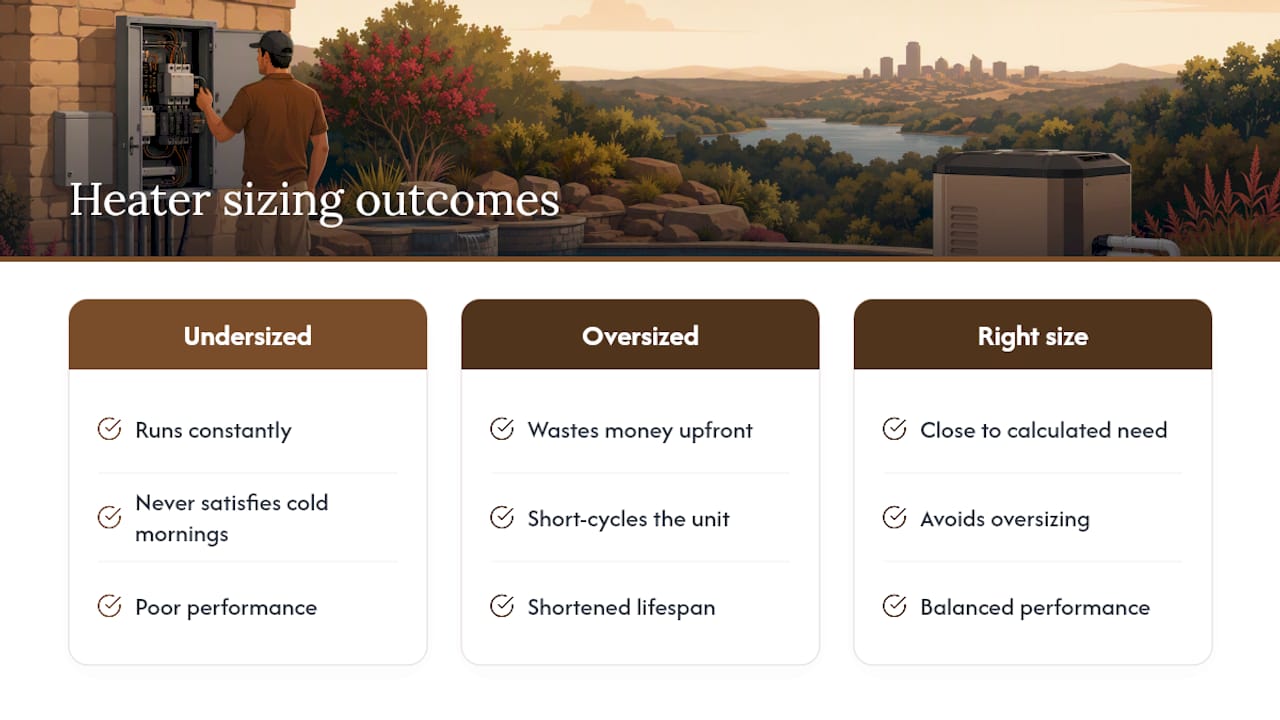
Manufacturers publish their own sizing charts that adjust for regional climate, average wind speed, and whether you’ll run a pool cover, so treat the rule-of-thumb number as a starting point, not a final spec. Undersizing means a heater that runs constantly and never fully satisfies demand on cold mornings. Oversizing wastes money upfront and can short-cycle the unit, which shortens its lifespan. The right size sits close to your calculated need, not comfortably above it “just in case.”
What Site and Utility Requirements Matter Most?
The pool is rarely the limiting factor in a heater retrofit. The gas meter, the electrical panel, and the equipment pad usually are.
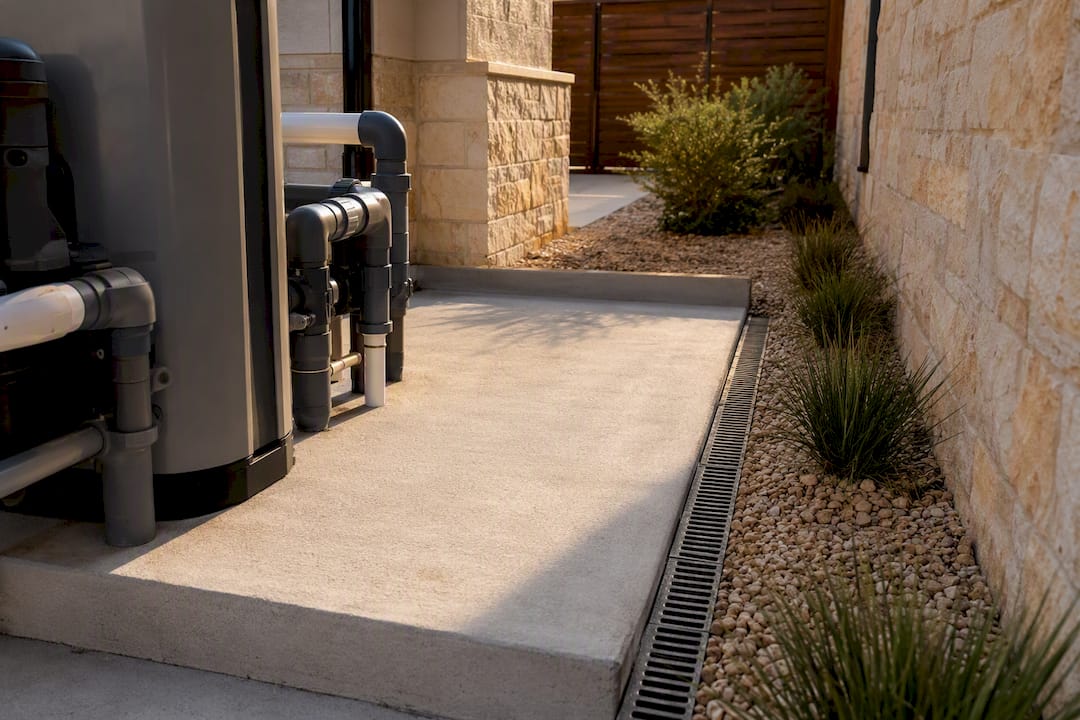
Every heater needs a code-compliant pad and clearance zone. Manufacturer installation manuals specify a level concrete pad, minimum airflow clearance around the unit, proper drainage so leaked water doesn’t pool against a wall, and venting distance from windows or doors for gas units. Manuals also call for keeping heaters off combustible surfaces and maintaining minimum distance from pool edges and structures, which is why equipment placement deserves real planning rather than an afterthought squeezed behind the pump.
Gas installations hinge on meter capacity. If your existing meter can’t support the added BTU load, you’ll need a line upgrade or a larger meter from the utility, and distance from the meter to the heater drives material and labor cost. No natural gas access? A propane tank is a common workaround, though it adds its own footprint and refill logistics.
Heat pumps draw serious amperage, typically in the 40 to 60 amp range, which usually means a dedicated circuit and sometimes a full panel upgrade if your existing panel is already near capacity.
Solar changes the plumbing conversation entirely. Roof-mounted collectors add pump head that an undersized existing pump may not overcome efficiently, and that added resistance often means re-evaluating your pump as part of the same project.
Pro Tip: Before you request a single quote, check your gas meter rating and open your electrical panel to see how much capacity is free. That five-minute check tells you more about feasibility than any brochure.
What Are the Installation Steps, and Which Ones Need a Licensed Pro?
A retrofit follows a fairly predictable sequence, though the order can shift slightly depending on whether you’re going gas, heat pump, or solar.
- Choose the heater type and confirm sizing based on your pool’s surface area and desired temperature rise.
- Prepare the equipment pad, including leveling, clearance spacing, and drainage.
- Plumb the heater into the return line, positioned after the filter so water arrives clean before it’s heated.
- Run gas line or propane connections for gas units, or wire the dedicated circuit for a heat pump.
- Install safety devices, including pressure and flow switches that shut the unit down if water flow drops.
- Add venting where the manual requires it for combustion exhaust.
- Commission and test the system, checking for leaks, correct ignition or compressor cycling, and accurate temperature readings.
Homeowners can reasonably handle pad prep and PVC plumbing runs themselves if they’re comfortable with basic pool equipment work. Gas and electrical connections are a different story: those steps nearly always require a licensed gas fitter or electrician, both because improper work risks fire, explosion, or shock, and because most manufacturers will void the warranty on DIY gas or electrical connections.
Most jurisdictions require a permit for gas line work and electrical panel changes, along with an inspection before the system goes live. Expect the full installation, permitting included, to run anywhere from a few days to two or three weeks, with the permit and inspection scheduling usually the biggest bottleneck rather than the physical labor itself.
What Does It Cost to Add a Heater to a Pool?
Installed cost swings widely based on heater type and how much utility work your site needs, so treat any flat number with suspicion until a contractor has actually looked at your meter and panel.
| Heater type | Typical installed cost range | What drives the spread |
|---|---|---|
| Gas (natural gas or propane) | Moderate, higher if a gas line extension or propane tank setup is needed | Distance from meter, line sizing, tank purchase |
| Electric heat pump | Moderate to higher, especially with panel work | Dedicated circuit, possible panel upgrade, unit efficiency tier |
| Solar | Wide range depending on roof vs. ground array | Collector square footage, pump re-evaluation, mounting complexity |
Budget for a gas-line extension or an electrical panel upgrade as a real possibility, not an edge case. Those two items, along with pad construction and permit fees, are the line items that most often push a bid higher than a homeowner expected going in.
Operating costs tell a different story than installed cost. Gas heaters cost the most to run per hour but only rack up charges when you’re actually heating, which suits homeowners who heat occasionally. Heat pumps cost far less per hour of runtime thanks to their efficiency, but they run longer to hit the same target temperature. Solar costs almost nothing to operate beyond pump electricity. A pool run consistently at a warm temperature all summer will usually see a heat pump come out ahead on the utility bill, while a pool heated only for occasional weekend use might not rack up enough hours for the heat pump’s efficiency advantage to fully pay off against a gas unit’s speed.
How Do You Vet a Contractor and Avoid Bad Bids?
Before you sign anything, run through a short list of criteria that separates a solid bid from a corner-cutting one.
- Confirm how many months of extended swim season you actually want. That target drives whether gas, heat pump, or solar makes sense.
- Ask if your gas meter or electrical panel has been checked, not assumed.
- Request the BTU or capacity math behind the recommended unit size, not just a model number.
- Ask what noise level to expect, especially if the pad sits near a bedroom window or a neighbor’s fence.
- Get the total budget in writing, including permit fees and any utility upgrade estimate.
Ask a contractor directly: Will you pull the required permits? Have you verified my meter or panel capacity? Why this size unit and not a smaller or larger one? What’s the warranty, and will you test the system with me before you leave?
Red flags are usually easy to spot once you know to look. A contractor who skips permits, can’t explain their sizing choice, or won’t put code compliance in writing is one to walk away from. So is a bid that seems suspiciously low with no mention of gas or electrical scope at all.
What Longhorn Pools Sees in Real Retrofit Projects
Most heater retrofits we handle around Austin run into the same two snags: an equipment pad that’s too cramped for proper clearance, and a meter or panel that needs upgrading before the heater can even go in. Neither is a dealbreaker, but both need to be caught before installation day, not during it.
We also see homeowners pair a new heater with efficiency upgrades like a pool cover or a variable-speed pump, which can cut overall pool energy use by 40 to 80 percent depending on the starting equipment. A heater alone raises your temperature; the cover is what keeps that heat from evaporating overnight. For homeowners weighing options locally, our guide to pool heaters for Austin properties walks through climate-specific sizing in more detail.
Is Adding a Heater Actually Worth It?
It depends entirely on how many extra weeks of swimming you actually want. If you’re chasing two extra months of shoulder-season use in a mild climate, a heat pump usually pays for itself in comfort alone. If you want a warm pool on demand regardless of season, pair gas with a pool cover so you’re not heating the open air above your water. Either way, budget some slack for panel or gas-line surprises, get more than one bid, and start with a quick site check on your meter and panel before you fall in love with a specific unit.
— Mark
Ready to Add a Heater to Your Pool the Right Way?
A DIY gas line or a mismatched heat pump install is how a simple upgrade turns into a warranty headache. A professional pool service handles the entire retrofit as one job: a site assessment that checks your meter and panel capacity before anything gets quoted, permit handling, turnkey installation, and full system testing before completion.

We also fold in the upgrades that make a new heater actually pay off, like equipment pad reconfiguration, variable-speed pump swaps, and energy-efficiency improvements, so you’re not heating a pool that leaks warmth overnight. If you’re planning a broader update alongside the heater, our renovation process guide walks through what a full retrofit project looks like from first call to final inspection. Request a site assessment with a local pool contractor to get a real cost estimate based on your actual gas meter, panel, and pad, not a generic number pulled from a brochure.
Sources
For deeper technical detail, Hayward’s installation manual covers exact clearance and venting specs. HomeAdvisor’s cost guide breaks down national installation pricing, and SwimmingPoolSteve’s heater comparison offers a clear gas-versus-heat-pump explainer worth reading before you request bids.
- HomeAdvisor — Install a swimming pool heater (cost guide)
- SwimmingPoolSteve — Heater comparison
- Hayward — Heater installation manual (installation & clearances)
- PoolUserGuide — Pool heaters and heat pumps (equipment guide)
FAQ
How much does it cost to add a heater to an existing pool?
Installed cost depends heavily on whether your site needs a gas-line extension or an electrical panel upgrade; those two items, along with pad work and permits, are the main variables separating a low bid from a high one.
How hard is it to add a heater to your pool?
The physical retrofit itself is moderate difficulty, but gas and electrical connections require a licensed professional, so the real complexity often lies in permitting and utility capacity rather than the plumbing.
What is the cheapest way to heat an inground pool?
Solar heating has the lowest operating cost of the three main options since it relies on sun rather than fuel or electricity, though it depends on weather and won’t deliver fast results on demand.
Can you add a heater to any existing pool?
Most in-ground pools can accept a heater, but feasibility depends on whether your gas meter, electrical panel, or roof space can support the equipment; a site check resolves this before you commit to a type.
How long does pool heater installation take?
A typical installation runs from a few days to two or three weeks once permitting is included, with inspection scheduling usually the biggest source of delay rather than the physical work.